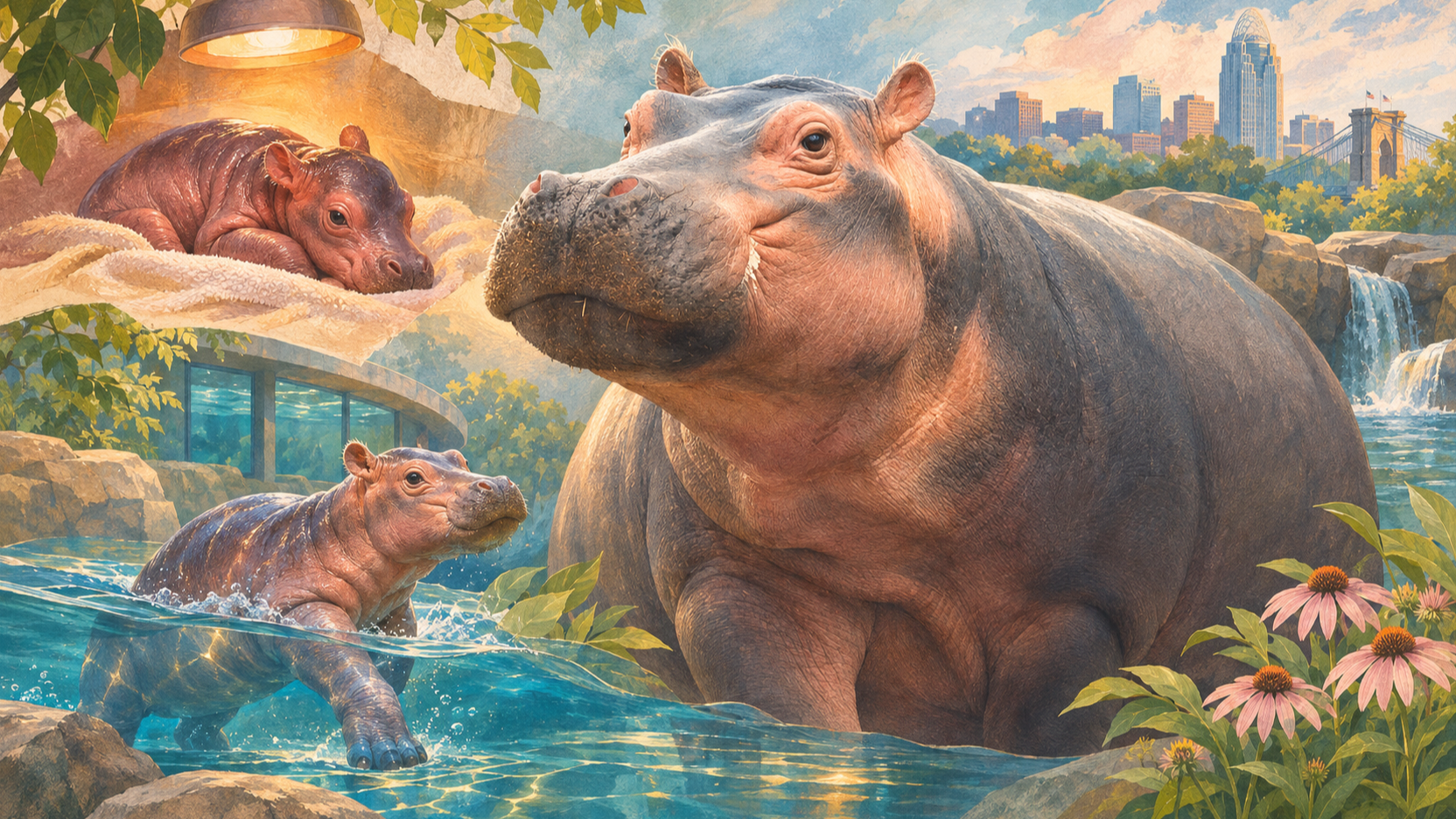
Fiona’s first fight for life made her famous. Nearly ten years later, Cincinnati’s beloved hippo died after a visitor’s knit hat became a medical emergency her care team could not reverse.
The Cincinnati Zoo announced on November 19, 2026, that Fiona had died at age 9. She had spent the previous 11 days under close veterinary care after swallowing a knit hat that entered her habitat in an improbable accident.
On November 8, a visitor tossed the hat into the air near Hippo Cove. It struck a ceiling fan, passed through a small opening above the viewing windows and landed inside the habitat. Fiona swallowed it. The zoo has consistently described the incident as accidental.
What followed was not a simple case of waiting for a foreign object to pass. The zoo said specialists it consulted concluded that surgery was not a realistic option for a full-grown hippo. Veterinary experts who spoke to the Associated Press described the risks of anesthesia, positioning and multiple incisions through thick skin, along with the difficulty of locating an object inside such a large digestive system.
Instead, Fiona’s keepers and veterinarians watched her around the clock. They gave her fluids and medication, tracked her appetite and behavior, and sedated her twice for closer evaluation. A nine-foot colonoscope did not locate the hat or reach far enough to remove it. Ultrasound and other examinations did not produce a safe way to extract the material.
The team even borrowed a vibration platform from a horse farm, hoping the gentle movement might help the material advance through her system. The unconventional step reflected the same kind of cross-disciplinary problem-solving seen when Oregon Zoo began treating Tula-Tu before a laboratory confirmed EEHV, or when experts had to weigh the risks and limits of intervening with Spinny the Yellowstone bison.
By November 19, the situation had become a medical emergency. In its official announcement, the zoo said the team could not get the material to progress, and supportive care that day did not save her.
That is the most precise account currently available. As of November 20, the zoo had not released necropsy findings or identified a more specific anatomical cause. Claims that the hat caused a particular blockage, perforation, infection or other complication go beyond what has been publicly confirmed.
The 29-pound calf who became Cincinnati’s Fiona
The scale of the loss is inseparable from the way Fiona entered the world.
She was born at 2:58 a.m. on January 24, 2017, six weeks before her due date. At 29 pounds, she was about 25 pounds lighter than the lowest recorded birth weight for a Nile hippo at the time. She was too small and weak to stand and nurse from her mother, Bibi.
Keepers turned the warmest room in the hippo building into a makeshift neonatal intensive-care unit. They kept Fiona warm and moist, monitored her underdeveloped lungs, supplied oxygen and offered bottles around the clock. Bibi had been trained to cooperate with ultrasound exams during pregnancy, and the team adapted that behavior so she could be milked. Samples of her milk were analyzed to create a formula suitable for a premature hippo.
When dehydration became dangerous and ordinary IV lines would not hold, a vascular-access team from Cincinnati Children’s Hospital helped place a longer catheter using ultrasound guidance. Zoo staff stayed beside Fiona for the next 48 hours, protecting the line and measuring every sign of progress.
There was no established manual for raising a hippo born this early. The effort resembled the intensive, uncertain care behind other zoo births, including the difficult beginning that preceded Milani’s eventual introduction to a giraffe herd. In Fiona’s case, the public could follow almost every small victory: a bottle finished, a stronger step, a first swim, the day she no longer needed supplemental oxygen.
By her original due date, she had passed 70 pounds. By the end of her first year, the first season of The Fiona Show had drawn more than 34 million views. Books, clothing and a steady stream of videos followed, but her appeal was not just that she was cute. People had watched a fragile animal survive through patience, expertise and improvisation. “Fight like Fiona” became shorthand for refusing to give up.
Fiona eventually grew to roughly 2,500 pounds and lived at Hippo Cove with Bibi, Tucker and her younger brother, Fritz. She became a familiar presence for Cincinnati families and an unusually effective ambassador for her species. Common hippos remain classified as Vulnerable under the IUCN assessment completed in 2016, with habitat loss and illegal or unregulated hunting among their major threats.
Her celebrity also changed what a zoo animal could mean to a city. Visitors marked her birthdays, publishers released books about her, and her image appeared on local products and in public art. When the zoo shared news of her death, people brought flowers, cards and watermelons to the Fiona statue outside the entrance.
There is a cruel symmetry in the story. Fiona survived a birth that few animals could have survived, only to die after a sequence of ordinary actions aligned in a way no one expected. The accident raises questions about barriers, visitor behavior and how habitats can be made safer. Those questions matter. They can be asked without assigning motives the evidence does not support.
Fiona’s life should not be reduced to the object she swallowed. The fuller record is nearly a decade long: a premature calf kept alive by an improvised network of keepers, veterinarians, nurses and researchers; a young hippo learning from her mother; an adult whose daily routines made millions of people curious about an animal they might otherwise never have considered.
The final chapter was brief and devastating. The life before it was the reason so many people cared.
Featured image: Editorial illustration.
Leave a comment