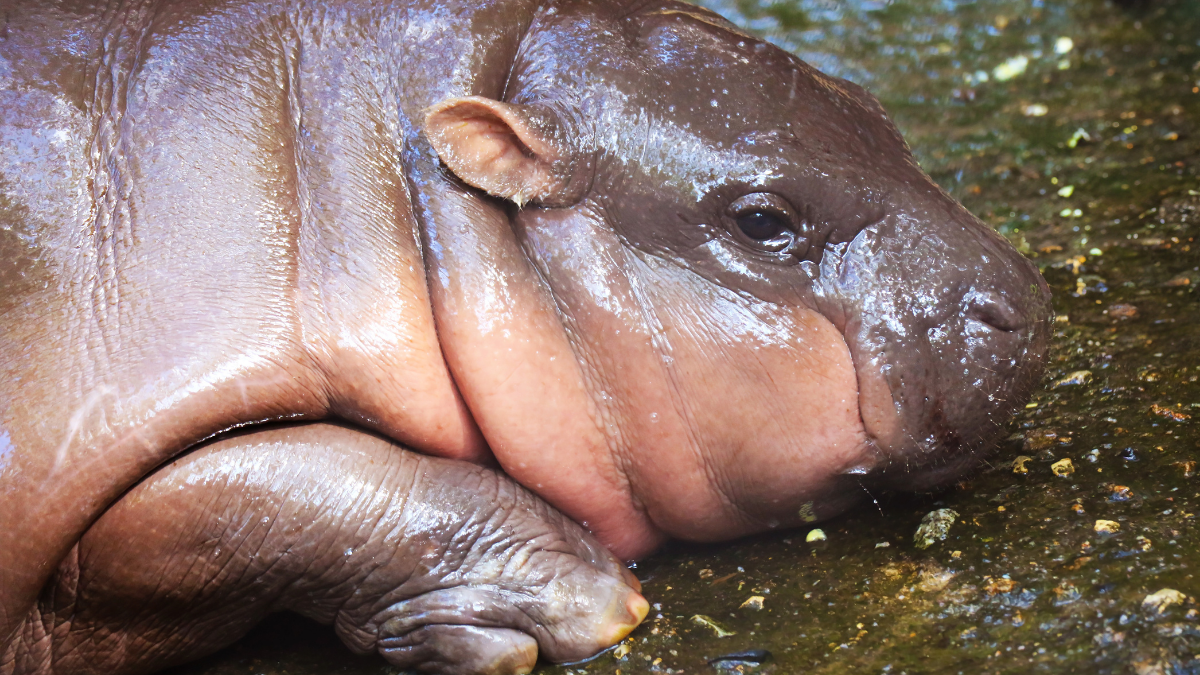
He doesn’t have teeth. He just discovered his tongue. And somehow, he’s become the face of a species teetering on the edge of extinction.
In the last year, baby pygmy hippos have gone viral around the world. One calf named Moo Deng, born at Thailand’s Khao Kheow Open Zoo in July 2024, became such a phenomenon she drew 12,000 visitors in a single day. Another, named Poppy, now splashes around Virginia’s Metro Richmond Zoo with a fanbase that voted on her name across 165 countries.
In Edinburgh, Scotland, a chubby-cheeked calf named Haggis inspired a tongue-in-cheek rivalry with her Thai counterpart. But behind the baby bleps and moist-eyed memes lies a lesser-known truth: these cuddly, internet-famous hippos are ambassadors for one of West Africa’s most endangered animals.

Pygmy hippos are nothing like their Nile cousins. They’re shy, solitary forest-dwellers, found in fragmented patches of rainforest across Liberia, Guinea, Sierra Leone, and Côte d’Ivoire. Unlike the thunderous grunts of a Nile hippo herd, pygmy hippos slip quietly through swamp and underbrush, rarely seen and even more rarely studied. Fewer than 2,500 are thought to remain in the wild. Some conservationists believe that number may be lower.
That obscurity is part of the problem. Until recently, most people didn’t even know pygmy hippos existed. But viral calves like Moo Deng have changed that. Her face—equal parts dough and defiance—has turned her into a global mascot. Her image appears on t-shirts, fruit snacks, and tote bags. She has a theme song in four languages. And yet, while zoos benefit from the boom in merch and ticket sales, conservationists in West Africa are still waiting for that attention to convert into funding, policy, and protection.
The real crisis is happening in the forest. Illegal mining and logging are rapidly eating away at what little pygmy hippo habitat remains. In Liberia, where most wild individuals live, rivers are contaminated with mercury runoff. Camera traps in places like Sapo National Park offer rare glimpses of the species, but those forests face pressure from every direction. Organizations like Fauna & Flora and local rangers are working on corridors and monitoring programs, but progress is slow. Resources are stretched thin.

In this context, the sudden fame of a few zoo-born babies is both an opportunity and a test. Zoo officials say these calves help visitors build emotional bonds with an otherwise invisible animal. And in some cases, that bond has real impact. Moo Deng’s zoo has announced plans to support fieldwork in Côte d’Ivoire. Virginia’s zoo is sending proceeds from its “Hippo Behind-the-Scenes” tours to conservation groups. But even zoo staff admit that viral reach doesn’t always mean real-world help.
There’s also an ethical balancing act. In Thailand, the crowds around Moo Deng became so intense that the zoo had to restrict access, install surveillance, and warn visitors not to poke or throw items into her enclosure. Fame can be a burden, even for a 40-pound baby who just wants to nap in peace.
So where does that leave us? Somewhere between clickbait and conservation. Between joy and jeopardy. The memes are cute, yes. But the forests are real. And disappearing.
Pygmy hippos don’t roar. They don’t stampede. They vanish. Quietly. Unless we learn to look.


Leave a comment