The next toy for Neil the Seal needs to move when he pushes it. It also needs to be tough enough for a southern elephant seal weighing about 2,200 pounds, practical to transport, and interesting enough to hold his attention.
That last requirement has proved difficult. Earlier objects caught Neil’s interest without keeping it.
Tasmania’s state government has commissioned a replacement, described in the updated 27-page management plan announced on November 15, 2026. The document addresses a practical question for coastal communities: how do you give a large wild animal room to rest when he chooses a place with roads, parked cars and people?
The sea lions gathering on a California road have presented their own version of that problem. Neil brings another complication. He’s one recognizable animal whose visits draw an audience, and he has a great deal of growing left to do.
Wildlife officers have known him since he was much easier to move.
In October 2020, the newborn seal was found on a tidal sandbar on Tasmania’s Tasman Peninsula. He weighed approximately 88 pounds. Kris Carlyon, a biologist with Tasmania’s Department of Natural Resources and Environment, told ABC that his colleagues intervened to get the pup out of danger.
“He was certainly going to drown on that day,” Carlyon said in a July 10, 2026 interview with ABC News.
Neil is now six years old and still a subadult. NRE estimates that he could eventually reach about 7,700 pounds and a length of roughly 16 feet. Equipment, access routes and techniques that worked when he was smaller will have to accommodate a much more powerful animal.
His visits follow the needs of an elephant seal. Coming ashore, known as hauling out, gives him time to rest after extended periods at sea. He also needs land for his annual molt, when he replaces his fur and the outer layer of his skin.
That renewal takes energy. Producing the new covering requires increased blood flow near the body’s surface, where cold water would draw away heat. Spending time ashore helps reduce that loss.
Neil usually comes ashore twice a year and can stay for weeks. NRE says he spends most of his time on land resting or sleeping. His more active moments, especially around objects built for people, are the ones that tend to attract attention.
Young male elephant seals practice the physical behaviors they’ll use in competition with other males. NRE’s explanation for Neil’s pushing and shoving allows for that background: without other seals nearby, he may direct some of his interest toward signs, barriers or vehicles.
A road sign offers something to push against. The difficulty is that it also has a job to do for the people using the road.
The new enrichment device is intended to provide an alternative. Its designers have been asked to consider movement, shape, weight and size, along with safe handling and transport. Officials want to give Neil something that responds to his attention while encouraging him to spend time in a more suitable area.
There’s already a photograph of him investigating a large, multicolored enrichment object supplied in 2025. The replacement is a further attempt to find something he’ll keep using. Whether it does that will have to be learned through observation.
Why moving Neil is a last resort
Neil has been relocated before. An NRE photograph records his release after a move on the Tasman Peninsula in July 2022. Another relocation, from Kingston Beach in April 2023, gave scientists an opportunity to attach a satellite tag while he was already sedated.
During the six-month trip recorded by the tag, Neil foraged about 1,000 miles southwest of Tasmania. The animal seen beside a road also spends long stretches far out in the ocean.
Moving him now would require an experienced wildlife veterinarian, sedation, lifting equipment and a suitable means of transport. Each operation has risks for the animal and the people doing it. His growing weight also restricts where equipment can safely reach him.
Then there’s the question of where he would go next. Elephant seals often return to familiar places. Taking Neil to a quieter shore could remove an immediate hazard, but managers can’t assume it would permanently change where he comes ashore.
The plan favors dealing with the circumstances around him whenever possible. That can mean moving vehicles, restricting access, putting up barriers, managing traffic or keeping spectators farther back. Neil still needs a suitable resting area and a clear route to the water.
Fencing has to guide an animal somewhere it can go safely, a principle also built into wildlife crossings alongside busy roads.
In an official disclosure covering four haul-outs between July 2024 and June 2026, NRE recorded 523 staff hours and operational spending equivalent to about US$30,700 at November 18, 2026 exchange rates. The final visit’s accounting was incomplete, and the staffing total excluded police and council hours.
Clarence City Council separately estimated the cost of 15 nights of traffic and crowd management, along with repairs, at about US$21,200 on the same conversion basis. Most of that expense was staffing. The materials needed to replace ten bollards, part of a fence and a sign came to about US$870.
Alongside the plan, Tasmania has introduced an Interim Protection Order for southern elephant seals in specified publicly managed coastal areas. Its default minimum distance for people, animals under their control and parked vehicles is 30 meters, or about 98 feet. The order also sets distances for vessels and drones, with provisions for official signs and directions.
NRE’s advice reaches beyond what happens at the beach. It asks people to avoid sharing Neil’s real-time location, because doing so can bring more spectators to the place where he is trying to rest. Visitors should keep dogs away, leave his route to the water open and move back if he approaches.
His latest reported stay suggests what a less eventful visit can look like. On November 15, NRE described a six-week visit to southeastern Tasmania that began in late September. Officials described him as healthy. After several days without a sighting, they thought he had probably returned to sea to feed.
Primary documents
The management framework and legal distances are available directly from Tasmania’s Department of Natural Resources and Environment.
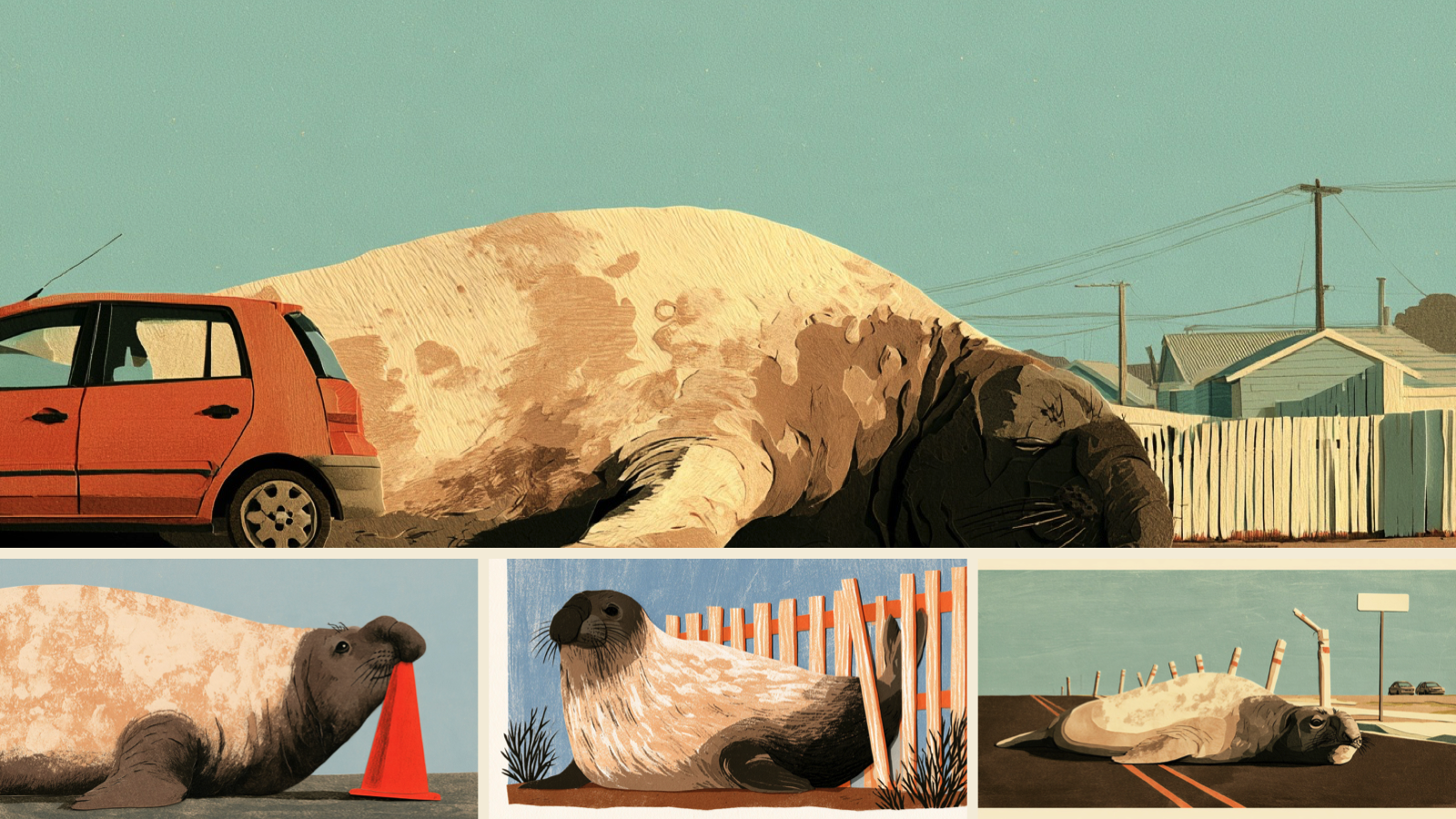
Featured illustration: an original editorial collage inspired by documented moments involving Neil the Seal. The four panels are illustrative composites, not literal photographs or camera frames.
Leave a comment