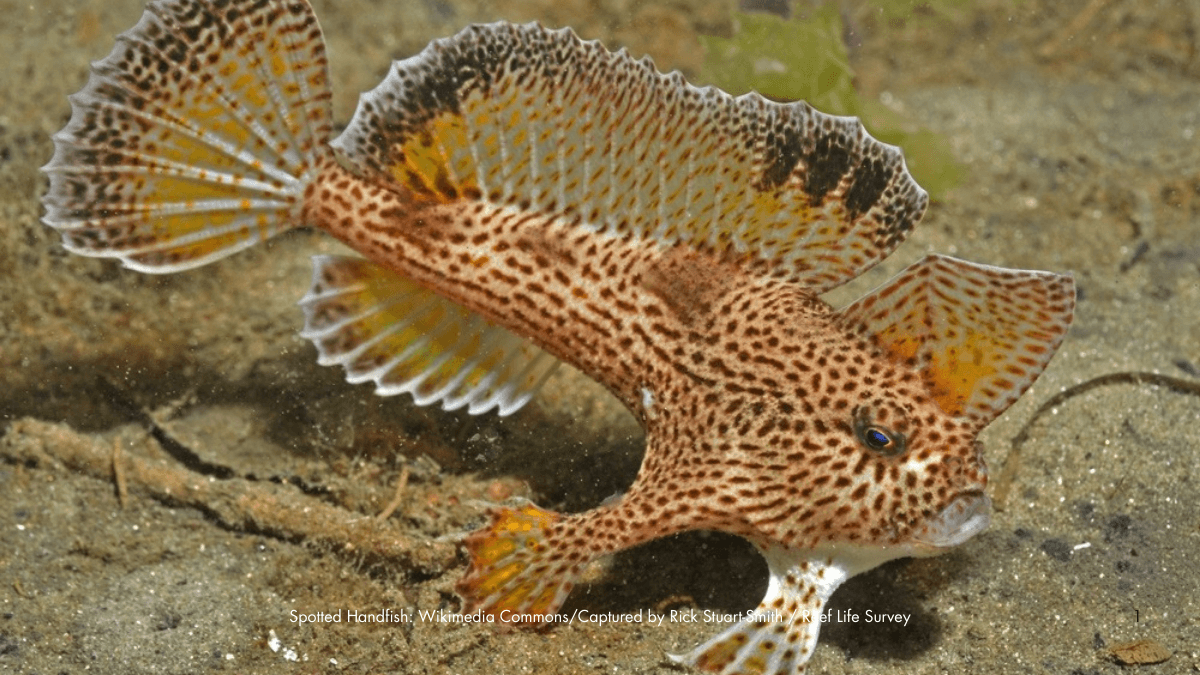
They call it the fish that walks, a small but entrancing creature meandering along the silty depths of Tasmania’s Derwent River. At just five inches long, the Spotted Handfish seems more like a miniature explorer than a typical swimmer, slowly pacing along the substrate on pectoral fins that act like stubby hands.
It’s a quiet presence in an estuary once teeming with life. Scientists say there are only a few known groups left—no more than eight scattered sites—where these fish manage to survive. One encounter is enough to sense both their delicate charm and the reality of their fading numbers.
A rare adaptation
The Spotted Handfish is part of an Australian anglerfish family that shows off pectoral fins shaped like little arms. Though they can swim in quick bursts, they prefer walking for most of their daily routine. Their bodies, often speckled with earthy spots or stripes, help them blend into a seabed of silt and sand. They feed on tiny crustaceans and worms, waiting for prey to stray within reach.
Unlike many fish that rely on broad habitats, these handfish cling to specific structures, particularly during breeding. Females attach their eggs to upright objects like seagrass or sea squirts, a tactic that once kept eggs safe from currents and predators. But invasive species and industrial impacts have reduced these vital anchor points in a matter of decades.

Threats and conservation efforts
Conservationists have grown increasingly alarmed, especially since the handfish was singled out as critically endangered in 1996. The invasive Northern Pacific seastar threatens spawning sites, devouring the sea squirts used for egg-laying. Pollution, oil rigs, and chain moorings further damage the river floor, making it tough for eggs to survive. As one local program put it, “Traditional chain moorings tear up handfish habitat and dislodge their eggs.”
Captive breeding offers a glimmer of hope. Institutions in Melbourne and Tasmania have welcomed these fish into specially designed tanks, where scientists carefully monitor their spawning behavior. Reintroduction efforts hinge on restoring or replacing the structures handfish rely on for egg-laying. In the Derwent, researchers have even tested artificial “spawning rods” meant to stand in for sea squirts. Early surveys suggest the fish will use them when natural options are scarce.
The Spotted Handfish’s plight underscores a broader challenge in marine conservation: small habitat ranges and specialized survival strategies can leave a species dangerously exposed to sudden change. One CSIRO scientist, Dr. Gunjan Pandey, emphasized how new genetic research might give an edge to monitoring. “What used to take six to twelve months, we can now accomplish in days,” she said, referencing recent genomic breakthroughs that may refine handfish recovery plans.
Their decline also illustrates a cautionary tale. “Due to the speed of their decline in range and abundance, the spotted handfish became the first marine fish to be listed as endangered under the Federal Environment Protection and Biodiversity Protection Act 1999.” This sobering milestone lingers as a call to guard what remains of the species and their mysterious, sandy realm on the estuary floor.
10 Cool Facts About the Spotted Handfish
1. It “walks” on pectoral fins rather than swimming most of the time.
2. The species measures only about five inches long.
3. Females lay eggs on vertical structures like sea squirts or seagrass.
4. Each fish can have unique spot patterns.
5. They were the first marine fish listed as critically endangered by the IUCN.
6. Invasive Northern Pacific seastars prey on their eggs and habitat.
7. Scientists have used ceramic rods to give them new spawning surfaces.
8. Their limited mobility means they rarely travel more than a few meters a day.
9. Captive breeding programs in Melbourne and Tasmania are boosting numbers.
10. Genetic sequencing now helps monitor and protect their tiny populations.




Leave a comment