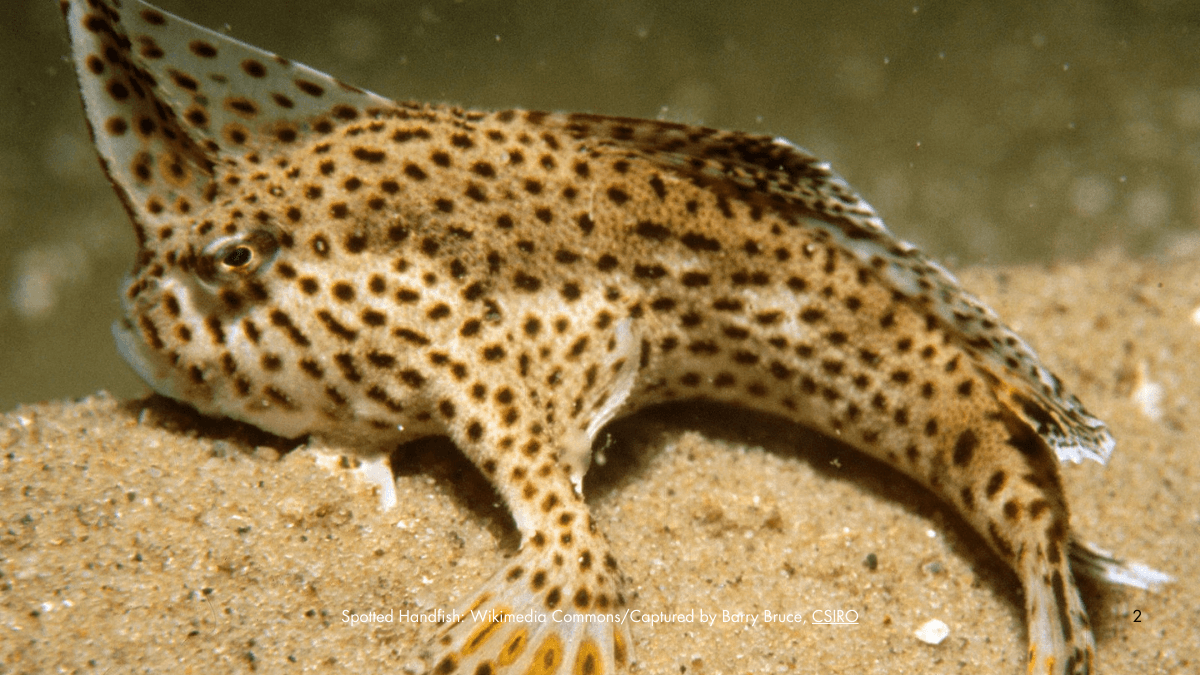
The Spotted Handfish is an unusual and captivating creature found solely in the coastal waters of southeastern Tasmania. It stands out not only for its unique appearance but also for its intriguing way of life. This small fish uses its pectoral fins to walk along the ocean floor rather than swim. Let’s dig deeper into some of the most fascinating facts about the Spotted Handfish.
1) Unique ability to ‘walk’ on the seabed
The spotted handfish is notable for its unusual movement. Unlike most fish, it uses its pectoral fins to “walk” along the seafloor.
This method of locomotion sets the handfish apart. Its fins act like small hands, allowing it to navigate its seabed habitat with precision, giving it a distinctive appearance and behavior in its underwater environment.
The handfish’s lifestyle is well-suited to the walking technique. Staying close to the seabed helps the handfish avoid predators, and it also uses this ability to hunt for food within its environment.
2) Critically endangered species
The spotted handfish is one of the world’s most threatened marine bony fish. It belongs to the family Brachionichthyidae, which includes several other handfish species.
Seven out of the fourteen handfish species are considered at risk, with the spotted handfish listed as Critically Endangered.
This unusual fish is native to parts of southeastern Australia, particularly the waters around Tasmania. It faces numerous threats, including habitat loss, pollution, and the impacts of invasive species.
Efforts are underway to help this distinctive fish. These include habitat protection and breeding programs within public aquariums. Monitoring and research initiatives aim to increase understanding and develop conservation strategies.
Conserving the spotted handfish is challenging, as it requires balancing complex environmental and ecological factors. Scientists and conservationists are collaborating to ensure that these fascinating creatures continue to survive in their natural habitat.
3) Native to Tasmania’s waters
The Spotted Handfish is a unique and rare species found only in the waters around Tasmania. This fish has adapted to a special way of moving, using its fin-like hands to “walk” on the seafloor rather than swim.
These fish inhabit the shallow coastal waters of Tasmania. They are usually found in sandy or silty environments. These habitats provide them with the cover and food sources they need for survival.
The Spotted Handfish is critically endangered, largely due to habitat loss and other human activities. Efforts are underway in Tasmania, including captive breeding projects, to help conserve their populations. These initiatives aim to protect the habitats crucial for their survival and study their unique lifestyle.
4) Spawning Occurs Once a Year

By Rick Stuart-Smith / Reef Life Survey – http://www.fishesofaustralia.net.au/home/species/2842, CC BY 3.0, Link
Spotted handfish, known scientifically as Brachionichthys hirsutus, have a unique spawning cycle. They lay eggs annually, requiring specific habitats for this process. The preferred environment includes regions with distinctive features that support their breeding needs.
Each year, female spotted handfish carefully lay their eggs on the seafloor. They often choose areas with enough protection, such as spaces around stalked ascidians or artificial spawning habitats. These structures provide a stable environment for the eggs to develop.
During the spawning season, there is notable activity in these habitats. Researchers observe behavioral changes as these fish prepare for reproduction. Egg masses are usually laid near the chosen substrates, and females take care to protect them.
The number of eggs and the process can vary, but sighting of egg masses indicates successful spawning events. Monitoring these events helps conservation efforts, as it provides insights into their breeding patterns and population health. Understanding this annual cycle is crucial for their ongoing protection and habitat management.
5) Distinctive hand-like fins
The spotted handfish is famous for its unique fins that resemble hands. These fins are unlike typical fish fins, being specially adapted for walking along the seafloor. This gives the spotted handfish an unusual and captivating appearance.
Instead of swimming like most fish, the spotted handfish uses its modified pectoral fins to “walk” on the seabed. This method of movement is similar to how a person might crawl on hands and knees. It allows the fish to navigate its bottom-dwelling habitat efficiently.
These hand-like fins are a defining feature of the Brachionichthyidae family. While other fish might use fins primarily for swimming or stability, handfishes have evolved this unique adaptation. The ability to walk can help them move precisely as they search for food or avoid predators.
6) Threatened by habitat loss
The spotted handfish, an endangered marine species, faces significant challenges due to habitat loss. These unique fish live on the sea floor in shallow waters, making them vulnerable to changes in their environment.
Human activities, such as coastal development and sea floor fishing, negatively impact the habitats of the spotted handfish. These activities destroy the sea floor where the handfish lay their eggs and find food.
Pollution further contributes to habitat degradation. Contaminants introduced into the water can harm the delicate ecosystem, affecting the survival of the handfish. This issue is compounded by the species’ limited range, as they are found only in specific areas.
Restoration efforts are crucial to prevent further habitat loss. Small structures, like artificial spawning habitats, have been used to help support the population of spotted handfish. Conservation initiatives aim to improve conditions to ensure this rare species can continue to thrive.
7) Carnivorous Diet

The spotted handfish is a carnivorous species that primarily eats other animals. Its diet mainly consists of tiny aquatic organisms found on the sea floor.
It preys on various small invertebrates, including crustaceans and worms. The handfish uses its specialized fins to move along the seabed for food.
Instead of swimming, this fish “walks” on the ocean floor. This unique adaptation helps it sneak up on prey more easily without alerting them. The diet of the spotted handfish reflects its role as a predator in its environment.
8) First filmed in 1996
The spotted handfish, known for its unique appearance and fascinating behavior, was first caught on camera in 1996. This was a significant moment for marine biologists and conservationists.
Seeing the spotted handfish for the first time in its natural habitat allowed researchers to gain new insights into its lifestyle and challenges. Before this, much of what was known came from limited observations.
Filming the handfish allowed us to better understand its needs and environment. This rare footage helped raise awareness about the species, inspiring further research and conservation efforts to protect its declining population.
9) Size reaches up to 15 cm
The spotted handfish, a unique member of the Brachionichthyidae family, is distinct for its small size. This fish typically grows to about 15 centimeters in length. This size allows it to navigate its underwater habitat with ease.
Their compact size contributes to their ability to hide among underwater plants and structures. This can be a useful trait for avoiding predators. Their body shape, along with their size, plays a significant role in their survival in the wild.
Spotted handfish are known for their unusual way of moving. Instead of swimming, they often use their pectoral fins to “walk” along the ocean floor. Despite their small stature, these fish have adapted well to their environment.
Understanding their size is crucial when considering their conservation needs. Knowing their typical size can help in identifying individuals in the wild and studying their population dynamics. This can be helpful for ensuring their continued survival.
While they are small, spotted handfish are an important part of their ecosystem. Their unique size and behavior make them a fascinating subject for researchers and conservationists alike.
10) Bright Coloration for Camouflage

The spotted handfish is an intriguing creature partly due to its unique use of color. It uses bold colors to blend into its surroundings. This might sound unusual since bright colors stand out to most predators.
The spotted handfish’s bright coloration matches its environment. It often resides on the seafloor among colorful sponges and corals, and the bright patterns help it hide from predators.
Being a master of disguise, the handfish’s coloration confuses predators rather than attracts them. This camouflage strategy is critical to its survival. Blending into its surroundings allows it to evade danger while remaining hidden from potential threats.
Colorful camouflage also helps the handfish in its feeding habits. By blending in, it can ambush prey effectively. This use of coloration is a fascinating adaptation in the marine world, where visibility can mean survival.
Unique Evolutionary Traits
The spotted handfish has developed unique evolutionary traits that set it apart. These traits help it survive and reproduce in its environment, showcasing its adaptability.
Adaptations for Survival
The spotted handfish exhibits distinctive adaptations that aid in its survival. Unlike most fish, it uses its pectoral fins to “walk” on the ocean floor rather than swim. This adaptation allows the handfish to maneuver easily through its habitat, searching for food and avoiding predators. Its camouflage pattern helps it blend into the seafloor, protecting it from threats.
Another notable trait is its small but effective habitat range, which reduces competition and exposure to danger. By staying within familiar terrain, the handfish maximizes its chances of finding food while minimizing the risk of encountering predators.
Reproductive Strategies
The spotted handfish’s reproductive strategies are equally fascinating. They lay eggs in clusters, attaching them to underwater structures like seaweed. This method protects the eggs from drifting away and keeps them safe from predators. The parents guard their eggs closely until they hatch, ensuring a higher survival rate for the offspring.
The handfish exhibits site fidelity, meaning they return to the same spawning grounds each year. This behavior increases the chances of mating with familiar partners and passing on successful genetic traits. These strategies enhance the species’ ability to thrive despite environmental changes and threats.
Habitat and Distribution
The spotted handfish is an intriguing species with unique habitat and distribution characteristics. Its survival is closely tied to specific environmental conditions and locations that are crucial for its ongoing conservation.
Specific Habitats
Spotted handfish prefer areas with complex structures, typically with sandy or silty bottoms. They make their home in places with natural features like aquatic plants and rocks. These structures provide protection from predators and suitable sites for spawning. Artificial spawning habitats have been introduced to support their reproduction, but studies suggest that handfish prefer natural environments.
The stability of the handfish population is linked to these natural habitats, emphasizing the importance of preserving these environments. Pollution and habitat degradation are significant threats, affecting their survival prospects.
Geographical Range
The spotted handfish is found primarily in southern Tasmania, Australia. They inhabit shallow coastal areas, usually at depths ranging from 5 to 15 meters. Within this limited range, populations are localized, meaning they do not travel far from their established territories.
This limited distribution makes them particularly vulnerable to local changes and environmental disturbances. Conservation efforts are focused on protecting these specific regions to ensure the species’ survival. Human activities such as urban development and marine disturbances have notably impacted their natural habitats.



Leave a comment