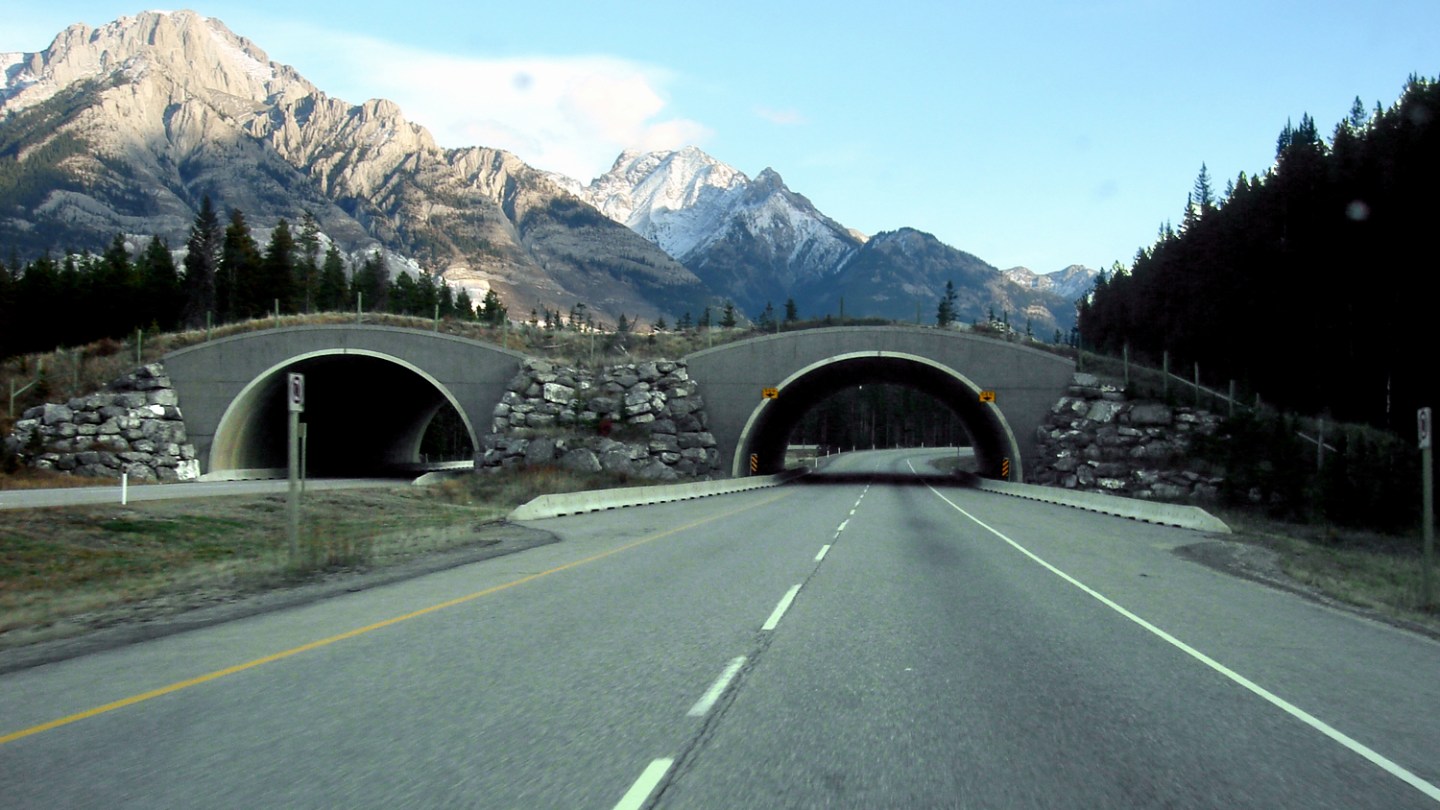
Featured image: Banff wildlife overpass, October 2006. Photo: Qyd / Wikimedia Commons · CC BY 2.5 · Cropped to 16:9.
The bridge wasn’t finished when its first recorded users arrived. In a June 3, 2026, announcement, UC Davis identified three mule deer as the first animals documented crossing a new wildlife overpass in Northern California. The deer had found a route above U.S. 97 while construction was still underway.
We usually judge a road by where it takes us, especially when it passes through some of the world’s most beautiful landscapes. For wildlife, the same road can interrupt access to food, shelter and mates. A crossing gives those journeys somewhere to continue without putting animals directly into traffic.
Across the United States, Canada and Mexico, the response includes forested bridges, passages beneath interstates and openings through railway infrastructure. Some have decades of monitoring behind them. Others are only beginning to reveal whether their designs work.
These ten projects show that range. They’re an editorial selection of important crossings and crossing systems, not a scientific ranking of the ten most effective. The difference between a documented success and a promising new structure matters.
1. Banff National Park, Alberta, Canada
Banff’s overpasses carry soil and vegetation across the Trans-Canada Highway, continuing the landscape above lanes of traffic. Beneath the road, another set of routes accommodates animals that prefer a more enclosed passage.
The park’s system contains 44 crossing structures: six overpasses and 38 underpasses. Approximately 51 miles of highway fencing help direct animals toward them. According to Parks Canada’s monitoring, the combined system has reduced wildlife-vehicle collisions by more than 80%, with reductions exceeding 96% for elk and deer.
Those results come from years of observation, not a few striking camera clips. Monitoring also revealed that some wary species take time to become comfortable with new routes. A bridge’s first quiet months don’t necessarily predict its long-term value.
Banff’s importance lies in that accumulated evidence. It gives planners elsewhere a way to ask which structures animals will use, how quickly they’ll adjust and what happens when fencing and safe passage are designed together.
This Parks Canada video contains flashing images.
2. State Highway 9, Colorado
Along 10.5 miles of highway south of Kremmling, Colorado built seven ways for wildlife to avoid traffic: five underpasses and two overpasses. The project was completed in 2016.
Monitoring from November 2015 through April 2020 documented more than 112,000 successful mule-deer passages. Colorado Parks and Wildlife also reports a 90% reduction in the number of wildlife carcasses associated with vehicle collisions. Elk, moose, black bears and other species used the system, too.
The distinction between passages and animals is important. Those 112,000 observations aren’t a count of 112,000 different deer, and they can’t be translated into an equal number of lives saved. Animals can cross repeatedly.
Even with that qualification, the finding is substantial: the structures became part of how wildlife moved through the area. Fencing helped turn seven individual openings into a coordinated route across a dangerous road.
3. U.S. 93, Montana
Montana’s U.S. 93 crossings are best understood as a network rather than a single photogenic bridge. Montana’s Department of Transportation describes 81 fish and wildlife passage structures within its broader reconstruction program, covering more than 76 miles between Hamilton and Lolo, and Evaro and Polson.
That figure shouldn’t be mistaken for 81 crossings concentrated on the Flathead Indian Reservation. It describes a larger collection of work along the highway.
On the reservation, the Confederated Salish and Kootenai Tribes are partners in planning improvements to U.S. 93. Wildlife connectivity remains part of decisions about how the corridor develops.
Montana’s approach also makes room for less conspicuous engineering. Underpasses, fencing and escape features belong in the same conversation as the overpass. An animal needs both a place to cross and a way to reach it without entering the traffic lanes first.

4. Trapper’s Point, Wyoming
At Trapper’s Point near Pinedale, the highway intersects a much older pattern of movement. Pronghorn and mule deer travel through a landscape where archaeological evidence records thousands of years of pronghorn use.
A Wyoming PBS documentary describes roughly 85,000 crossings recorded during three years of post-construction monitoring, including about 60,000 mule-deer passages and 25,000 pronghorn passages. More than 90% of the pronghorn crossings used overpasses.
That preference helps explain why one design can’t serve every animal equally well. Pronghorn used the open routes above the highway far more often than the alternatives beneath it. That doesn’t mean they never enter underpasses. It means a plan built entirely around tunnels would have missed an important behavioral difference.
The engineering here follows an existing movement corridor. The animals didn’t need a new destination. They needed a less dangerous way through a place they already used.
Watch Wyoming PBS’s Trapper’s Point documentary.
5. Snoqualmie Pass East, Washington
The wildlife infrastructure along Interstate 90 east of Snoqualmie Pass has a cast that extends well beyond elk and deer.
By the end of 2023, cameras had documented more than 25,000 wildlife crossings since monitoring began in 2014. At the Keechelus Wildlife Overcrossing alone, researchers recorded 1,304 elk passages during 2023.
But young western toads also crossed the highway using that overpass. Coastal giant salamanders were found in reconstructed streambeds beneath the interstate. The project links habitat for animals whose movements wouldn’t necessarily register in a large-mammal camera tally.
That changes what a successful crossing can look like. A broad, planted bridge may carry a herd, while restored water and vegetation help much smaller animals move through the same corridor. Both belong in an assessment of whether the landscape is becoming less fragmented.
6. Alligator Alley, Florida
Some of North America’s most consequential wildlife crossings are easy for drivers to miss. In Florida, much of the work happens below Interstate 75.
When Alligator Alley was converted into an interstate, the project included 24 dedicated wildlife crossings and 12 additional bridges modified for panther use along approximately 40 miles. Completed in the early 1990s, they were accompanied by continuous fencing that guided animals toward the passages.
The Florida Fish and Wildlife Conservation Commission says panther deaths from vehicle collisions have been sharply reduced where crossings and fencing are installed. That isn’t the same as eliminating road mortality across Florida, where vehicles remain a threat.
Like the Iberian lynx’s recovery, the panther story brings attention to the practical hazards facing wild cats in human-altered landscapes. Protecting habitat has limited value when an animal can’t safely move between the places it needs.

7. U.S. 93 and Interstate 80, Nevada
Nevada’s crossings serve seasonal movement across a landscape that can appear open until a highway cuts across it.
The state’s northeastern system includes nine crossings along U.S. 93 north of Wells and Interstate 80 between Wells and Wendover. Research on the U.S. 93 structures documented more than 35,000 mule-deer passages during early monitoring from fall 2010 through spring 2014.
The structures were placed with the help of wildlife research, including tracking that identified where deer traveled. That detail is central to their value. A bridge isn’t useful simply because it spans a road; it must lie along a route the animals can reach and will use.
Taken together, the U.S. 93 and I-80 projects show why crossing work often needs to extend beyond one construction site. A seasonal journey may encounter more than one highway before an animal reaches its destination.
8. Radium wildlife overpass, British Columbia, Canada
South of Radium Hot Springs, a new overpass gives bighorn sheep and other wildlife an alternative to crossing Highway 93/95 at road level.
Completed in summer 2025, the structure is approximately 112 feet wide and accompanied by about 3.7 miles of fencing. It connects national-park lands east of the highway with the Columbia Wetlands to the west.
British Columbia’s transportation ministry says wildlife began using it before construction was complete. That establishes an encouraging early result: animals found the route. It doesn’t yet establish a long-term percentage reduction in collisions at this particular site.
Radium’s story is still developing. The useful comparison with Banff isn’t that both have already achieved the same results. It’s that monitoring can now follow a new crossing from its earliest use, revealing whether that first uptake becomes a lasting change in how animals navigate the valley.
9. Grass Lake wildlife overcrossing, California
The new U.S. 97 crossing in Siskiyou County provides a route above a documented wildlife-collision hotspot. Caltrans recorded more than 50 deer and 16 elk killed along the project corridor between 2015 and 2020.
The overpass measures approximately 100 feet along the span and 140 feet across its width. About two miles of wildlife fencing, escape jump-outs and an additional undercrossing support the project.
Those first three mule deer announced by UC Davis in June 2026 are evidence of use, not yet evidence of a measured decline in collisions. Researchers have deployed roughly 100 cameras around the project to track what happens next.

As of October 7, 2026, Caltrans still anticipated construction completion during the fall, followed by a year of plant establishment. The crossing’s early arrivals are a beginning. Its longer record will show which species adopt the route and whether fewer animals end up on the road.
10. Tren Maya wildlife passages, Mexico
Mexico’s contribution to this list runs through railway infrastructure rather than a highway. The Tren Maya project includes wildlife passages and elevated sections intended to maintain movement through the landscapes crossed by the railway.
Official construction updates distinguish individual passages, drainage works and stretches of viaduct. These aren’t interchangeable units. An August 2024 update, for example, identified 17 wildlife passages in the northern part of Section 5; that isn’t a count for the entire railway.
The operator has also reported camera detections of jaguars, ocelots and other animals along the route. Seeing an animal in the surrounding landscape doesn’t, by itself, prove that a dedicated crossing is functioning as intended.
That makes Tren Maya an important case to watch rather than an established conservation success. The question is whether animals can continue moving between habitats over time, and whether the passages meaningfully reduce the barrier created by the railway. A construction inventory can’t answer that on its own.
What makes a wildlife crossing work
A wildlife bridge can photograph beautifully and still leave the central ecological questions unanswered. Are animals reaching it? Are they using it? Are collisions declining? Does it reconnect useful habitat on both sides?
The established projects point toward a combined approach: choose sites using evidence of animal movement, provide structures suited to the species, guide animals with fencing and keep monitoring after construction crews leave. Parks Canada’s research also shows why patience matters. Some species need years to adjust to a new passage.
Camera footage helps answer the first questions, but a crossing count isn’t a population count. Repeated use by the same animal can demonstrate a useful route without proving that a population has recovered. Likewise, an early photograph can’t establish a long-term reduction in road deaths.
The next prominent test is approaching in Southern California. The Wallis Annenberg Wildlife Crossing’s official site lists December 2, 2026, as its planned opening to wildlife. As of October 7, that opening is still ahead.
Once animals have access, the questions will become concrete: which species cross, how often, and what changes on either side of the freeway. Those observations, accumulated over years, are what turn a completed structure into evidence of a reconnected landscape.


.jpg)
Leave a comment