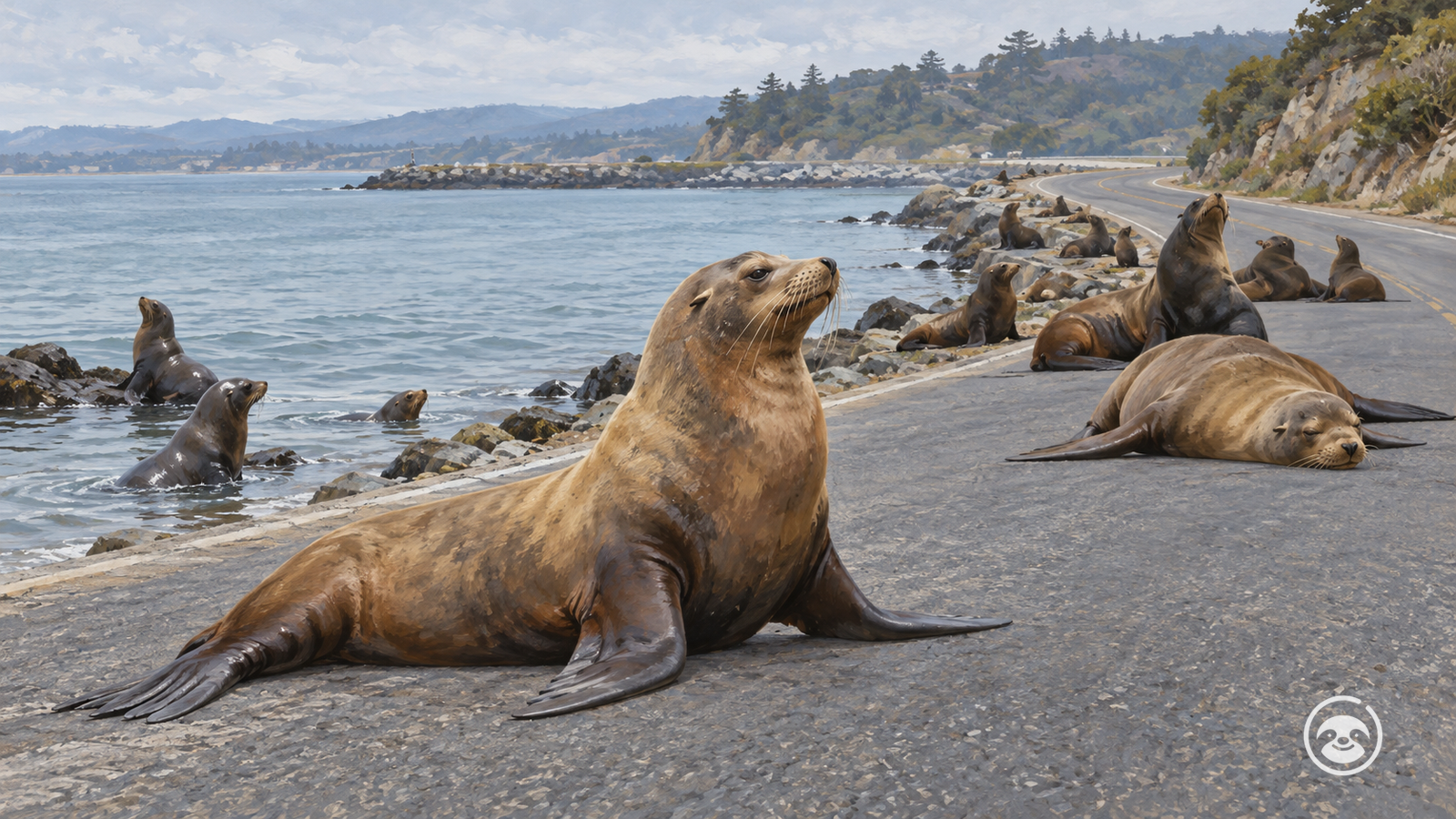
On October 11, 2026, a California Highway Patrol vehicle sounded its siren at a group of sea lions occupying a road in Moss Landing. Footage recorded by Evan Brodsky shows the animals moving aside.
By October 13, hundreds had gathered along Sandholdt Road near the harbor bridge. Giancarlo Rulli of The Marine Mammal Center told SFGATE that the animals returned after being moved.
With Monterey Bay beside them, why would sea lions choose a road? Part of the answer is that their lives depend on access to land as well as water.
California sea lions come ashore to rest, a behavior known as hauling out. Beaches and rocks offer places to do it, but so do docks, jetties and buoys. A surface built for people can become somewhere an animal rests between periods in the water.
They're also capable of getting around on land. Sea lions have large flippers and can bring their hind flippers underneath their bodies, supporting themselves as they move. Their ability to leave the water and travel across a shoreline helps explain how a gathering can extend beyond the edge of a harbor.
Sea lions also tend to rest in company. The Marine Mammal Center describes close groups ashore, a habit that helps explain why usable space can hold so many animals at once.
That need for somewhere to rest sits alongside another requirement: food. California sea lions eat squid and schooling fish, including anchovies and sardines. Monterey Bay is part of a coast where ocean conditions support a rich marine food web.
Much of that productivity starts with wind. During coastal upwelling, water near the surface moves offshore and colder water rises from below. It carries nutrients into the sunlit upper ocean, where microscopic organisms grow and help feed larger animals. Research by the Monterey Bay Aquarium Research Institute traces the influence of this process through marine communities from surface waters to the deep seafloor.
For a sea lion, feeding waters and places to come ashore are both useful parts of that coastal landscape. The region offers both, although the exact attraction of Sandholdt Road remains unclear.
Seasonal travel can also change how many sea lions appear along the Central Coast. The Monterey Bay sanctuary's SIMoN program describes animals moving north toward feeding areas in August and September. Those journeys help explain why local numbers can vary over the course of a year.
Their presence in the area also predates this road problem. A NOAA sanctuary report from 2019 includes records of disturbances involving sea lions around Elkhorn Slough and Moss Landing going back to 2003. What's unusual in the recent coverage is the conflict over a road people need to use.
Why moving them once doesn't settle the problem
One plausible explanation for repeated road use is that a clearance leaves the site's appeal intact. A siren can interrupt a rest and send animals moving without changing the surrounding harbor. If the space remains accessible and useful, sea lions may occupy it again.
NOAA's guidance on deterring sea lions says there isn't one nonlethal method that works in every situation. Moving animals out of a traffic lane and keeping that lane available over time are different tasks.
The Marine Mammal Protection Act generally prohibits harassing, capturing or killing sea lions. It also allows qualifying officials to take humane action in the course of their duties to protect public welfare and remove nuisance animals without killing them.
For anyone passing through, the helpful response is to follow officers and barriers, keep space around the animals and leave efforts to clear the road to the authorities. Don't get out to herd them, and don't try to push them aside with a vehicle.
A road occupied by wildlife is a poor place to stop for photographs. It can put people close to large animals while adding another obstacle for drivers and responders. Choose a viewing location where watching doesn't interfere with traffic or require an approach to the group.
NOAA's West Coast stranding guidance recommends keeping people and pets at least 100 yards, or 300 feet, from marine mammals ashore. Use a zoom lens, keep dogs leashed and away, and give an animal more space if it reacts to your presence. Never feed or touch it.
Being on land doesn't automatically mean a sea lion needs rescuing. If an animal appears injured, is entangled or can't get back to the water, contact The Marine Mammal Center at 415-289-7325. Give its location and describe what you can see from a safe distance. Trained responders can assess whether it needs help.
Featured image: AI-generated editorial illustration of sea lions on a coastal road.
Leave a comment