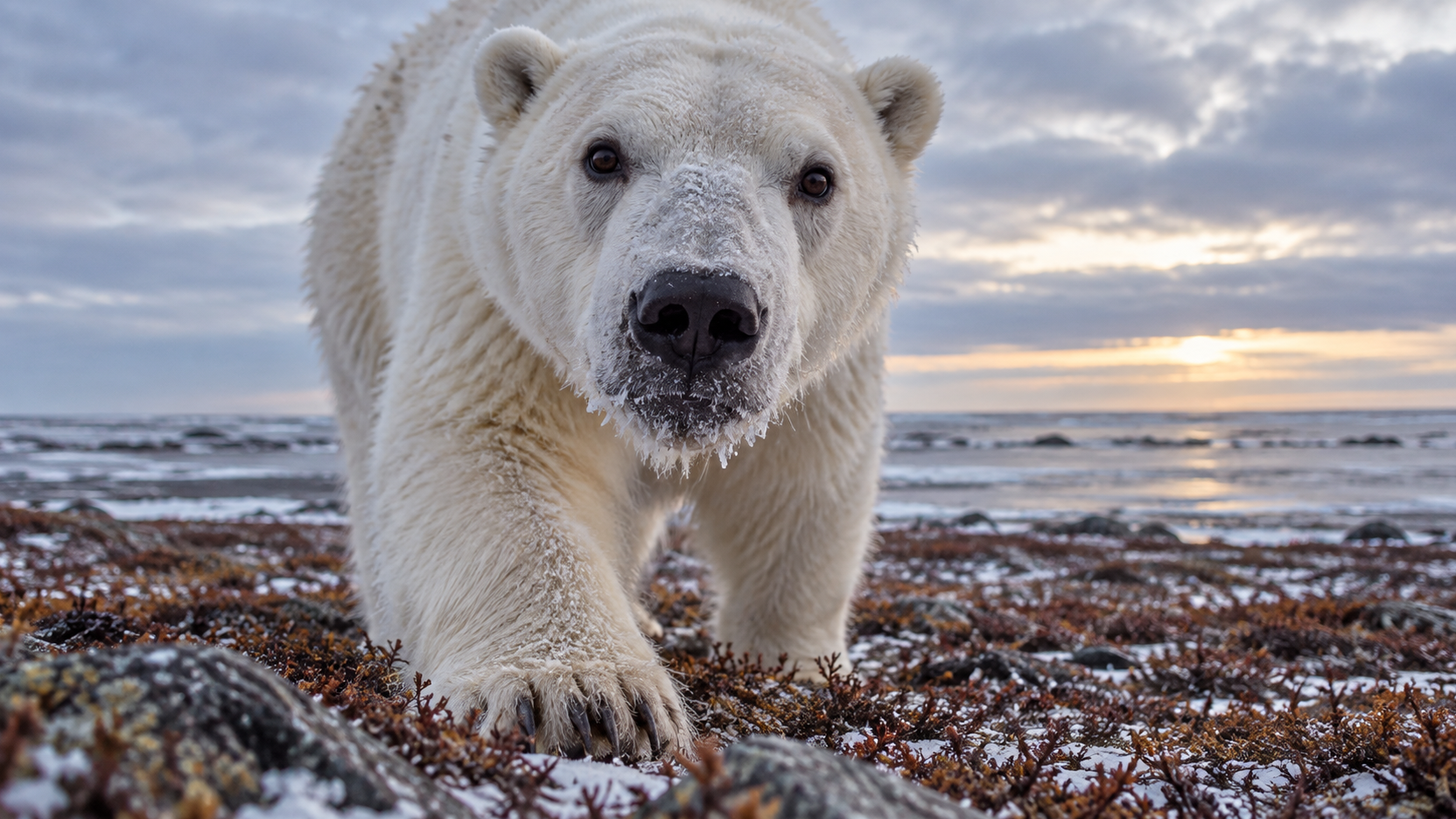
Fat Bear Week ended September 29 with Bear 89 Backpack beating Bear 910 by 5,081 votes. For anyone who spent September checking the bracket and returning to Brooks River, another remarkable bear season is already opening on the western edge of Hudson Bay.
Every fall, polar bears gather along the coast near Churchill, Manitoba, while they wait for the bay to freeze. Cameras operated through a partnership involving Polar Bears International, explore.org and Frontiers North Adventures allow people around the world to watch that wait unfold. Polar Bears International says the annual audience for the cams now exceeds two million viewers.
There is one important distinction for anyone arriving here directly from Fat Bear Week.
Polar Bear Week isn’t a polar-bear version of Fat Bear Week. There is no tournament, public vote or champion.
The official Polar Bear Week runs November 1 through November 7 in 2026. Polar Bears International created the awareness event around the annual gathering near Churchill, but the broader polar bear viewing season begins earlier. Most of its seasonal cameras operate during October and November, while the Cape South camera in Wapusk National Park streams year-round.
How to watch Churchill’s polar bears live in 2026
The easiest way to tune in is through Polar Bears International’s official polar bear camera page. The organization works with explore.org and Frontiers North Adventures to provide five camera perspectives: Tundra Buggy Lodge North, Tundra Buggy Lodge South, Cape South, Cape East and the Polar Bear Tundra Buggy Cam. The cameras are free to watch.
As of October 13, 2026, explore.org lists both Tundra Buggy Lodge feeds as live. That describes the camera feeds, not a guarantee of bears on screen. Other cameras may run on daytime schedules, be temporarily unavailable or show highlights when they are not broadcasting live.
Tundra Buggy Lodge North and South
The Tundra Buggy Lodge is a remote, elevated accommodation complex made of connected tundra vehicles. Its two cameras look out in different directions, increasing the chances of seeing an animal pass nearby. These are fixed lodge views rather than a continuously moving tour.
Watch the official North Lodge camera:
Watch the official South Lodge camera:
Cape South and Cape East in Wapusk National Park
The coastal cameras offer a broader look at tundra habitats used by wildlife around Wapusk National Park. Polar Bears International says Cape South streams year-round; other seasonal polar bear cams generally operate in October and November. You may see long stretches of empty coastline, changing weather or animals moving through the frame.
Watch the Cape South camera:
The fifth main view is Cape East in Wapusk National Park. It is also featured on the official five-camera page.
Polar Bear Tundra Buggy Cam
For a different perspective, the Tundra Buggy Cam broadcasts from a specially designed all-terrain vehicle. Unlike the lodge’s stationary north and south views, this camera can accompany a buggy out onto the Churchill tundra. Its availability depends on the seasonal operating schedule.
Watch the Tundra Buggy camera:
When is the best time to watch?
October and November are the key viewing months, but there is no scheduled time when polar bears are guaranteed to appear. Check during Churchill’s daylight hours and revisit the feeds: bears may rest out of sight for hours, then wander across a camera view with little warning.
For example, explore.org lists the Lodge South camera’s viewing hours as 7:30 a.m. to 4:30 p.m. in Churchill, or 8:30 a.m. to 5:30 p.m. Eastern in mid-October. This is a posted camera window, not a promise that the feed will be on every day or that bears will be visible.
If a player looks quiet or displays a replay, check its status before assuming the footage is live. Daylight, equipment, weather and seasonal schedules can all affect what viewers see.
Beyond the bear cameras
There is more to explore while you wait. The Churchill northern lights camera runs year-round, although February and March are usually better for aurora viewing. Explore.org also offers a Churchill raven nest camera, subject to its own operating conditions.
The Polar Bears International Bear Tracker offers another way to follow the Arctic: delayed GPS locations from research-collared female bears. It is not a live map of every bear, and its public movement updates are intentionally delayed, generally arriving about once a week when data is available.
The most meaningful change viewers can watch for is the return of Hudson Bay sea ice. When it becomes strong enough for bears to travel and hunt seals, many begin leaving the coast. That is why this annual wait matters far beyond the camera feed.
Why Churchill becomes polar bear country each fall
The story starts with the ice.
Western Hudson Bay is part of a seasonal sea-ice region. The ice disappears during the warmer months, pushing polar bears onto land and separating them from the seals that make up their most important prey.
As fall advances, the bears become more active. Parks Canada says many move north toward the coast between late September and mid-November, with numbers increasing around the Cape Churchill peninsula as winter approaches.
Churchill also sits in a particularly useful place for a bear waiting to get back onto Hudson Bay.
Currents in the bay move counterclockwise and can help push developing ice toward its western shore. The Churchill, Nelson and Hayes rivers also empty freshwater into shallow coastal waters in the region. Because freshwater freezes more readily than saltwater, those conditions can help ice begin accumulating along this section of the coast.
The seasonal gathering is driven primarily by access to returning sea ice. For a polar bear, that ice isn’t winter scenery. It is hunting habitat.
Polar bears use the frozen surface to reach seals. Once the bears are ashore, they can still find food. They have been documented eating vegetation, berries, birds, eggs and carrion, among other things. The problem is that terrestrial food isn’t a simple substitute for a seal-rich marine diet.
A 2024 study in Nature Communications followed 20 Western Hudson Bay polar bears for periods of 19 to 23 days during August and September. The animals varied enormously in how much they moved and what they ate, yet 19 of the 20 lost body mass, at rates ranging from about 0.4 to 1.7 kilograms per day. One subadult male gained weight.
That doesn’t mean every polar bear loses weight at the same rate, or that a bear seen eating onshore is necessarily in trouble. It does show why finding a few berries or catching a bird doesn’t automatically solve the energy problem created by losing access to seals.
That energy equation also explains something viewers may notice immediately on the live cameras: sometimes, very little seems to happen.
A polar bear can spend long periods resting. Conserving energy is useful while its best hunting grounds remain inaccessible. Others move along the shoreline, shelter from the wind or investigate their surroundings.
Then there is sparring.
Male polar bears sometimes stand upright and grapple. Those bouts aren’t necessarily serious combat. Polar Bears International says sparring can serve both social and physical purposes, helping males maintain muscles and navigate relationships with other bears.
For viewers, this means the Churchill cams work differently from a tournament.
There isn’t one moment every day when something happens. A bear may wander into frame and disappear. A mother and young bears may pass through. Two males may spar. Snow can arrive. The coastline can begin to change.
And then the ice itself becomes the story.
The physical season is beginning in Churchill, too. Polar Bears International House switched to its 2026 bear-season schedule on October 3 and is scheduled to operate those seasonal hours through November 19.
What nobody knows yet is exactly when this year’s wait will end.
In 2026, Western Hudson Bay dropped below Polar Bears International’s 30 percent sea-ice threshold on June 27, marking the beginning of the organization’s measured ice-free period. That breakup ranked as the 16th earliest in 48 years of satellite observations.
Last year showed how long the other end of that wait can become.
During the exceptionally warm fall of 2025, Polar Bears International reported that ice capable of supporting bears near Churchill didn’t develop until November 26. Western Hudson Bay didn’t reach the organization’s 30 percent threshold until December 7. The resulting 172-day ice-free period was the second longest in the satellite record dating to 1979.
There is no basis yet for assuming 2026 will follow the same timetable. Wind, temperature and ocean conditions can make one year look very different from another.
That uncertainty is part of what makes the next several weeks worth watching.
There are larger stakes behind the cameras.
The most recent Western Hudson Bay aerial survey, conducted in 2021, produced an estimate of 618 polar bears, 27 percent below the comparable 2016 estimate of 842. Polar Bears International currently describes the subpopulation as very likely declining.
A single livestream scene shouldn’t be treated as proof of that broader trend. A resting bear, a thin-looking bear or an unusually active bear can have many explanations. Population surveys, measurements of body condition and long-term sea-ice records are what allow researchers to examine changes over time.
That distinction will matter during Polar Bear Week.
The 2026 event is putting particular emphasis on human-polar bear coexistence, including efforts to reduce attractants, improve deterrence and give northern communities better warning when bears approach. Polar Bears International says the issue is becoming increasingly important as changing sea-ice conditions keep some bears on land for longer periods.
For people watching from home, though, the entry point can remain remarkably simple.
Open a camera and see what happens.
The same habit of returning to familiar animals helps explain the shared ritual around Fat Bear Week. Churchill offers that connection without the bracket. Viewers begin recognizing behaviors, noticing weather and learning why an animal that appears to be waiting is actually living through one of the most important transitions of its year.
Fat Bear Week gives viewers a champion. Churchill gives them a threshold.
The defining moment isn’t when one bear defeats another. It is when enough ice returns for bears to begin leaving the coast.
And when polar bears finally disappear from the shoreline cameras because they have moved back onto Hudson Bay, viewers may miss them.
For the bears, that is the outcome they have been waiting for.
Leave a comment