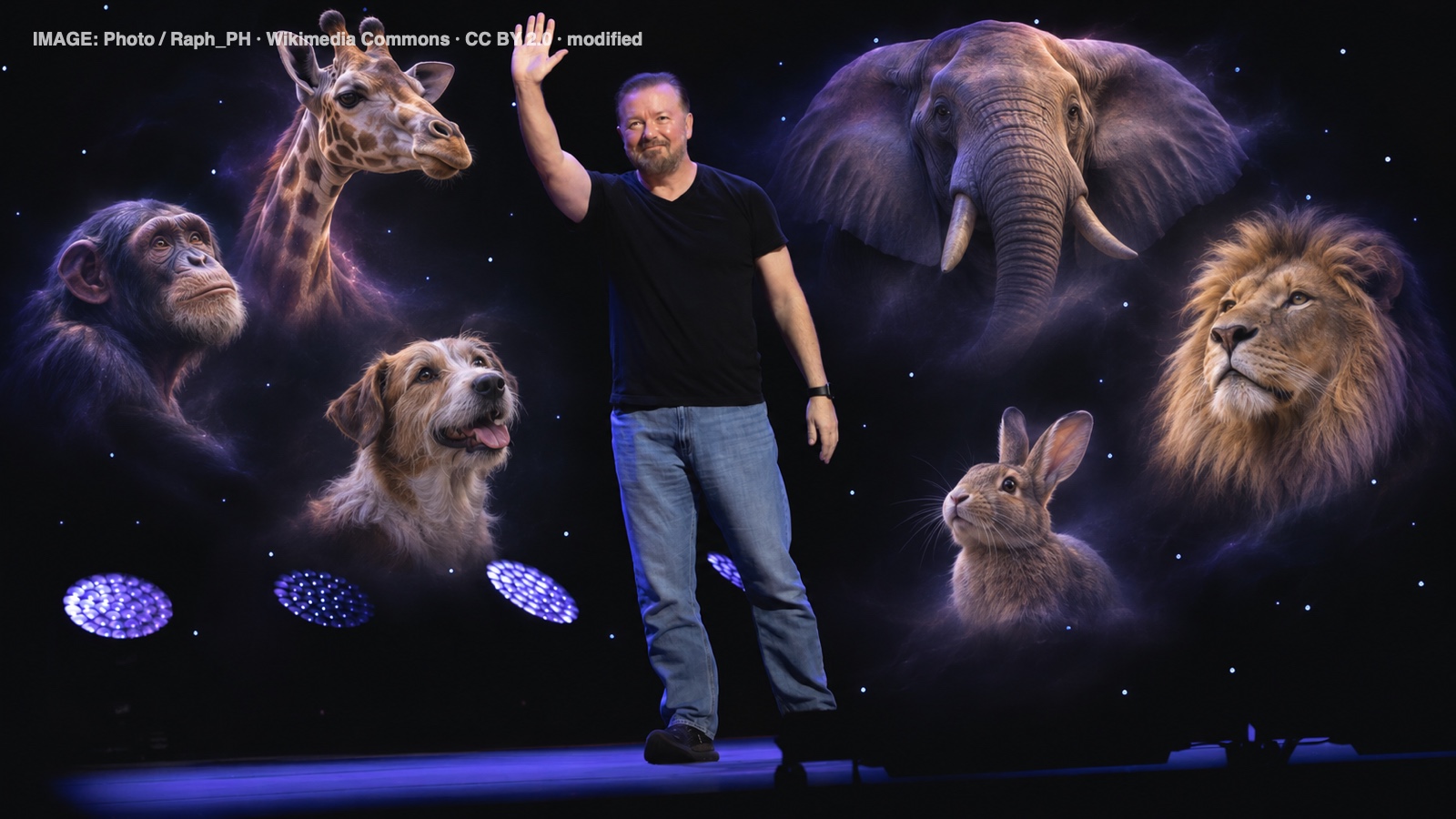
When Ricky Gervais accepted an animal-advocacy award in London this year, he immediately tried to shrink the moment. “I tweet. I sign petitions. I give a bit of cash,” he told the room, before joking that he had never gone to live with chimpanzees for 40 years.
The joke landed at the inaugural Jane Goodall Hope Gala on March 23, 2026, where Gervais received the Award for Unwavering Advocacy for Animals. Coming months after Jane Goodall died at 91, it also revealed something Gervais rarely lets sit without a punchline: animal welfare has become one of the longest and most consistent commitments of his public life.
For nearly two decades, the comedian has used the same abrasive directness that defines his stand-up to attack trophy hunting, animal testing, bullfighting, fur, the dog-meat trade and other forms of cruelty. The posts are usually what travel. Behind them is a longer record of charity work, campaigning and personal change that is easy to miss if the story stops at the latest argument.
One of the earliest public markers came in January 2007, when Gervais joined a London comedy benefit for the World Society for the Protection of Animals, now called World Animal Protection. That summer, an episode of Gordon Ramsay’s The F Word caught him in a more uncomfortable position. He was still eating meat, but watching Ramsay’s pet lambs head to slaughter forced him to question the distance people create between the animals they name and the animals they eat.
He did not transform overnight. In the years that followed, he backed World Animal Protection campaigns for global animal-welfare standards and emergency care for dogs caught in disasters. He signed a 2010 petition supporting Catalonia’s bullfighting ban and wrote publicly against foie gras. By 2013, he had reduced the conviction to a simple principle: animals were not humanity’s inferiors or property, he argued, but part of the same family.
His approach could be confrontational. In April 2015, Gervais shared a photo of American hunter Rebecca Francis smiling beside a dead giraffe and asked what could make someone kill “a beautiful animal” and pose with it. The image was already about five years old when he posted it, but his message sent it surging back across social media.
Francis defended the legal hunt, saying the giraffe was old and that its meat had been used by local people. The exchange became a global argument about trophy hunting, conservation and online shaming. Francis later described receiving threats from other users. Gervais did not make those threats, but the episode showed the combustible side of his method: a single moral challenge, delivered to millions, can leave little room for context once the crowd arrives.
The giraffe post was not an isolated burst. That same year, he supported Humane Society International’s campaign against China’s Yulin dog-meat festival. In 2018, the organization gave him its first Cecil Award for opposing trophy hunting. In 2021, he voiced the interviewer in Save Ralph, a stop-motion film that made cosmetic testing visceral by following a laboratory rabbit through a day of pain. His causes have ranged from the brutal reality of bullfighting to bear-bile farming, fur, whaling and the killing of stray dogs.
When conviction became a commitment
The less visible shift happened in Gervais’s own life. He has said he began moving toward veganism around 2020, first giving up meat, then eggs and finally dairy. In 2022, he publicly identified as vegan. Two years later, he explained that the choice had always been ethical. Raising money to save dogs while eating other animals had started to feel hypocritical.
That admission matters because it complicates the usual celebrity-activist story. Gervais did not present himself as someone who had always lived perfectly by his beliefs. He spent years campaigning for animals while still consuming animal products, then changed gradually when the contradiction became harder for him to defend.
The financial record has grown with that personal shift. In 2022, he distributed about $534,000 from premium-ticket profits on his SuperNature tour to animal charities. The following year, roughly $2.38 million from Armageddon went to 11 organizations working with dogs, cats, primates, rhinos and other animals. His 2024–25 Mortality tour generated another $3.23 million for 22 groups, according to recipient Pangea Trust.
Together, those three tour-linked rounds amount to about $6.15 million. The money came from extra profits on premium Platinum ticket sales, not from every ticket or all tour revenue. It supported organizations ranging from small dog-rescue groups to wildlife sanctuaries and conservation programs.
Gervais still describes the underlying idea more plainly than the numbers suggest. In a 2026 conversation with comedian Romesh Ranganathan, he called kindness to animals a moral obligation. People should help with whatever they can, he said, and those who have more should give more because there is only so much any one person needs.
That view now extends beyond one-off campaigns. Gervais is a patron of the dog-rescue charities Paws2Rescue and All Dogs Matter, and a longtime supporter of Animals Asia. In 2026 alone, he added his name to campaigns opposing the mass killing of stray dogs in Turkey and commercial whaling in Iceland.
Celebrity support does not prove that a campaign succeeded because of one famous voice, and fame is not the same as expertise. Gervais’s posts can also compress difficult questions about conservation, poverty and animal management into a verdict designed for social media. The 2015 giraffe dispute remains the clearest example of both his reach and its risks.
But the record is now too long to dismiss as branding. The benefits began before social media rewarded every provocation. The donations continued across successive tours. His diet eventually moved closer to the ethics he had promoted for years.
At the Hope Gala, Gervais joked that animal advocates are the best people and also the most annoying because they are always asking for money. Then he imagined the next appeal: somewhere, a rare slug was in trouble.
The line was funny because everyone in the room knew he would probably help the slug.
Featured image: Photo by Raph_PH via Wikimedia Commons, licensed under CC BY 2.0. Digitally modified with generated animal artwork.

Leave a comment