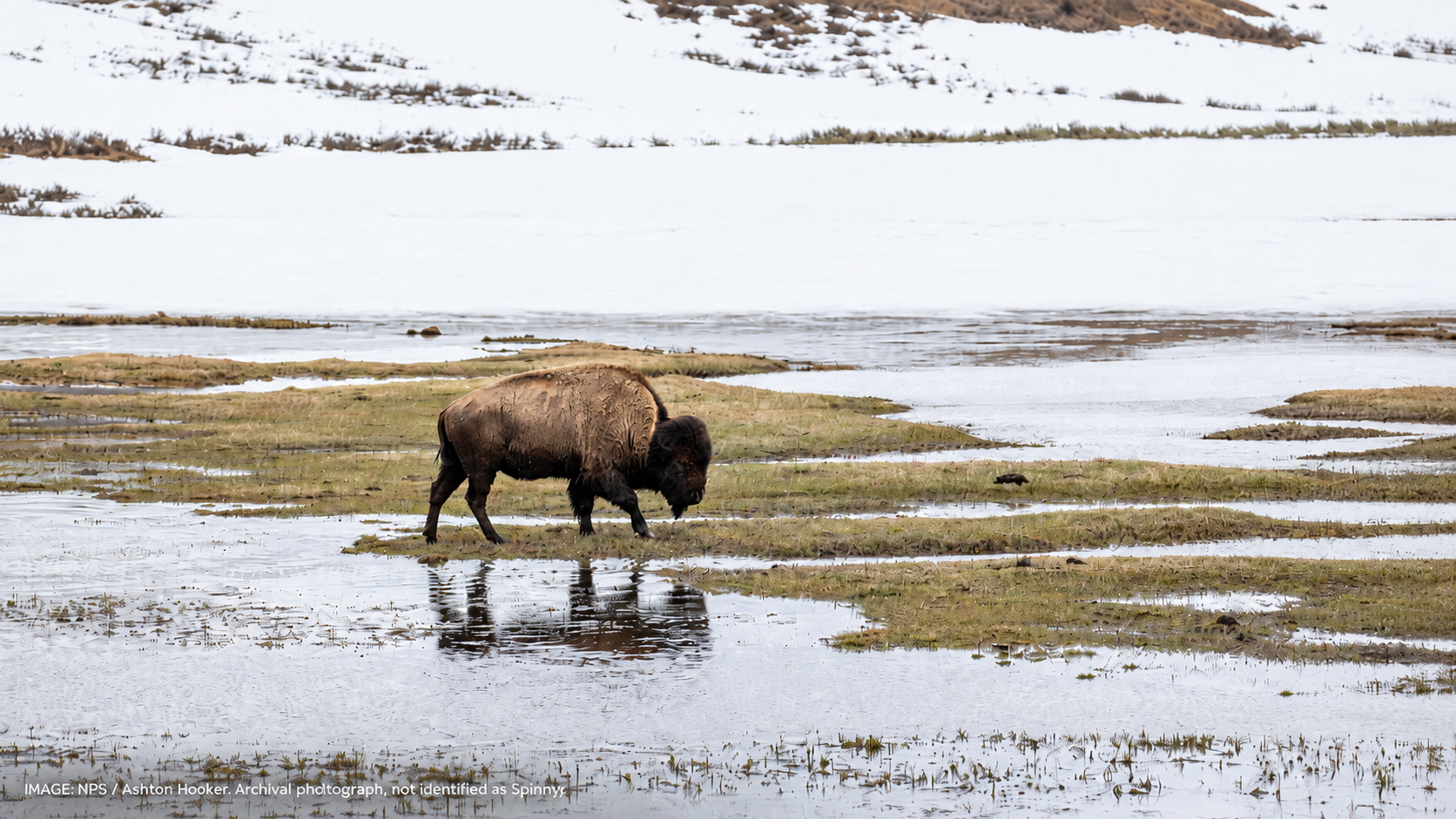
In the debate over Spinny, Yellowstone’s circling bison, one reader raised a question that deserves more attention: how would anyone actually treat his eye?
It’s a practical way to approach when Yellowstone should intervene. Catching an animal, identifying its problem and providing care that improves its life are separate challenges. A successful capture wouldn’t necessarily mean a successful treatment.
Photographer Tammy Neufeld gave the bull his nickname after observing him repeatedly circling in the Yellowstone River. Other visitors had noticed the unusual behavior, too. A September 24, 2026, story in Cowboy State Daily included an eyewitness account from September 15 and placed the animal in Hayden Valley.
Those observations document a troubling pattern. They don’t establish that he circled without stopping between sightings, what caused his apparent eye injury or whether the eye explains his movements.
As of October 8, the public material reviewed for this article doesn’t establish a confirmed diagnosis or recovery. Reports about his condition include eyewitness interpretations, not a published veterinary assessment. That distinction matters before deciding that treatment would either save him or make things worse.
The first practical question has an answer: professionals can immobilize and examine bison. A 2018 study in the Journal of Wildlife Diseases described field immobilizations of 21 animals. Every animal recovered, and the procedures allowed researchers to collect blood and skin samples. Some bison needed additional medication, however, and the researchers identified inconsistent induction as a limitation.
Another study, published in 2017, evaluated 12 American bison across 13 handling attempts. The researchers obtained adequate sedation on all but one attempt. Their recurring concern was reduced blood oxygen, and they recommended supplying oxygen when using that particular drug combination.
These were small studies of particular methods. They show that veterinary access is possible, while documenting problems that need attention. Neither provides an individual risk estimate for Spinny.
Eye surgery is possible in bison, too. Oklahoma City Zoo’s veterinary team has described an American bison undergoing eye surgery at its hospital in 2013. The account doesn’t give that animal’s diagnosis or outcome, and a zoo hospital isn’t the same setting as a Yellowstone riverbank. Still, it rules out the idea that a bison’s eye is simply beyond veterinary care.
For Spinny, the useful questions begin before any proposed capture. What have staff observed about his feeding, drinking and movement? What could an examination clarify? Is there a plausible treatment that would improve his comfort or ability to function? What care would be possible afterward?
Those are questions for the professionals assessing the animal. They aren’t evidence that Yellowstone has already performed an examination or developed a treatment plan.
The capture itself would introduce hazards. Field-anesthesia guidance from the National Bison Association lists complications including overheating, low blood oxygen, digestive complications and injuries during induction. It also identifies capture myopathy, a stress-related condition that can damage muscles and become fatal.
Knowing those risks doesn’t settle the decision. The relevant comparison is between the harm an animal might experience without treatment and the likely benefits and burdens of a specific intervention. Without a diagnosis or prognosis, saying capture would be more dangerous is as premature as saying there’s nothing to lose by trying.
Treatment also needn’t mean the daily eye drops some readers might imagine. Oklahoma State University’s guidance for cattle pinkeye discusses long-acting antibiotics, veterinary pain relief and protection of the affected eye. At Kansas State University, extension advice adds that a badly affected eye may have to be removed.
Those are examples from cattle, not a prescription for a wild American bison. They illustrate why the nature and severity of an eye problem determine the options. They don’t establish that Spinny has pinkeye, needs surgery or could be helped by a single injection.
Nor would fixing an eye problem necessarily explain or resolve his circling. Two abnormalities appearing together aren’t proof that one caused the other. A proposed intervention would need a realistic goal, along with some way to assess whether it worked.
The same uncertainty applies to a question repeated in the comments: could his condition spread to other bison?
Some livestock eye infections are contagious. According to Oklahoma State, flies can carry the bacteria responsible for cattle pinkeye; contact with secretions from an affected eye can spread it, too. That makes the concern understandable, but a visibly abnormal eye doesn’t identify an infectious agent. No contagious condition or threat to the herd has been established for Spinny in the material reviewed.
Evidence of other affected animals, diagnostic testing or a case-specific assessment would change the discussion. Until then, labeling him contagious would turn an unanswered question into an unsupported fact.
Yellowstone’s policy doesn’t settle Spinny’s medical questions
Yellowstone’s explanation of its wildlife-rescue policy starts with the health of wild populations and the ecological processes that sustain them. Routine feeding, rehabilitation and protection of individual animals aren’t its purpose.
That principle helps explain why an animal’s visible distress doesn’t automatically produce a rescue operation. It also helps explain the argument many readers made about the food chain: deaths provide food for predators and scavengers, while decomposition returns nutrients to the ecosystem.
The policy has exceptions. Yellowstone identifies circumstances involving public safety, protection of park resources and repairing ecological disruption caused by people. Its examples include rehabilitation of human-injured raptors. Human involvement can matter, but the policy doesn’t promise treatment after every human-caused injury. The evidence reviewed doesn’t establish a human cause for Spinny’s condition.
Different conservation goals can also justify different actions. The work of protecting threatened species can require intensive intervention, including habitat protection and restoration. National Park Service policy explicitly provides for such efforts. That doesn’t create a general rule that every sick animal receives clinical care.
Yellowstone also actively captures and tests bison through its conservation-transfer program, which moves qualifying animals to Tribal partners. That is population management with defined objectives, rather than an individual rescue service.
Disease raises another distinction. National Park Service policy recognizes that native disease organisms can be ordinary parts of an ecosystem. It also allows specified management for threats involving vulnerable species, human health or spread beyond park boundaries. Even a confirmed infection would require assessment of its significance rather than an automatic assumption that it must be eliminated.
For readers focused on suffering, however, explanations about populations leave a difficult question: when would continued observation cease to be humane?
There isn’t a published Spinny-specific assessment in the sources reviewed that answers it. The park’s general statement doesn’t tell us whether staff evaluated his pain, considered treatment or discussed euthanasia. It shouldn’t be rewritten as proof that veterinarians examined him and decided nothing could help.
In wildlife medicine, euthanasia is a separate welfare decision. Veterinarian Dave McRuer’s discussion in the Wildlife Rehabilitation Bulletin emphasizes minimizing pain and distress and considering the animal’s interests. That guidance concerns rehabilitation; it isn’t a Yellowstone rule for this bull.
The questions worth putting to the park are concrete. Can he maintain feeding and drinking? Is his condition improving, stable or deteriorating? What evidence indicates persistent pain or distress? Is there a reasonable prospect of recovery, and could available treatment change that prospect?
The answers could support very different choices. An impaired animal that continues to function isn’t automatically in the same position as one with an irreversible, terminal condition. But a wildlife video alone doesn’t establish which description applies to Spinny.
Even the suggestion of euthanizing him and leaving the carcass for scavengers needs qualification. Pentobarbital residues in a carcass can poison scavengers, the U.S. Fish and Wildlife Service explains. The drug is used for euthanasia. That risk depends on the method used; it doesn’t apply equally to every form of euthanasia. It illustrates why intervention can create consequences beyond the original animal.
Meanwhile, the hopeful claims deserve the same scrutiny as the frightening ones. An October 3 Outdoors.com article relayed Neufeld’s response to a photograph taken the day before. She thought it might show Spinny and tentatively interpreted it as a sign of improvement. The identification wasn’t conclusive.
The material reviewed doesn’t independently verify readers’ claims that he is now traveling with another bull, has a particular degree of blindness or is recovering. A new photograph would first need a reliable date and identification. Even a reliable sighting would show he was alive when it was recorded. It wouldn’t establish that the underlying problem had improved.
For visitors who encounter an animal that appears injured, the immediate action is to alert park staff and avoid approaching it. Yellowstone requires at least 25 yards of separation from bison, with more distance restored if an animal moves closer.
For everyone following from a screen, the next meaningful update would be specific: a reliably identified sighting, an account of his condition or a park explanation tied to this animal. Until then, an important question remains unanswered: what would give Spinny the best chance of living comfortably enough to remain wild?
Leave a comment