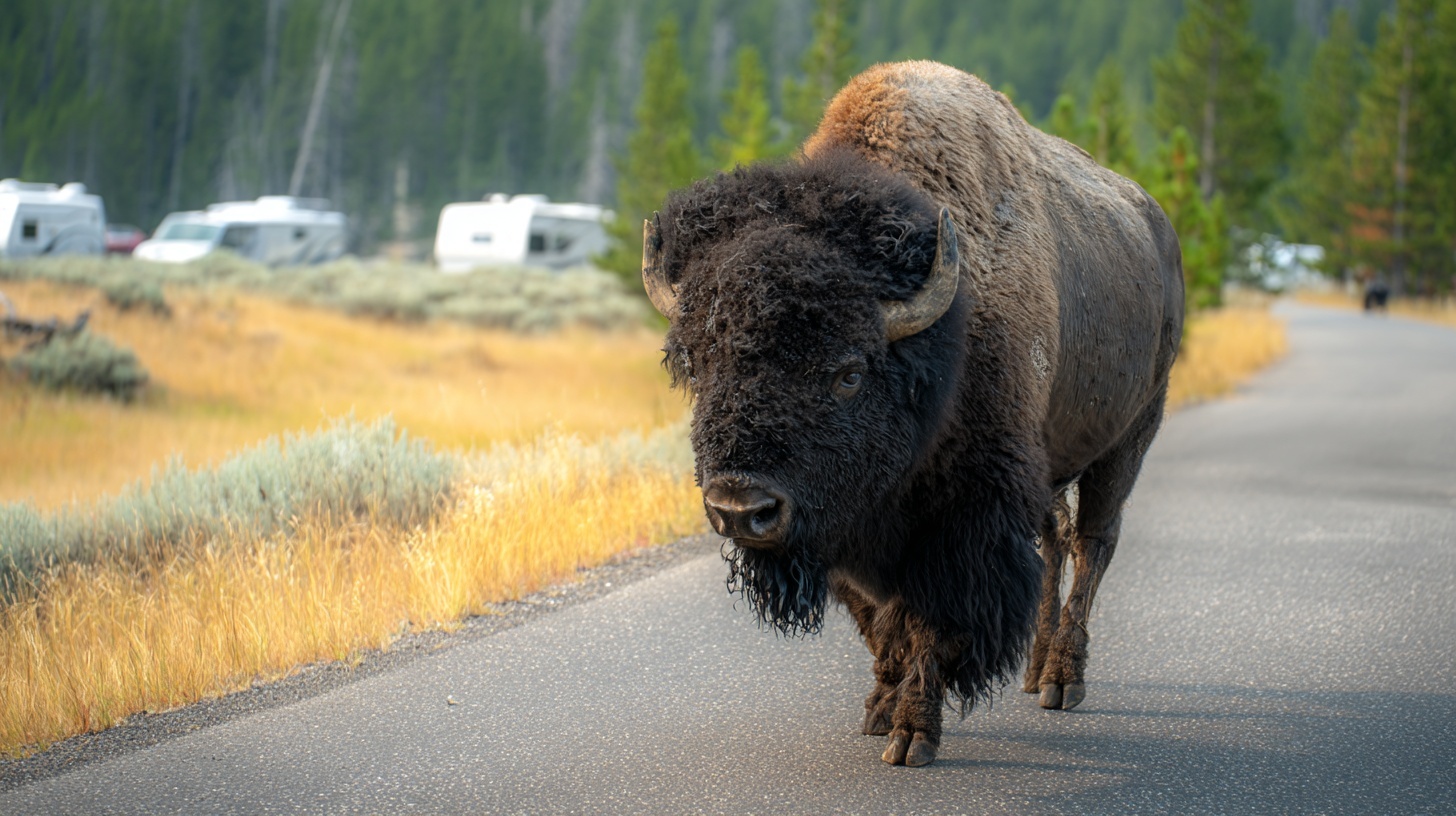
At Bridge Bay Campground, the distance between a quiet wildlife sighting and a medical emergency disappeared in seconds.
On July 10, 2026, Carl Isom-McDaniel, 65, was visiting Yellowstone National Park with his 13-year-old grandson. They were walking near Yellowstone Lake when a bull bison began moving through the campground.
Footage recorded by Montana photographer Mike MacLeod showed the animal pursuing McDaniel around several trees before striking him near the hip and throwing him into the air. His grandson escaped unharmed. Campers then shouted and advanced toward the bull until it moved away from the injured man.
Witnesses described the bison as agitated before it reached McDaniel. It had moved through the campground and reportedly charged elsewhere before turning toward the grandfather and his grandson.
Accounts differ over whether a passing pickup sounded its horn. The widely circulated footage has no audio, and the National Park Service hasn’t publicly identified what triggered the charge.
McDaniel reportedly suffered four fractures to his femur near the hip. He underwent surgery on July 12 and was able to stand the following day.
The frequently repeated estimate that the bison threw him approximately eight feet came from the footage and witness descriptions, not an official park measurement.
The next development moved attention from McDaniel’s injuries to the fate of the animal.
Yellowstone officials reportedly told TMZ that no “management action” would be taken against the bull. Media reports interpreted that language to mean the bison would not be relocated or euthanized. The park has not published a detailed, case-specific assessment explaining the decision.

Why a serious injury does not automatically mean euthanasia
Yellowstone’s published wildlife policy offers useful context, although it does not provide a formal ruling on this particular bull.
The park’s mission focuses on sustaining wild populations and natural ecological processes rather than protecting every individual animal. Managers generally avoid intervening unless human life, public safety, park resources, or ecosystem restoration require it.
Yellowstone says managers may remove animals that become conditioned to human food or that attack and feed on people. Ungulates, the group that includes bison, are generally tolerated in developed areas provided serious conflicts do not continue.
That distinction sits at the center of many human-wildlife conflicts. Managers must consider the severity of one encounter, the animal’s previous behavior, the possibility of another incident, and the conservation value of allowing wildlife to remain wild.
A Yellowstone case from 2023 shows what a continuing hazard can look like. Rangers euthanized an abandoned bison calf after repeated attempts to reunite it with its herd failed. The calf continued approaching people and vehicles along a roadway, creating an ongoing public-safety risk.
Nothing publicly released about the Bridge Bay bull establishes that it was food-conditioned, habituated to people, or linked to a documented series of earlier attacks. That does not prove the animal presents no future risk. It means the public evidence remains limited.
The reported distance also makes McDaniel’s encounter unusual. MacLeod estimated that McDaniel and his grandson had been roughly 100 yards from the animal before it closed the gap, although the National Park Service has not verified that figure.
A peer-reviewed review of 25 Yellowstone bison injuries between 2000 and 2015 found that victims had been an average of only 3.4 meters from the animals. Eighty percent had actively approached a bison, while 48 percent were taking photographs.
If the witness estimate is broadly accurate, the Bridge Bay encounter does not fit the more familiar pattern of a visitor stepping within a few feet of a bison for a photograph.
It demonstrates a harder reality. Yellowstone’s minimum viewing distance reduces danger, but it cannot form a physical barrier around an animal capable of accelerating rapidly and changing direction with little warning.

Yellowstone requires visitors to stay at least 25 yards, or 23 meters, from bison. If one moves closer, visitors should retreat to restore that distance. If a bison charges, the park advises people to walk or run away immediately and seek cover behind a tree or vehicle.
Drivers should remain inside their vehicles, wait for bison to move, and never use the horn or drive aggressively toward them.
The park estimated nearly 5,300 bison in Yellowstone in 2025. The population is not federally listed as threatened or endangered, but it remains exceptional. Yellowstone is the only place in the United States where bison have lived continuously since prehistoric times.
McDaniel’s encounter also exposes the limits of human control around powerful wildlife. Distance, experience, and good intentions can reduce risk, but none can dictate an animal’s next movement.
His injuries were severe, and leaving the bull alive does not make the incident less serious.
The public record supports a narrower conclusion. Yellowstone reportedly decided against management action, but it has not released the detailed assessment behind that choice. A few seconds of footage can show what happened once. They cannot, by themselves, establish what danger remains.
Leave a comment