Finn Oakley has spent over five years as a nature and science writer at Discvr.Blog, drawing on his experience at National Geographic Channel. Based in Melbourne, he’s passionate about uncovering the world’s mysteries, dreams of returning to Peru, and enjoys Aussie Bites in his downtime.
A Virginia family was trimming the tree when they noticed something was off. 🦉
The star had been bumped aside, and in its place sat a barred owl, calm, heavy, and perfectly balanced in the highest branches.
A wild barred owl flew down the chimney of a Virginia family's home and promptly perched itself high atop a Christmas tree. The Animal Welfare League posted video of the owl flying from the kitchen to the Christmas tree — unceremoniously knocking over the star tree topper. The… pic.twitter.com/V4jxArZhlE
Holiday stories often feel like they belong to people, lights, and schedules. This one belonged to a wild animal making a practical decision. The Animal Welfare League of Arlington responded to the call and the owl was safely removed and released, which is the ending you want for both the family and the bird.
Barred owls are built for twilight and deep woods, but they don’t need a forest to do what they do best. They’re strong, quiet fliers with dark eyes and broad wings, and adults can span about 39 to 43 inches from tip to tip. If one shows up in a neighborhood, it’s usually following food, shelter, or both.
Why a chimney can look like shelter
To a person, a chimney is a vent. To a wild animal on a cold night, it can resemble a protected hollow, a vertical cavity that blocks wind and keeps out rain. It’s the same basic logic that draws squirrels, raccoons, and bats toward human structures during winter: warmth and safety are easier to find near buildings than out in open weather.
An owl came down a family's chimney in Virginia and found the perfect spot on top of their Christmas tree.
Animal control came and released the wild barred owl outside.
And once an owl is inside, the “choice” it makes can look almost funny. A Christmas tree is tall, stable, and shaped like the kind of perch an owl would use outdoors. It’s also often placed near a room’s most open sightlines. From the top, the bird can watch everything without being cornered.
The part worth taking seriously is what happens next. A trapped animal can injure itself trying to escape, and people can get hurt trying to handle wildlife without training. The safest move is to give the animal space, keep pets and kids away, and contact local wildlife professionals.
There’s also a simple prevention lesson wrapped inside the humor. Chimney caps and basic winter entry-point checks can stop a surprise guest before it turns into a stressful rescue. In the end, the goal isn’t to keep nature out. It’s to keep wild animals from making the kind of mistake that starts with curiosity and ends with panic.
On a cool Tasmanian afternoon, a retired soldier stands in thick scrub, listening for a sound that officially should not exist.
On another continent, trackers in Rwanda climb through volcanic mist counting newborn gorillas, while ranchers in Montana string electric fences and hope the bears stay on the far side of the wire.
How far are we willing to go to keep another species on the planet?
Why these stories matter now
Scientists estimate that close to a million species face some level of extinction risk in the coming decades. That number is large enough to feel abstract. The 60 Minutes compilation on animals that faced extinction turns it into human-scale encounters: one tiger that may or may not still exist, one bear in a snare, one tortoise being carried out of a forest like stolen gold.
These pieces span more than a decade of reporting. Some animals are already gone in the wild, existing only in preserved DNA. Others are clawing their way back because people decided they should.
1. Tasmanian tiger: chasing a striped ghost
The Tasmanian tiger looked like a slender dog with dark stripes across its back, weighed about 55 pounds, and roamed Tasmania for thousands of years. In the early twentieth century it was declared a nuisance to sheep farmers. The government paid bounties for carcasses. By the mid-1930s only one captive animal remained, pacing a concrete enclosure in Hobart’s Beaumaris Zoo. It died in 1936.
Half a century without a verified sighting led officials to declare the thylacine extinct in 1986. Yet in Tasmania, the tiger never really left. Its silhouette decorates license plates and coats of arms. Locals in small pubs still tell stories of striped shapes slipping across back roads. Enthusiasts invest in motion-sensing cameras, satellite-linked traps, and long nights in the bush. Long-time seeker Adrien “Richo” Richardson carefully records what he believes are tiger calls echoing from both sides of a forestry track.
In a Melbourne laboratory, developmental biologist Andrew Pask and his team are trying to reverse extinction by editing the genome of a tiny marsupial called the fat-tailed dunnart. Their goal is to modify its DNA until its cells resemble those of a thylacine, then grow a living animal. The project, supported by investors and by the American company Colossal Biosciences, borrows tools from gene-editing and stem-cell science. Critics like Australian mammalogist Chris Helgen see it as more symbolic than practical—the biological gap between a mouse-sized carnivore and a wolf-sized apex predator is enormous.
People drove this animal off the island once. De-extinction is partly an attempt to answer a nagging question: if we could undo that, would we?
2. Grizzlies in Montana: conservation with teeth
When the Lewis and Clark expedition first wrote about grizzlies, there may have been 100,000 of them spread from Canada to Mexico. Settlers and ranchers saw them as a direct threat to life and property. Over the next 150 years, hunting and government eradication campaigns pushed them to near collapse. By the 1960s, only a few hundred grizzlies survived in the lower 48 states.
The Endangered Species Act listing in 1975 turned the tide. Core populations in Yellowstone and Glacier National Parks became the foundation for a slow recovery. Biologists like Eric Wenham now capture bears in remote Montana valleys using snare traps baited with beaver meat. In a makeshift forest “field hospital,” they sedate, weigh, measure, and sometimes collar the bears before releasing them. The collars reveal a valley where bears walk at night through spaces that look purely human by day—including within a hundred feet of a biologist’s house.
Grizzly numbers have more than tripled since the 1970s. Their range has doubled. Human populations have grown too, adding houses, hobby farms, and vacation cabins at the edge of bear country. Farmers report bears flattening cornfields and raiding melon patches. Ranchers lose dozens of cattle a year. Nonprofits like People and Carnivores work with them to install high-voltage fencing and secure attractants.
Some bears still cross the line from wild animal to repeat offender. When they learn to associate human trash, chicken coops, or livestock with easy calories, they become dangerous. Federal bear-recovery coordinator Hillary Cooley has authorized the killing of roughly fifty such animals in a single year. She calls it a necessary but miserable part of keeping both bears and people alive.
3. Mountain gorillas: turning tourism into protection
On the steep slopes of Rwanda’s Virunga volcanoes, mountain gorillas once hovered near extinction. When Dian Fossey began her research there in the late 1960s, only about 254 animals remained. Poachers killed gorillas for trophies. Farmers pushed their fields higher up the mountainside, eating away the forest.
Rwanda and neighboring Uganda now share more than 1,000 mountain gorillas. Around 600 live in Rwanda, the rest in Uganda. This is the only great ape whose population is increasing.
Each morning at Volcanoes National Park headquarters, small groups of tourists gather, masked and briefed on how to behave around the animals. A one-hour trekking permit costs about $1,500. Gorilla tourism has become one of Rwanda’s top sources of foreign revenue. Ten percent of the income flows back into villages surrounding the park. Communities decide whether to spend it on new classrooms, health centers, water tanks, or livestock cooperatives.
A small army of trackers follows each gorilla family every day of the year. They know every individual, monitor injuries and illnesses, and remove snares set for antelope that could maim an ape by accident. The Fossey Fund maintains a research campus, bone collection, and a “poop lab” that uses fecal samples to track stress hormones and genetics. A new green campus, partly underwritten by Ellen DeGeneres, will add space for scientists, exhibits, and local students.
Mountain gorillas remain vulnerable. Their entire population fits within a few patches of volcano forest, and any disease outbreak or political upheaval could undo decades of progress.
4. Humpback whales: from harpoons to hydrophones
The humpback whale was once a textbook example of industrial overkill. Commercial whaling fleets pursued humpbacks across oceans, harpooning and processing them at sea until only a few thousand remained worldwide. International bans on commercial whaling changed the rules, but enforcement remained patchy.
The 60 Minutes piece follows this story on two fronts. On the Southern Ocean, conservation group Sea Shepherd, led for many years by Paul Watson, confronts Japanese whaling vessels operating under a “research” loophole. Their ships throw lines to foul propellers and launch small boats to block the transfer of dead whales to processing factories. The tactics are aggressive and controversial. Watson argues that inaction means tacit support for illegal killing.
In the tropical Pacific, marine biologist Nan Hauser works from a quieter angle. Based on Rarotonga in the Cook Islands, she has spent years studying humpbacks that migrate thousands of miles between Antarctic feeding grounds and breeding areas in warmer waters. Her team tags whales with satellite transmitters to map their routes and records their songs underwater. One male may hang upside down, motionless, while a twenty-minute song rolls out through the dark. He repeats the pattern for hours, then innovates a new theme the following year.
Thanks to whaling bans, shifting public opinion, and science-driven advocacy, humpbacks have rebounded to an estimated 80,000 animals—about 30 percent of their pre-whaling numbers. Their biggest threats now are ship strikes and entanglement in fishing lines. Hauser hopes detailed migration maps will give regulators enough information to steer vessels away from the busiest whale corridors.
5. Turtles and tortoises: the slowest emergency
Turtles and tortoises have survived since before the dinosaurs, yet nearly half of the more than 300 species are headed toward extinction. Habitat loss, climate change, and a surge in illegal trade for meat, medicine, and status symbols are all part of the problem.
The program profiles Eric Goode, a New York hotel and restaurant owner who now spends much of his time and money trying to save the world’s rarest tortoises. His work takes him to Madagascar, where slash-and-burn agriculture has stripped away about 90 percent of the island’s forests and left rivers running red with eroded soil. Those remaining forests hold five species of rare turtles and tortoises, including the plowshare tortoise—a golden-shelled animal considered the most endangered tortoise on Earth.
Plowshares sell for tens of thousands of dollars in East Asian markets. Poachers slip into protected areas at night, following the same trails conservation patrols use by day. At one breeding center run with the Durrell Wildlife Conservation Trust, thieves broke past fences and guards to steal 75 young tortoises and two adults. Half the carefully raised breeding population, gone in a night.
Goode’s team began an extreme experiment in response. Using handheld drills, they cut shallow scars into the shells of wild plowshares, marring the smooth golden surface collectors prize. The tortoises are not harmed medically, but their commercial value drops. The work is hard to watch. It feels like vandalizing an art piece to save it from being stolen. No one knows yet if it will be enough.
Back in the United States, Goode has built a “tortoise hotel” in the hills outside Los Angeles. The facility houses hundreds of turtles and tortoises from three dozen endangered species, many confiscated from smugglers. Each enclosure replicates a distant habitat, from Burmese forests to Indian riverbanks.
6. Bonobos: a gentler cousin under siege
Bonobos look enough like chimpanzees that early researchers confused the two. Genetic tests show they are just as closely related to humans as chimps are, but their social lives follow a different script. Groups are led by coalitions of females. Conflicts tend to be defused with sexual contact rather than escalated with violence. Researchers see tool use, problem solving, and intricate vocal exchanges. They do not see deliberate killing of one another—something that appears regularly among chimps and humans.
Bonobos live only in the forests of the Democratic Republic of Congo, a country where decades of war and poverty have pushed wildlife down the priority list. In city bush-meat markets, monkeys and other forest animals are still sold as food. Bonobos are officially protected, yet orphaned infants continue to appear in the capital.
At the Lola ya Bonobo sanctuary near Kinshasa, founder Claudine André and her staff take in these traumatized youngsters. Each baby is paired with a human caregiver who acts as a surrogate mother—constant contact, bottle feeding, comfort. As they grow, the orphans move into groups where they learn bonobo behavior from one another instead of humans. By about age five they graduate into larger forested enclosures.
The sanctuary has taken the next step by releasing groups into a remote forest reserve along the Lomako or Lopori River. Getting there requires a three-hour flight into northern Congo and a day’s travel by dugout canoe. When André visits by boat and calls their names, the released bonobos gather along the riverbank, listening for the voice that once meant safety.
If the releases continue to succeed, they may create the first new wild bonobo population in living memory.
7. Giant pandas: when a national symbol becomes a shield
The giant panda is China’s national symbol and a global shorthand for endangered species. In the 1980s only about 1,200 remained in China’s bamboo forests. Habitat had been carved up by logging, farming, and roads.
The Chengdu Research Base of Giant Panda Breeding began as a shelter for injured pandas, run on a tiny budget with a handful of seriously ill animals. Over thirty years, scientists at Chengdu and partner institutions like the Smithsonian National Zoo have cracked some of the biological puzzles that made panda recovery so difficult.
Pandas eat almost nothing but bamboo, which is low in nutrition. Adults may spend sixteen hours a day chewing through forty pounds of stalks and leaves. Females can become pregnant only during a three-day fertility window once a year. Newborn cubs weigh about four ounces—the size of a stick of butter. In the wild, a mother that gives birth to twins usually raises only one.
Captive breeding programs learned to swap twins in and out of the den so each gets time with the mother and supplemental feeding from keepers. Veterinarians train adult pandas to voluntarily offer an arm through a slot in the enclosure wall for blood draws, avoiding repeated anesthesia. Better nutrition, careful genetic management, and this kind of cooperative care have lifted the captive population at Chengdu to about 200 pandas. Worldwide, wild numbers have climbed to just under 2,000—enough for the IUCN to downgrade the species from endangered to vulnerable in 2016.
China is now planning a massive panda national park of about 10,000 square miles that will connect fragmented habitats across three mountainous provinces. Conservation biologists call pandas an “umbrella species.” The corridors and forests protected for them will shelter lesser-known plants and animals sharing the same slopes.
What holds
None of these animals came back on goodwill alone. Grizzlies needed the Endangered Species Act, federal funding, and someone willing to tranquilize a 300-pound predator in the name of data. Mountain gorillas needed a government ready to tie protection directly to national revenue. Pandas benefited from being an icon that leaders refused to lose.
What doesn’t
These are not finished victories. Grizzlies can lose protection if political winds shift. Poachers can wipe out decades of plowshare breeding in a single night. Bonobos can vanish if the forests are logged or armed groups return. A disease outbreak could sweep through gorilla families or panda valleys. Climate change complicates all of it.
These animals are not safe. They are less unsafe than they used to be.
People once considered killing whales and shooting grizzlies standard practice. They stopped. That took money, patience, compromise, and years of work that rarely made headlines. Whether the work continues is still an open question.
On a warm November morning in 2004, families drifted past the lion exhibit at Taipei Zoo, pausing to watch a male and female lion lounging in the shade. Then a man climbed over the barriers and began walking toward the cats with a Bible in his hand.
Some visitors thought it was a stunt. Others assumed he was a keeper. But when he stopped in front of the lions, raised his voice, and shouted that Jesus would save them, the illusion snapped. Within minutes, the male lion charged.
Nearly twenty-one years later, the story of Chen Chung-ho still resurfaces online in headline form: the Christian who threw himself to the lions and somehow lived. But beneath the viral framing is a far more complicated story about mental health, faith, and how wild animals get pulled into human dramas they never asked for.
1. The morning a man walked into a lions’ den
On November 3, 2004, Taipei Zoo was hosting visiting zoo officials from around the world. The lions’ exhibit, a concrete pit lined with rockwork and trees, sat behind multiple barriers: walls, a flower bed, fencing, and a drop into the enclosure.
Sometime late in the morning, a 46-year-old man in ordinary clothes climbed over the public fence. He crossed a planted area, got past wire mesh, and scaled the rock wall that separated the viewing area from the lions. Then he jumped several meters down into the habitat.
Visitors screamed. A mother yanked her son back from the railing. The male lion rose first, mane catching the light, and turned his head toward the man now standing in his territory. The female followed.
Chen kept walking, Bible in one hand.
2. How belief, drugs, and illness intertwined
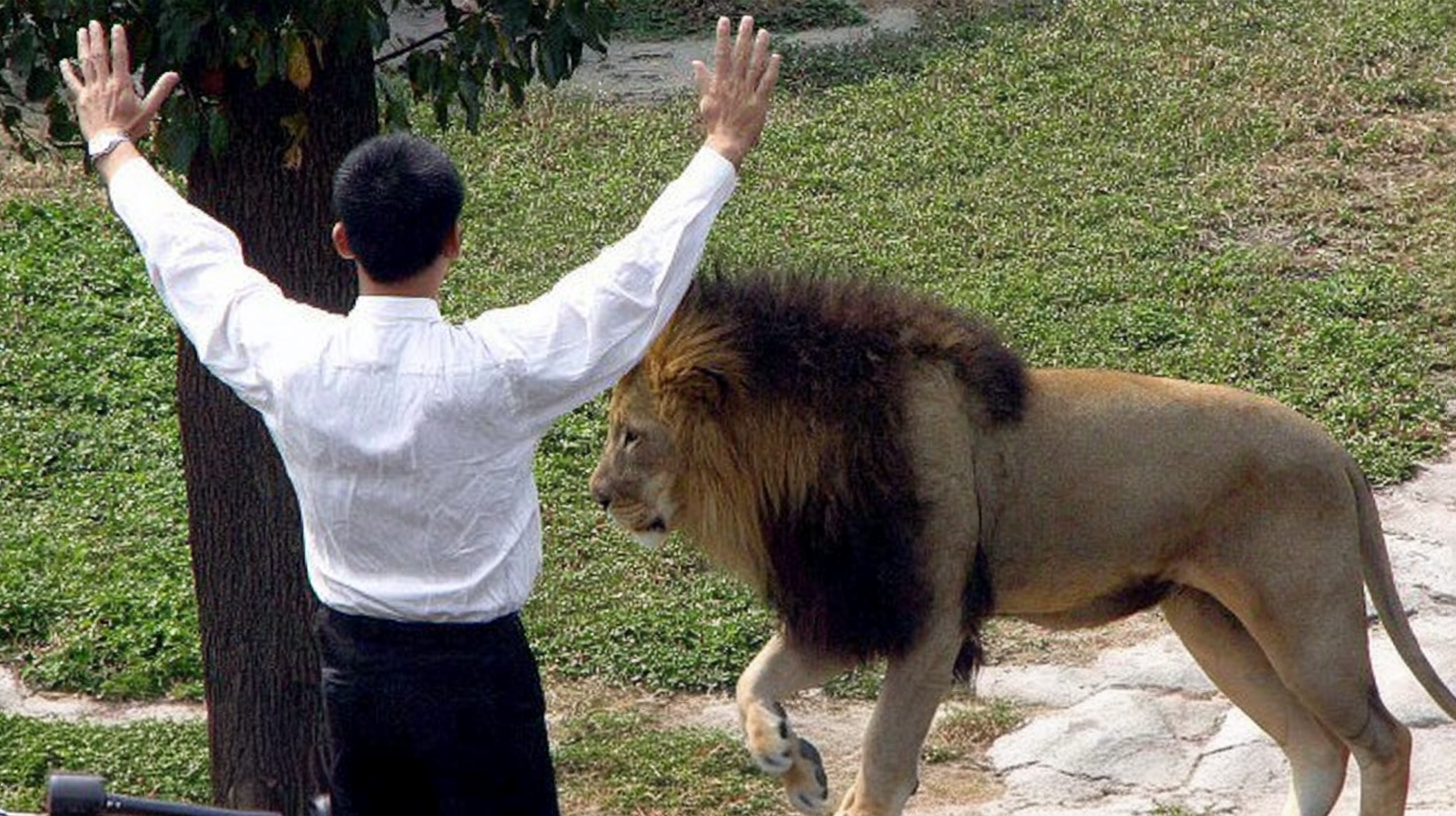
To bystanders, what happened next looked like pure religious fervor. Chen stood in front of the lions and shouted that Jesus would save them. He waved his jacket, called out to the animals, and according to multiple reports even taunted them to bite him.
Chen had been struggling with heavy drinking and amphetamine use for years. In the months leading up to the incident, his family noticed a sharp change. He spoke about seeing ghosts. He heard voices. His thinking became fragmented and grandiose.
Around the same time, he began attending a Christian church, hoping to break his addictions. For a man already teetering on the edge of psychosis, the story of Daniel in the lions’ den was a potent script: a righteous believer thrown among lions, spared by divine protection.
By the morning he walked into the enclosure, Chen was high, withdrawing, or both. Later he would say that he was drinking and using drugs daily and that his thoughts no longer lined up with reality. In that altered state, re-enacting Daniel’s ordeal did not feel suicidal. It felt like a brutal test of faith he was meant to pass.
3. What the lions actually did
From the lions’ point of view, a stranger had just entered their territory, shouting and gesturing.
At first, both cats hesitated. They stood, watched, and approached slowly, ears forward, as if trying to make sense of the unusual intruder. Chen took off his jacket and waved it. He moved closer rather than backing away.
The male lion closed the distance.
In the video that circulated later, the lion lunges, hooks Chen’s jacket in its jaws, and yanks it free. A heartbeat later, it bites his arm. Chen stumbles back onto a rock ledge, arms raised in a posture that could read as surrender, prayer, or both.
Instead of fleeing, he stays put.
The male lion bites again, this time catching his leg. The female hovers nearby. The attack is violent, but oddly restrained. The lions do not drag him down and kill him. They bite, release, and pace. One possible reason, mentioned in local reports: they had been fed earlier in the day.
To spectators, it looks like a miracle. To keepers, it looks like two big cats reacting defensively to a confusing threat, not hunting.
4. The rescue that spared both man and animals
Once Chen dropped into the pit, the zoo’s emergency protocols kicked in fast.
Security guards cleared the crowd back from the viewing edge. Veterinarians grabbed tranquilizer rifles and blowguns. Firefighters arrived with high-pressure hoses. Police officers took up positions with live ammunition in case the lions could not be stopped any other way.
The plan centered on two tools most big cats hate: needles and water.
Keepers fired tranquilizer darts at the male lion. Some shots missed in the chaos. While the sedatives began to take effect, firefighters opened the hoses, sending sheets of water arcing into the enclosure. The streams created a moving barrier between the lions and the man, pushing the cats back without injuring them.
As the drugs finally took hold, the male staggered toward an inner holding area and the female lay down. Only then did staff risk entering the pit. They reached Chen, who was now bleeding and clutching his leg, and carried him out on a stretcher.
He was rushed to a nearby hospital with deep bite wounds to his arm and thigh but no life-threatening injuries. The lions were monitored in the zoo’s animal hospital until the tranquilizers wore off. No bullets were fired.
5. What happened to Chen after the attack
The dramatic images from the zoo traveled quickly through news wires. The harder, quieter work happened afterward in a hospital ward.
Doctors cleaned and stitched Chen’s wounds. Surgeons closed the gash in his leg. Once his physical condition stabilized, psychiatrists stepped in.
Chen arrived at the hospital mumbling religious phrases, talking about suffering and paying tribute to the lions. He described hearing voices. His family reported weeks of strange behavior leading up to the incident.
Psychiatrists diagnosed an acute manic or psychotic episode, likely fueled by years of alcohol dependence and amphetamine use. Instead of jail, Chen was transferred to a psychiatric facility and then to a rehab program.
There, away from the cameras, he slowly sobered up. In later interviews with Christian media, he described his life before the attack as a blur of gambling and drugs, and the lions’ den as a turning point he barely understood at the time. He said he eventually got clean and stayed that way.
That version of Chen, years out from the pit, is not the wild-eyed figure in the viral footage. He is a middle-aged man reflecting on how close he came to dying in front of two confused lions and a packed viewing platform.
6. Other people who stepped toward predators
In the early 1990s in Nigeria, a self-proclaimed prophet named Daniel Abodunrin entered the lions’ cage at a zoo in Ibadan, reportedly trying to demonstrate that he, like the biblical Daniel, would be protected. The lions killed him in front of witnesses.
In 2016 in Santiago, Chile, a young man climbed into a lion exhibit, stripped off his clothes, and shouted apocalyptic phrases. Zoo staff, faced with a mauling in progress and no time for tranquilizers, shot and killed two lions to save him. He survived with severe injuries.
In New York in 2012, a man jumped into a tiger enclosure at the Bronx Zoo, later telling investigators he wanted to be “one” with the animal. He was mauled but lived.
These stories share a few traits. They involve people in obvious distress, often mixing spiritual language with suicidal or grandiose thinking. They require determined effort to bypass barriers. And they leave captive animals paying the price for human behavior, whether through stress, bullets, or being framed as villains.
7. What psychologists see in cases like this
Substance dependence changes brain chemistry and decision-making. Psychosis makes hallucinations and delusions take on the texture of reality. And in many cultures, scripture and spiritual stories are the most available language for grand ideas.
When people in a psychotic state reach for meaning, they often grab the most powerful stories around them. For some, that might be espionage or government conspiracies. For others, it’s angels, demons, and miracle tales.
The Daniel story is ready-made for this kind of appropriation. It centers on a believer thrown among lions, spared by divine intervention. In a healthy context, it’s a metaphor about faith under pressure. In untreated mental illness, it can morph into an actionable script: go find lions, prove your faith, and you will be safe.
Chen’s brain, scrambled by drugs and illness, convinced him he was living inside a miracle story and that normal rules—like “lions will maul you”—no longer applied.
8. Faith, scripture, and the danger of literal tests
Religious leaders who reflected on the Taipei incident were quick to draw a line between spirituality and spectacle.
The Daniel story is not an instruction manual. Daniel doesn’t seek out the lions. He’s thrown into the den by an imperial decree. The miracle isn’t in the setup; it’s in the survival.
Most religious traditions also include strong warnings about testing God on purpose. In Christian scripture, the idea of deliberately manufacturing danger to force divine action is explicitly rejected.
What happens in cases like Chen’s is less theology than appropriation. A mind in crisis pulls a dramatic scene from a sacred text and turns it into a personal dare. The lions become props in a one-man play that nobody else auditioned for.
A man whose life was unraveling under addiction and psychosis walked into a place designed to be impossible to enter. Two captive lions responded in a way that was violent but not total. A group of keepers, firefighters, and police managed to improvise a rescue that saved everyone involved.
The lions went back to pacing their enclosure. The visitors eventually went home. Chen, stitched and sedated, started a long, slow climb back to himself.
The morning started the way autumn mornings do in northern Maine. Cold air. Quiet spruce. First light spreading over a landscape shaped by hard winters and moose trails older than memory. For one family, it was also the start of something they’d done for decades: a permitted bull moose hunt.
Autumn Clark grew up this way. Hunting wasn’t a hobby—it was how her family filled the freezer for winter. When they set out on this particular hunt, she strapped her 11-month-old daughter into a back carrier, the same way her own parents had carried her through these woods years ago. When they brought down a bull moose, Clark posed for a photo with her daughter beside the animal. To her, it was ordinary. To the internet, it was something else entirely.
When tradition meets the timeline
Maine’s moose lottery pulls thousands of applicants every year. Win a permit, and you’ve got a shot at hundreds of pounds of meat—enough to feed a family through the lean months. For people here, the hunt marks the turn of the season as clearly as falling leaves.
Clark’s photo didn’t stay in Maine. It hit feeds across the country, and suddenly people who’d never set foot in a deer stand had opinions. Some saw a mother teaching her daughter where food comes from. Others saw something they couldn’t square with their idea of childhood.
Clark said later that she kept distance from the rifle when it fired. She carried her daughter on the approach but stayed clear when the shot happened. This is how hunting works for most families who do it—structured, careful, built on safety habits passed down like recipes. What looks dangerous from a distance often isn’t, up close.
Moose hunting in Maine runs through a tangle of regulations. Biologists count herds, set quotas by region, adjust permits year to year. The whole system connects to larger questions about conservation and managing wildlife in a changing climate—the same circle of life dynamics that play out wherever predators and prey share space.
The comments piled up. In hunting country, people shrugged. Of course you bring your kids—how else do they learn? But scroll down far enough and you’d find parents horrified that a baby was anywhere near a dead animal, let alone posing next to one.
A person raised field-dressing deer sees self-reliance in that photo. A person raised on grocery stores sees something jarring. The difference isn’t new—but social media made it impossible to ignore.
This keeps happening. Americans relate to the land in wildly different ways, and debates about how we get our food keep drawing the same lines.
Clark’s photo sits right on that crack—a life ordinary for some, foreign for others, suddenly on screens thousands of miles away.
A week later, the comments slowed down. The internet moved on. Clark’s family still had a freezer full of meat and a photo they liked. Everyone else had an opinion they’d forget by spring.
If you grew up in the 70s or 80s, you probably remember the chalky white dog poop that dotted sidewalks and lawns. It wasn’t a trick of memory. It was diet, sunlight, and the way pet food was made at the time.
The calcium connection
Decades ago, many commercial dog foods leaned on meat and bone meal. Those ingredients carried a lot of calcium. Dogs only absorbed part of that mineral load; the rest moved through, and when the stool sat out, the organic material broke down while the mineral content lingered. The result was a crumbly, pale relic that turned bright white as it dried.
Sun and time did the rest. As moisture evaporated and pigments degraded, the leftover mineral fraction made the surface look chalky and brittle. That’s why a pile might start brown and end up white after a few dry days.
Pet food changed. By the 1990s, formulas pivoted toward more balanced mineral profiles and less bone meal, which meant less excess calcium passing through a dog’s system. The familiar white piles faded from everyday view.
You can still spot white poop now and then, usually for two reasons. One is simple drying in the sun. The other is diet, especially when dogs eat bone‑heavy raw meals, calcium supplements, or too many bones after a big chew session. For families comparing gentle dog breeds, today’s balanced kibbles and fresh foods are designed to avoid those extremes, though individual choices and treats can tip the scale.
Fresh stool that’s pale or gray from the start is a different story. That can signal a lack of bile pigment or an issue with the liver, gallbladder, or pancreas. If you see persistent color changes, or if your dog seems unwell, call your veterinarian.
The white‑poop era is a small reminder that products on store shelves shape what we notice in our neighborhoods. From the ancient Xoloitzcuintli to today’s beloved retrievers, our dogs have always reflected our choices in what we feed them and how we care for them. And because we’re very good at talking to our pets like people, mysteries like this tend to stick in our collective memory.
If the sight brings you back, you’re not alone. For many, it’s a snapshot of summer sidewalks, backyard sprinklers, and dogs dozing under porch steps. Everyday history leaves traces in unexpected places, then vanishes when habits and formulas change.
Serafín Marín’s recent injury at Madrid’s Las Ventas bullring has sparked yet another round of debate over Spain’s most controversial tradition. The 42-year-old veteran matador was gored through the thigh by a bull named Estudiante, lifted into the air, and carried off with a deep wound after coming back to the ring following a six-year break.
This article dives into ten of the most shocking matador gores recorded in Spain. These moments lay bare both the raw physical risk and the emotional weight of the spectacle.
From fatal encounters to near-misses that changed careers, each story shows the razor-thin line between mastery and tragedy in the bullring.
10) Serafín Marín’s first fight of the year ended with severe leg injury
During his first bullfight of the season at Madrid’s Las Ventas arena, veteran matador Serafín Marín suffered a serious injury. He was performing a traditional veronica maneuver when the bull struck his leg, lifting him into the air before assistants rushed in.
Doctors found a deep wound, about 30 centimeters long. The bull’s horn pierced straight through his thigh, causing heavy bleeding and muscle damage.
Staff rushed him to the arena’s infirmary and later moved him to a hospital for surgery. Marín’s injury happened during the third pass of the bull, Estafador, and the event paused while medics worked to stabilize him.
Fellow bullfighters and the crowd watched anxiously as the severity of the wound became clear. Marín, known for his disciplined style, had just returned to the ring after a long break, making this a tough blow to his career.
9) Alejandro Conquero tossed like a ragdoll after rectal gore
In Cenicientos, near Madrid, Spanish matador Alejandro Conquero suffered a brutal injury when a bull’s horn pierced his rectum. This happened during the Prieto de la Cal festival, which is famous for its close calls between fighters and bulls.
Spectators saw the bull lift Conquero into the air before slamming him to the ground. The crowd gasped as medics rushed in to provide emergency treatment.
He was later taken to the hospital in serious condition. Conquero, son of a well-known bullfighter called “The Hurricane of Huelva,” had been building his own career in the ring.
His injury reminded everyone how dangerous bullfighting remains, even with modern safety measures. He survived but needed extensive care, and the event reignited fierce debate in Spain about the physical toll and ethics of bullfighting.
8) Shocking triple goring during a violent Madrid bullfight
At Madrid’s Las Ventas arena, three matadors suffered serious injuries during a single evening. The chaos forced organizers to halt the fight before all six bulls had even entered the ring.
Witnesses said the accidents happened in rapid succession. Each matador faced a bull that broke through the usual defenses, and the animals’ sheer force left little room for escape.
Serafín Marín was among those hurt, taking a deep wound to his leg. David Mora and Jiménez Fortes also got gored—one through the side, the other in the neck.
Medics rushed in to help, and the triple goring left the crowd stunned. Las Ventas, Spain’s most prestigious bullring, almost never sees all the matadors injured in a single event. The spectacle ended abruptly, with three bulls left unused and the audience in shock.
7) Veteran matador thrown into the air after leg gore in Madrid
At Las Ventas in Madrid, veteran matador Serafín Marín got gored in the thigh by a bull’s horn. The arena was packed with thousands of spectators for one of Spain’s biggest bullfighting events.
People watched in disbelief as the bull launched Marín into the air, then tossed him to the ground. Assistants quickly drew the animal away, but the wound was deep—about 30 centimeters.
Marín, 42, was rushed to the hospital for emergency care. The injury was one of the worst of his career and put a spotlight on the risks even the most seasoned matadors face.
The event stirred up more talk about safety and the unpredictable nature of bullfighting. Despite the trauma, Marín stayed conscious as they carried him from the ring.
6) Andrés Roca Rey impaled in the leg and buttocks in Madrid debut
During his Madrid debut, Peruvian matador Andrés Roca Rey suffered a vicious goring to his leg and buttocks. The bull caught him from behind, lifted him up, and tossed him down as the arena fell silent.
Spectators and medics raced to his side. Roca Rey, then 27, already had a reputation for boldness and risk-taking in the ring.
The injury only added to his status as one of the most frequently injured matadors of his generation. Reports said the bull’s horn caused deep wounds that needed immediate surgery.
This accident reignited fierce debate about bullfighting’s safety and ethics in Spain. Roca Rey had survived other serious injuries before, and despite the trauma, he recovered and returned to the ring. The danger and persistence in this profession? It’s honestly hard to overstate.
5) Victor Barrio’s deadly gore on live Spanish television
On July 9, 2016, Spanish matador Víctor Barrio died after a bull fatally gored him at the Feria del Ángel festival in Teruel, Aragon. The tragedy played out live on national television, making it one of the most public deaths in modern bullfighting.
Barrio, 29, faced a bull named Lorenzo when the horn pierced his chest. The wound was catastrophic, and he died shortly after, despite the medical team’s efforts.
His wife, family, and stunned spectators watched from the stands. Barrio had won Spain’s “Best Newcomer” award in 2011 and was seen as a rising star in the bullfighting world.
His death marked the first time in over thirty years that a professional matador died in a Spanish ring. The incident once again ignited national debate over bullfighting’s safety and ethics, with supporters and critics clashing over its future.
4) Ivan Fandiño’s fatal gore after tripping over his cape in France
In June 2017, Spanish matador Iván Fandiño died after a fatal accident at the Aire-sur-l’Adour festival in southwest France. The 36-year-old Basque veteran lost his footing in the ring.
He tripped over his own cape and fell right in front of the charging bull. The animal’s horn struck his torso, causing severe internal injuries that proved fatal, even with immediate medical help.
They rushed him to a nearby hospital, but doctors couldn’t save him. Fandiño’s death shocked the bullfighting world, which saw him as a skilled and daring professional with more than a decade in the ring.
His death stands as a stark reminder of how quickly things can turn deadly in the arena, even for the most experienced matadors.
3) Three matadors severely injured in Las Ventas bullring incident
During the San Isidro festival at Madrid’s Las Ventas arena, three matadors were gored by half-tonne fighting bulls. The injuries happened in rapid succession, leaving all three unable to continue.
Medics stormed the ring, and organizers canceled the rest of the event. That kind of cancellation hadn’t happened at Las Ventas in decades.
The injured matadors—David Mora, Antonio Nazaré, and Saúl Jiménez Fortes—all required hospital treatment. Mora suffered a deep leg wound, Fortes took multiple punctures to his thigh and pelvis, and Nazaré was also badly hurt.
Spectators described the atmosphere as tense and eerily silent as emergency crews worked to stabilize the fighters. Spanish media noted the rarity of all scheduled matadors being incapacitated in one night, making this a historic moment in modern bullfighting.
2) Alejandro Conquero gored in the rectum during Madrid fight
Spanish matador Alejandro Conquero suffered serious injuries during a bullfight in Cenicientos, a small town in Madrid’s outskirts.
The annual Prieto de la Cal festival draws crowds for its reputation—these bulls aren’t just strong, they’re unpredictable.
One of them charged unexpectedly and caught Conquero from behind.
The bull’s horn pierced his rectal area, causing brutal internal injuries.
People in the stands and medical staff rushed over, and the fight stopped right there.
At just 28, Conquero was whisked off to a nearby hospital where surgeons worked to stabilize him.
Doctors described him as serious but stable after the operation, but recovery would be slow.
He’s from a well-known bullfighting family, sometimes called “The Hurricane of Huelva.”
Even seasoned matadors face these dangers—no amount of training can erase that risk.
1) Serafín Marín’s 30cm leg gore at Las Ventas, Madrid
In September 2025, veteran matador Serafín Marín faced a nightmare in Madrid’s Las Ventas ring.
A bull’s horn drove deep into his leg during the third pass, right in front of thousands of spectators.
The wound stretched about 30 centimeters, according to the arena’s surgical team.
Other bullfighters and assistants moved fast, distracting the animal and carrying Marín to the infirmary.
Marín, a 42-year-old Catalan with decades in the ring, had just returned for his first fight of the year.
The Monteviejo bull lifted him clear off the ground before the goring.
He was soon transferred to a Madrid hospital for more surgery and a long recovery.
Within Spain’s bullfighting world, the incident reignited talk of just how dangerous this profession really is.
Understanding Bullfighting Injuries
Bullfighting injuries usually mean deep puncture wounds, broken bones, or internal trauma from horns and sheer force.
How bad it gets depends on the bull’s angle, the matador’s position, and just plain luck.
Common Types of Goring Incidents
Most gores hit the thighs, groin, abdomen, or chest.
Horns can slice through muscle and even reach vital organs.
Wounds are usually ragged, tearing deep into tissue and dragging in dirt and bits of fabric—perfect for infection.
Leg injuries happen often since matadors face the bull head-on, leaving their lower half exposed.
Some, like Serafín Marín, have endured leg wounds over 25 or even 30 centimeters deep.
Thoracic and neck gores, while less frequent, can wreck lungs, arteries, or the trachea in seconds.
Facial and neck wounds—think Daniel García Navarrete’s ordeal—bring the risk of airway blockage and massive bleeding.
Injury Location
Typical Consequence
Risk Level
Leg/Thigh
Deep muscle tears, vascular damage
High
Abdomen
Organ perforation, internal bleeding
Critical
Neck/Face
Airway injury, major vessel damage
Life-threatening
Medical Response and Emergency Care
Immediate on-site medical care is everything.
Spanish bullrings keep surgical teams and mobile operating rooms ready to handle trauma within minutes.
The first job: stop the bleeding, keep the patient from going into shock, and get them stable for transfer.
Doctors often have to quickly clean out contaminated tissue to lower infection risk.
If major blood vessels are hit, they clamp or repair them, and sometimes pack wounds to control bleeding until full surgery is possible.
After surgery, patients get broad-spectrum antibiotics, wound cleaning, and close monitoring for complications like compartment syndrome or nerve damage.
Recovery times are all over the place—minor gores might heal in a few weeks, while bad or multiple injuries can drag on for months and need reconstructive work.
Impact on Spanish Culture and Public Perception
Matador injuries and deaths have a way of shaking Spain’s relationship with bullfighting.
They push the country to wrestle with tradition, ethics, and the very real risks for everyone involved.
Media Coverage of Matador Gores
Spanish and international media don’t hold back when a matador gets hurt.
National TV and online news blast out footage from big arenas like Las Ventas, often with dramatic headlines and emotional commentary.
The focus usually lands on the spectacle and the danger, sometimes pushing the cultural roots of the sport into the background.
Viral clips and social media make sure the world sees what happens in those rings, whether they want to or not.
Here’s what you’ll notice in the coverage:
Sensational headlines zero in on injuries or deaths.
Clips spread instantly on YouTube, X, and everywhere else.
Every high-profile goring sparks another round of public debate.
This constant spotlight keeps bullfighting in the news but also deepens the split between supporters and critics.
Some say the coverage is just hype, while others argue it exposes the sport’s real costs—physical and moral.
Changing Attitudes Toward Bullfighting
Public opinion in Spain has changed a lot in the past few decades. Most Spaniards now, especially the younger crowd, either oppose bullfighting outright or want to see tougher restrictions on it.
Animal rights groups and city dwellers usually lead the push for reform or even a total ban. But out in the countryside, and among traditionalists, people still defend bullfighting as an art form and a deep part of Spanish identity.
Regional bans, like Catalonia’s 2010 prohibition, really highlight this cultural split. Fewer people are going to bullfights these days, and sponsors have started to pull back as more folks think about the ethical side.
People see more violent moments in the ring now, thanks to media coverage.
Concern for animal welfare keeps growing.
Ideas about national culture and what counts as modern entertainment keep shifting.
Jane Goodall, who died on October 1, 2025 at the age of 91, changed how humanity understands animals, and in doing so, how we understand ourselves.
Her life’s work revealed that chimpanzees are not simply creatures of instinct, but beings with emotions, intelligence, and social bonds that echo our own. From her earliest days in the forests of Tanzania to her final years as a global advocate, Goodall lived with an unmatched sense of purpose.
In 1960, a 26‑year‑old Goodall arrived at Gombe Stream, Tanzania, with a notebook, a pair of binoculars, and an endless curiosity. Within months, she made discoveries that shocked the scientific world: chimpanzees using tools, chimpanzees hunting and eating meat, chimpanzees showing joy, grief, and even warlike aggression.
These observations collapsed the old idea that humans were set apart from the rest of the animal kingdom. Louis Leakey, her mentor, famously said, “Now we must redefine tool, redefine man, or accept chimpanzees as human.”
Her groundbreaking science soon gave way to a wider calling. Goodall founded the Jane Goodall Institute in 1977 to protect chimpanzees and their forests. She launched Roots & Shoots in 1991, a youth program that grew from a dozen Tanzanian students to tens of thousands of young people in more than 70 countries.
Through these efforts, she championed not just wildlife, but also people and the planet. For her, conservation was always about connection — the health of the forest was tied to the well‑being of the communities who lived around it.
Over the decades, she became a traveling teacher for the world. With her soft voice and signature pant‑hoot greeting, she filled classrooms, conference halls, and United Nations assemblies with stories of chimpanzees and urgent calls to action.
Jane Goodall, the renowned conservationist who shaped the world's knowledge of chimpanzees, has died at 91.
The famed naturalist dedicated her life to protecting wildlife and the environment, and she reached out to as many people as possible to advocate for a more sustainable… pic.twitter.com/YNfn1IP23f
She spoke against laboratory testing on great apes, rallied for habitat protection, and reminded audiences that the fight against climate change could not wait. At every turn she carried the same message: “What you do makes a difference, and you have to decide what kind of difference you want to make.”
Her achievements brought her some of the highest honors imaginable, from damehood by Queen Elizabeth II to the Presidential Medal of Freedom in the United States. Yet she wore these accolades lightly, always redirecting attention back to the work at hand. She wanted people to look not at her, but at the chimpanzees of Gombe, the forests under threat, and the next generation who would inherit the earth.
Her enduring legacy
Goodall’s passing has been met with tributes from scientists, world leaders, and everyday admirers who saw in her a model of perseverance and hope. The Jane Goodall Institute continues its programs across Africa, protecting wild chimpanzees and restoring habitats. Roots & Shoots now counts hundreds of thousands of participants, carrying forward her belief that young people are the engine of change. Her books, from In the Shadow of Man to The Book of Hope, still remind readers that optimism is not naïve, but necessary.
Perhaps the truest measure of her legacy is the shift in how people think about animals. Thanks to Goodall, it is now common to speak of chimpanzees as individuals, to recognize the emotions of elephants, or to argue for the rights of dolphins and whales. Her quiet revolution was not only about science, but about empathy.
In remembering Jane Goodall, we remember the little girl who once hid in a henhouse for hours just to see how a chicken lays an egg. That same patience and curiosity carried her across continents and decades, into the forests of Tanzania and the halls of power. She leaves behind not just research papers or awards, but a living movement that continues to remind us: we are not separate from nature, we are part of it.
As the 2025 government shutdown stretches into its first week, America’s national parks sit in uneasy limbo.
The Department of the Interior announced that most parks would remain open, but with only a fraction of the usual staff. Roughly 9,300 of the National Park Service’s 14,500 employees have been furloughed, leaving just a third of the workforce on duty.
A stunning sunset at Arches National Park, showcasing the iconic Delicate Arch amidst vibrant skies.
Roads and trails are technically accessible, but visitor centers, campgrounds, and many facilities are locked. For travelers, that means open landscapes but little else: no rangers to guide hikes, no updates on trail conditions, and no one to clean restrooms or haul trash when budgets run dry.
The administration has leaned on recreation fees to keep the basics afloat.
At parks that collect entrance fees, those funds are being diverted to cover sanitation, trash removal, law enforcement patrols, and emergency response.
In Yellowstone, concession-operated lodges and restaurants remain open, even as NPS visitor centers stay dark. At Shenandoah, Skyline Drive and campgrounds are open, but visitors must pack out their own waste and expect limited safety patrols.
Grand Canyon, long a flashpoint in past shutdowns, faces uncertainty this time as Arizona declined to step in with emergency funds as it did in 2013 and 2018.
Critics argue the plan is risky and possibly unlawful.
Majestic towering sequoia trees, symbolizing the natural grandeur of America’s national parks during ongoing government shutdown challenges.
The National Parks Conservation Association warned, “If the federal government shuts down, unfortunately our parks should too. We know what happened last time park staff were forced to leave parks open and unprotected, and the impacts were disastrous.”
Former superintendents have also cautioned that fragile resources and visitor safety can’t be protected by a skeleton crew. They recall that during the 2018–2019 shutdown, vandalism and sanitation crises forced some parks to close mid-crisis.
This moment recalls earlier shutdowns: in 2013, parks were closed entirely, while in 2018–2019, leaving gates open without rangers led to damage and chaos. The current approach splits the difference, but observers warn it risks the worst of both worlds.
A serene reflection of a mountain at Glacier National Park in calm waters, showcasing the natural beauty of America’s national parks.
Communities and visitors under strain
Gateway communities around Yellowstone, Shenandoah, and the Grand Canyon are bracing for economic fallout.
In 2013, parks lost an estimated $500 million in visitor spending during a 16-day closure. With autumn foliage season in Virginia and wildlife watching in Wyoming now underway, small towns fear a repeat loss of tourism dollars.
As one Arizona business leader noted, Grand Canyon tourism alone brings in over $1 billion annually and supports thousands of jobs.
Even a partially open park, stripped of services, means fewer visitors and shorter stays. A Shenandoah innkeeper put it simply: “Every cancellation hurts. We depend on this season.”
For visitors still arriving, the experience is a mix of beauty and unease.
A bison grazes in the expansive fields of Yellowstone National Park, showcasing the natural beauty and wildlife of the area amidst the ongoing government shutdown.
Some have adapted by bringing their own supplies or joining volunteer groups cleaning up trash. Old Faithful erupts as scheduled, Shenandoah’s hills glow red and gold, and the Grand Canyon still stuns at sunset.
But behind the vistas are shuttered restrooms, absent rangers, and towns on edge. Lack of patrols also raises risks for wildlife, with bears drawn to overflowing trash and fragile landscapes left unguarded against vandalism.
National parks have always balanced preservation with access. This shutdown leaves both goals in jeopardy, compounded by legal questions. A previous Government Accountability Office review found that using recreation fees to cover normal operations during shutdowns was unlawful, adding yet another layer of uncertainty.
Government shutdowns affecting national parks to date
1995–1996: Two shutdowns under President Clinton, totaling 27 days. Parks closed, millions of visits lost.
2013: 16-day shutdown under President Obama. All national parks closed, an estimated $500 million in visitor spending lost.
2018–2019: Record 35-day shutdown under President Trump. Parks left open without staff, leading to vandalism, sanitation crises, and safety risks.
2025: Current shutdown under President Trump. Parks technically open with skeleton crews, fee funds diverted to cover basics, and legal controversy over the practice.
The hairy frogfish is easily one of the ocean’s oddest masters of disguise. With its scruffy filaments, squat body, and knack for vanishing into coral, algae, or even rubble, it’s proof that evolution sometimes gets downright creative.
Let’s look at seven types of hairy frogfish, each with its own wild way of hiding in plain sight. Some mimic seaweed, others shift colors, and a few even wave lures to hunt.
These fish don’t just blend in—they show off the wild variety and adaptability of one of the ocean’s most secretive ambush predators.
7) Algae-Mimic Frogfish – Resembles seaweed to evade predators
The algae-mimic frogfish shapes itself and grows fleshy spinules that look just like seaweed or algae strands. It hunkers down in seagrass beds or coral rubble, vanishing into the green tangle around it.
By copying the look of its home turf, it dodges bigger fish looking for an easy meal. But that’s not all—it uses this disguise to hunt, too.
Small fish and crustaceans cruise by, thinking it’s just a harmless patch of algae. Suddenly, the frogfish snaps its jaws, and that’s that.
Its color shifts from green to brown or yellow, depending on where it lives. That flexibility lets it blend in, whether it’s drifting among shallow reefs or tucked into floating vegetation.
6) Illicium-Equipped Frogfish – Uses a glowing lure to attract prey
The illicium, a kind of fishing rod growing from the frogfish’s head, ends in a fleshy lure called the esca. This lure can look like a tiny shrimp, worm, or other tasty critter, and the frogfish wiggles it to draw in prey.
Each species tweaks the illicium’s length and shape. The longlure frogfish, for instance, sports an extra-long rod, while the ocellated frogfish keeps it short and stubby. These differences help scientists tell them apart—and probably change how they hunt, too.
Frogfish control their illicium with specialized neurons, an adaptation borrowed from distant relatives that once used these spines for defense. Over time, they turned this into a precision hunting tool.
Some scientists even think the lure might attract mates, but honestly, nobody’s totally sure. Either way, that little “fishing pole” is one of the most distinctive features in the whole frogfish family.
5) Color-Changing Hairy Frogfish – Adapts its color to match surroundings
The hairy frogfish pulls off color changes to match wherever it lands. Whether it’s yellow, red, brown, black, or even white, it blends in with its backdrop—making it tough for both predators and prey to spot.
Some frogfish swap colors in seconds, while others take their time, shifting hues over days or even weeks. Water conditions, habitat, and the fish’s mood all play a part.
Its skin bristles with tiny, hair-like spinules, adding texture so it can mimic seaweed, sponges, or coral. Combined with its color magic, it practically vanishes.
Staying hidden isn’t just about not getting eaten—it’s also the perfect setup for an ambush. The frogfish waits until something tasty wanders close, then strikes.
4) Spiny Hairy Frogfish – Covered in spine-like hairs for reef blending
The spiny hairy frogfish sports a coat of fine, spine-like hairs called dermal spinules. These break up its outline, helping it look like algae or coral and making it nearly invisible in the reef.
It prefers coral reefs and rocky hideouts in warm seas. By tucking into these spots, it becomes just another lump of seaweed or sponge.
Like its relatives, it waves a lure on its head. When a small fish or shrimp comes to investigate, the frogfish’s mouth opens wide, and—gone.
This species can hit about 20–25 centimeters long. Its odd looks aren’t just for show; every spine and color shift is about survival and catching dinner.
3) Warty Hairy Frogfish – Features bumpy skin that mimics coral textures
The warty hairy frogfish—scientists call it Antennarius maculatus—looks like it’s covered in little bumps and lumps. These warts help it blend right into coral or rocky backgrounds.
It hangs out in Indo-Pacific reefs, where its round, chunky body and odd fins let it “walk” along the bottom instead of swimming.
This frogfish uses its illicium, tipped with a lure, to trick curious fish into coming close. Once they’re in range, it snaps them up.
Its color and texture mimic coral, sponges, or algae, letting it hide in plain sight. The bumps aren’t just decoration—they’re camouflage in action.
Warty hairy frogfish usually grow to about 15 centimeters. They’re slow, patient hunters, relying on stealth and surprise.
2) Blue Hairy Frogfish – Known for its striking blue coloration and camouflage
The blue hairy frogfish, a version of Antennarius striatus, stands out for its rare blue shades—though it can also be yellow, brown, or green. Hair-like filaments cover its skin, letting it vanish into coral, sponges, or seaweed.
It sits motionless on the seafloor, looking like just another bit of the reef. Both predators and prey usually pass right by.
With a lure on its head, it wiggles to attract small fish. When one comes close enough, the frogfish snaps it up with a lightning-fast bite.
The blue color isn’t common, but it shows how adaptable this species can be. That flexibility helps it survive in all sorts of Indo-Pacific and Atlantic habitats.
It stays compact, up to about 22 centimeters, making it easy to tuck away. The mix of colors and textures keeps it a master of disguise beneath the waves.
1) Antennarius striatus – The classic hairy frogfish with algae-like appendages
Antennarius striatus, better known as the hairy or striated frogfish, is probably the most recognizable of the bunch. It lives in tropical and subtropical waters—think Indo-Pacific and eastern Atlantic—and loves coral reefs, rocky bottoms, or spots thick with sponges and algae.
It can grow up to 25 centimeters long. Its skin bristles with tiny, hair-like spinules, giving it a shaggy, seaweed look that helps it disappear into textured backgrounds.
This frogfish shifts its color to match its surroundings. That trick keeps it hidden from predators and lets it sneak up on prey. It’s a pro ambush hunter.
Like its relatives, it sports a modified dorsal spine—the illicium—topped with a worm-like lure. It wiggles this lure to tempt prey close, then swallows them with a sudden gulp.