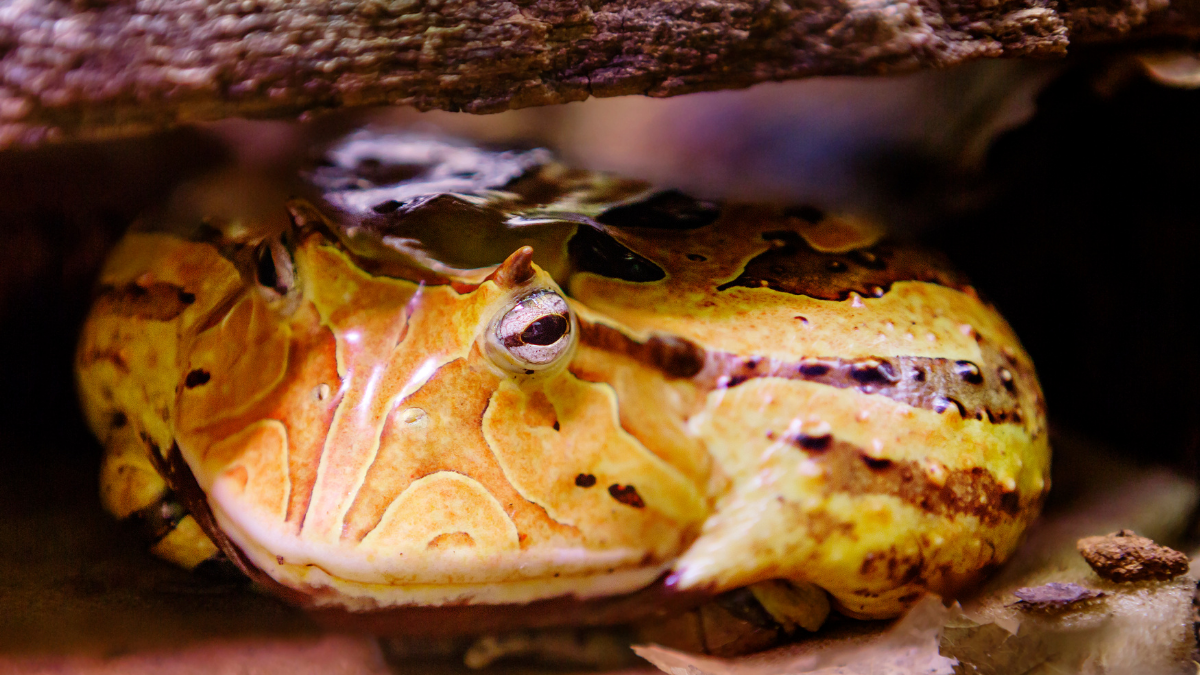
Deep in the Amazon’s leaf-littered floor sits a Surinam horned frog (Ceratophrys cornuta), motionless and nearly invisible. Only two raised “horns” above its eyes and a pair of staring pupils betray its presence.
In an instant, this rotund frog explodes into action, jaws gaping impossibly wide to engulf a passing lizard. These frogs are ambush predators, burying themselves so only the head protrudes as they lie in wait.

Their mottled greens, browns, and tans perfectly mimic dead leaves. Even the fleshy horns likely resemble leaf stems, enhancing the disguise. Often, an unwary animal’s only warning is the sudden snap of a wide mouth.
And what a mouth it is. The Amazonian horned frog’s gaping maw and powerful bite have earned it the nickname “Pac-Man frog,” after the video game character known for devouring everything in its path.
The vise-like bite: Jaws built for power
Most frogs have weak jaws and rely on sticky tongues to catch small prey. Horned frogs are the exception.
Biologists have dubbed them “hopping heads” for good reason. Nearly half their body is an oversized head armed with a massive mouth. Inside are rows of sharp, peg-like teeth and two bony odontoid “fangs” on the lower jaw that help impale and secure struggling prey.
These structural weapons, combined with enormous jaw muscles and a short, stout skull, give horned frogs a bite far stronger than their size suggests.

In 2017, researchers found that even a juvenile just 1.8 inches wide could deliver a bite of 30 Newtons—about 3 kilograms of force. A large adult could chomp with nearly 500 Newtons.
That’s on par with similarly sized mammalian predators. Some extinct relatives, like Beelzebufo, may have reached bite forces over 2,000 Newtons, comparable to a tiger.
The skulls of horned frogs are specially adapted for this purpose, with a wide, fortified structure and powerful leverage from massive adductor muscles.
These adaptations allow horned frogs to tackle prey much larger and tougher than most amphibians can handle. From rodents and snakes to other frogs and even small birds, few creatures are off-limits.
They sometimes even choke trying to swallow something too large. It’s a risky, but effective, strategy for a predator that rarely moves.
Horns and hiding: Ambush camouflage
When not lunging at prey, C. cornuta is a master of invisibility. Its body is flat and burly, colored in earth tones that blend seamlessly with the forest floor.
It often buries itself up to the eyes, with only the horned head visible. Scientists believe the curved “horns” above the eyes help break up the frog’s outline, enhancing its resemblance to a fallen leaf.

This camouflage is so effective that adult horned frogs are seldom seen unless they move.
The strategy is simple: wait. Sometimes for hours, sometimes for days. When prey approaches, the frog strikes with blinding speed and swallows it whole.
Their appetite is remarkably indiscriminate. Insects, lizards, snakes, mice, and other frogs are all fair game. They’ve even been known to attempt eating prey their own size.
Even among siblings, young horned frogs can be dangerously aggressive.
Unconventional defenses: Puffing up and underwater screams
If threatened, horned frogs don’t flee. They inflate.
Puffing up makes them appear larger and harder to grab, especially when combined with loud hissing or squeaking. This bluff, along with a readiness to bite, often deters predators.
More surprising is their vocal defense as tadpoles. In a rare discovery, scientists observed horned frog tadpoles emitting distress calls underwater.
These high-pitched, metallic chirps seem to act as a deterrent against cannibalistic siblings. It’s the first recorded case of frog larvae using sound for defense and reveals the species’ aggressive tendencies from a very early stage.

Cannibalism is a hallmark of Ceratophrys behavior. In both wild and captive environments, they will attempt to eat each other if given the chance.
That’s why pet stores recommend keeping horned frogs in isolation. From tadpole to adult, this species is always ready to consume anything smaller and slower.
Ancient lineage: From “Pac-Man frog” to “Devil Frog”
The Amazonian horned frog belongs to a group of South American frogs known for their oversized heads and insatiable appetites. But its roots go much deeper.
In 2008, paleontologists discovered Beelzebufo ampinga in Madagascar—a prehistoric giant frog roughly the size of a bowling ball. With a skull built for biting and armor-like features, it was dubbed the “Devil Frog.”

Beelzebufo may have been a close relative of modern Ceratophrys. If so, it suggests that these ambush predators have been perfecting their strategy since the age of dinosaurs.
Whether they shared a common ancestor or evolved similar traits independently remains a topic of debate. But the resemblance is striking.
From screaming tadpoles to armored skulls and fossil giants, the story of the Amazonian horned frog goes well beyond camouflage and aggression.
It offers a glimpse into evolutionary ingenuity where patience, power, and disguise converge in one grumpy, leaf-shaped predator.


Leave a comment