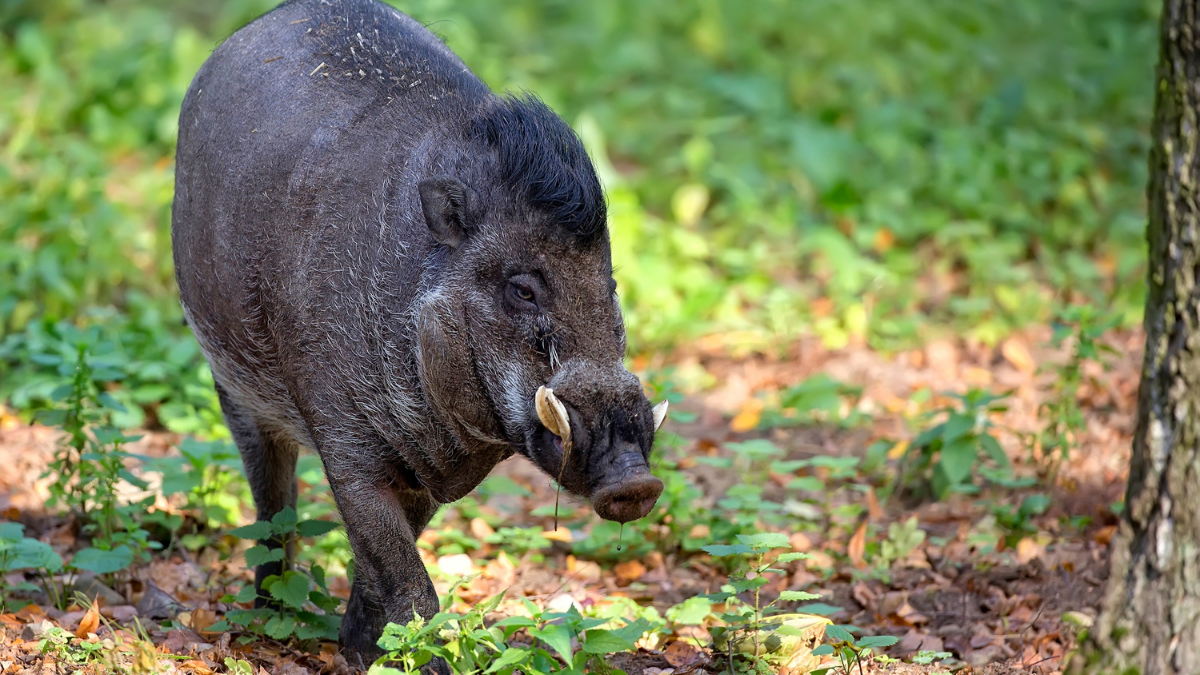
The Visayan warty pig is one of the rarest and most misunderstood animals in the world.
Found only on the Philippine islands of Negros and Panay, this critically endangered wild pig is more than just a curious face with a mohawk. It plays a vital role in forest health, shows signs of surprising intelligence, and could hold the key to restoring an entire island ecosystem.
A member of the genus Sus, the Visayan warty pig (Sus cebifrons) evolved in isolation, adapting to the dense rainforests of the Visayas. Smaller than its Eurasian relatives, it has a bristly dark coat, a distinctive white stripe across the snout, and in males, a punk-rock mane and three pairs of fleshy facial warts.

That mane, which grows long and floppy during mating season, is part display, part defense. Raised upright, it makes males look larger and more intimidating. The warts, meanwhile, protect their faces during fights with rival boars.
More than a wild pig: a forest engineer
Despite their striking looks, these pigs are quiet ecosystem engineers. Their powerful snouts turn over soil as they root for food, helping aerate the forest floor and disperse seeds. They feed on fruits, fungi, tubers, and the occasional worm or grub,recycling nutrients and helping maintain forest diversity.
They also live in small, tight-knit family groups. Sows are known to build ground nests for their piglets, and males sometimes stay with the group, forming bachelor herds when not competing for mates. Piglets are born with striped camouflage and stay with the group for months.
One group even made scientific history. In a French zoo, a Visayan warty pig was observed using a piece of bark as a digging tool, the first documented case of tool use by any pig species. Her piglets watched and learned.

But in the wild, their numbers have crashed. Decades of deforestation, slash-and-burn agriculture, and hunting have reduced them to less than 5% of their historic range. Hybridization with domestic pigs poses a genetic threat, and outbreaks of swine diseases like African Swine Fever loom large.
Conservationists are working to turn things around. Protected areas in Negros and Panay offer safe habitat, while breeding centers in the Philippines and abroad have built up a genetically diverse safety net. Reintroductions into reforested areas have begun, and early results are promising.
For many years, people saw these pigs as pests or prey. But a shift is underway. Education campaigns and local pride efforts are reframing them as a symbol of Visayan biodiversity. Kids are learning to identify them, farmers are reporting sightings instead of retaliating, and rewilded pigs are starting to roam where none had for decades.
And perhaps most importantly, the forest is listening.
Because when a warty pig returns, so do the seeds it scatters. The holes it digs. The balance it restores.
And that makes this muddy, mohawked pig more than just a survivor. It makes it a keystone.

Leave a comment