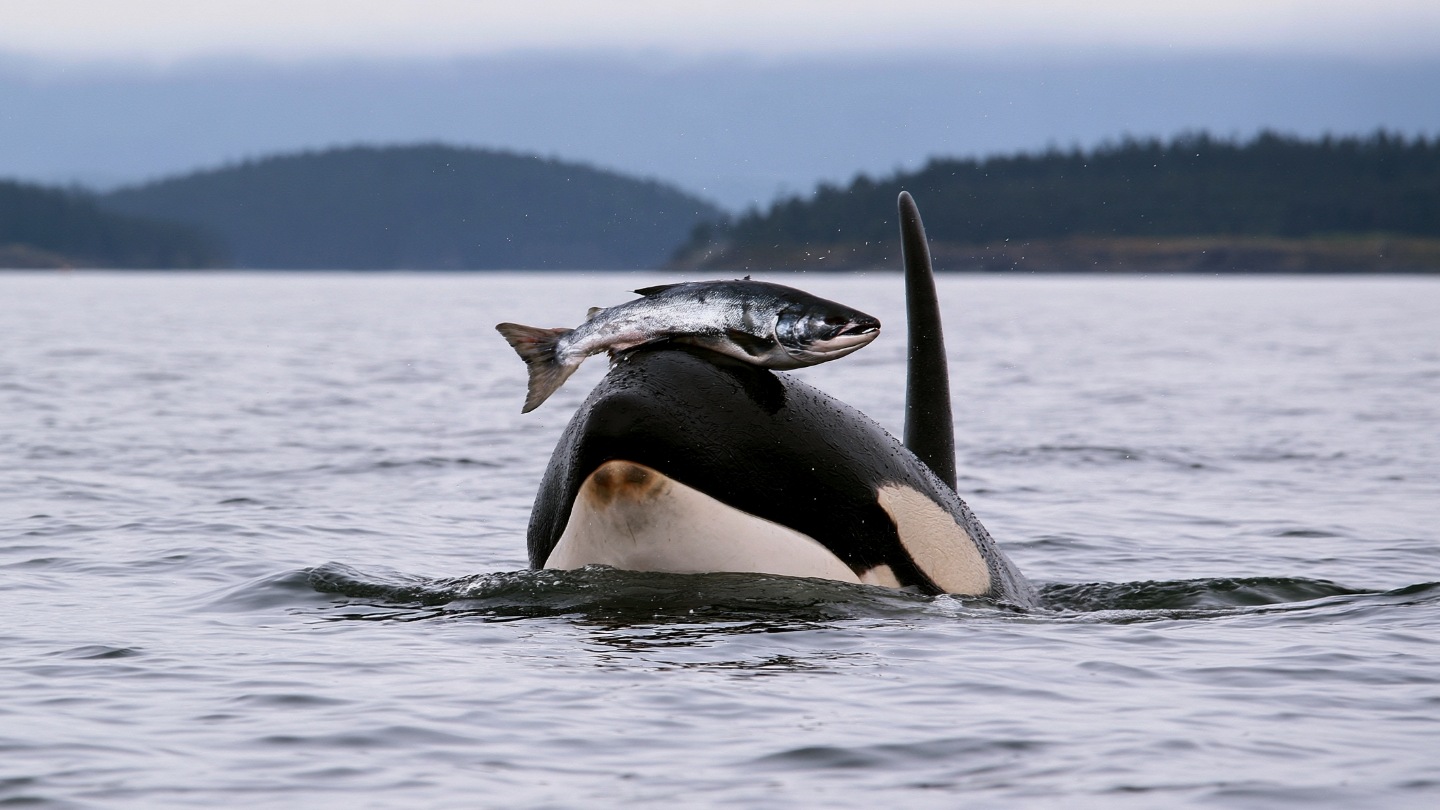
A female orca swam at the surface with a salmon balanced on her snout. She kept it there for seven minutes.
The episode appears in a study published on July 21, 2026, examining how fish-eating killer whales handle and share their catches. Drone imagery allowed researchers to follow the salmon as well as the whales, recording some of the peculiar pauses and exchanges that happen before a meal.
In a separate encounter, the Southern Resident female J31 balanced a living salmon while her daughter, J56, stayed beside her. The fish slipped away. J31 caught it again, repeatedly releasing and retrieving it before eventually eating it.
Another sequence followed A99, a juvenile from the Northern Resident population. He and his mother passed a salmon back and forth, and he balanced the dead fish on his snout before it was eaten.

The best-known historical account begins in 1987, with a female belonging to K pod, one of the three pods in the Southern Resident community. She began carrying a dead salmon, and whales in the other two pods took up the behavior over the next five to six weeks.
That account appears in a 2004 review of animal culture, which attributes it to researcher Richard Osborne’s observations. The carrying faded, although a few examples were recorded again the following summer.
For scientists studying culture, the spread was the intriguing part. Animals can acquire habits from one another, allowing a behavior to travel through a group. Some traditions persist across generations; others briefly become common and then disappear. The researchers included salmon carrying as an example of the latter.
Similar-looking encounters continued to surface. On March 18, 2023, Monterey Bay Whale Watch reported Southern Residents rising with salmon on their heads or snouts. The account, preserved by Orca Network, described the whales feeding during a visit to California.
Then, on October 25, 2024, photographer Jim Pasola captured J27 Blackberry with a salmon on his head from Point No Point, Washington. Orca Network shared the photograph in its newsletter four days later. It helped turn a scattered observational history into a widely discussed story about an apparent return of orca fashion.
The newer scientific paper adds longer sequences to that history. Its Northern Resident imagery dates from 2014 through 2024, and its Southern Resident recordings from 2018 through 2024. Publication brought the observations together; the whales had performed the behavior earlier.
What happens around the catch
The team, led by Sharon Kay, set out to investigate how captured food moves between whales. They examined 41 Northern Resident prey-handling episodes and 52 Southern Resident episodes, finding examples of sharing in both populations.
An aerial camera gives researchers a useful view of those transactions. A whale can release food into the water, and another can move in to collect it. Following the fish helps reveal exchanges that are difficult to track from a boat, where the animals’ bodies and the water’s surface can obscure what happens.
Adult females did much of the recorded food sharing, often passing prey to their offspring. The cameras could follow exchanges near the surface, while deeper interactions and some initial captures remained out of sight.
Food can also draw orcas into less familiar social encounters. Separate research has documented orcas offering prey to people, sometimes waiting nearby after releasing it. Such observations have prompted researchers to examine how food features in interactions beyond feeding alone.
Exactly where salmon balancing fits remains uncertain. Play, temporary carrying and the sensation of contact with a fish are among the possibilities researchers have considered.
Deborah Giles, a longtime Southern Resident researcher, described the whales’ tactile interest in their surroundings during a December 2024 interview with KUOW.
“We do know that they've got very sensitive skin, so it might just feel interesting.”
Giles also suggested that a whale that had already eaten might hold another fish for later, or have food available to share. Her sightings had coincided with successful foraging. She proposed that having enough to eat could give the whales more time to play.
A fish resting on a whale’s head gives little access to those possibilities. A longer recording can reveal what follows: the fish is eaten, passed to another animal or released. To establish a socially spreading habit, researchers would also need to follow its appearance among identifiable whales over time.

Those daily exchanges depend on finding enough salmon in the first place. Southern Residents rely heavily on Chinook, and their prospects remain closely tied to the availability of that prey.
The Center for Whale Research counted 76 Southern Residents in its July 1, 2026 census. Although that was an increase from the previous year, the organization cautioned that the population still wasn’t reproducing at the rate needed for recovery.
For families such as Tahlequah and her new calf, a dependable food supply supports both a mother and the young whale relying on her. Older offspring can continue receiving food, too.
The salmon-hat mystery sits within that everyday work of catching and handling prey. As researchers follow more of those encounters, they can begin to trace who catches a fish, who carries it and who finally gets to eat.



Leave a comment