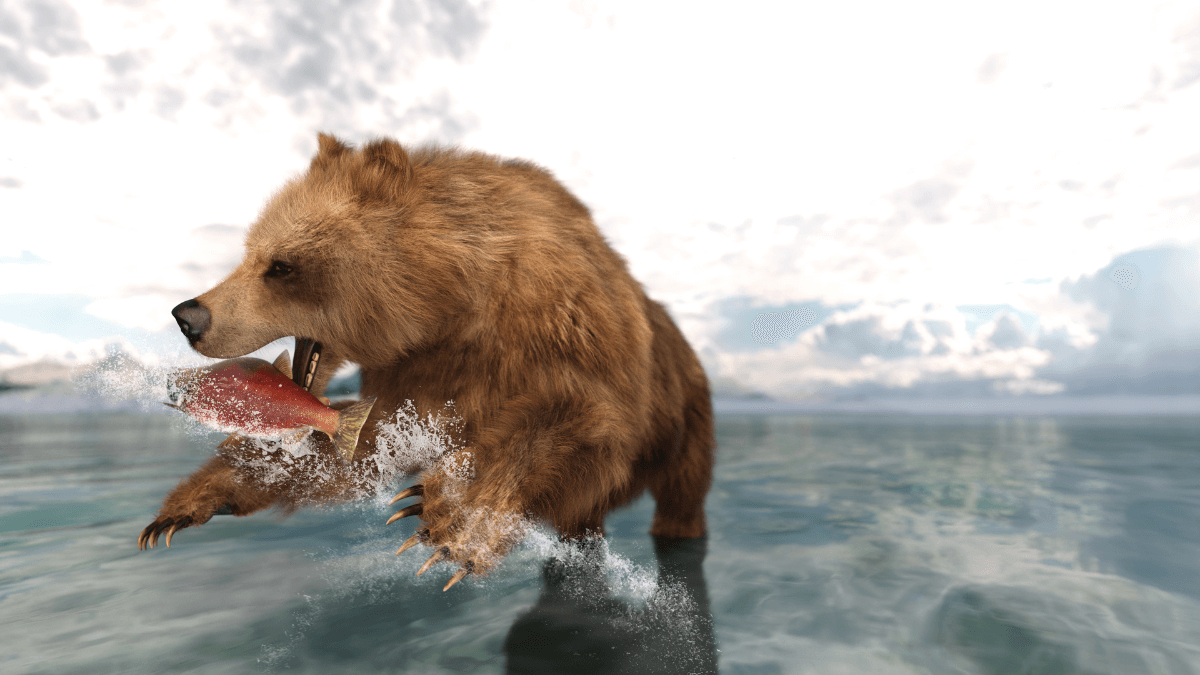
Not every salmon a bear catches at Brooks Falls is heading upstream. Some are falling back down. Bear 164 Bucky has made use of that possibility by fishing beside a deep pool beneath the cascade, where he can intercept fish dropping from above as well as those moving up through the water or leaping into the air.
Bucky is one of the contenders in this year’s expanded Fat Bear Week bracket. Voting runs September 22–29, 2026, with a pause on September 26 and 27. Before choosing a favorite from the photographs, though, it’s worth looking at how the bears caught the meals behind those changing silhouettes.
The setting helps explain the opportunity. Brooks River, in Alaska’s Katmai National Park and Preserve, is both a spawning stream and a passage to waters farther upstream. Its roughly six-foot waterfall interrupts that journey. Sockeye salmon gather below the drop before attempting to clear it, bringing fish within reach of the waiting bears.

At the upper edge, the familiar mouth-open catch depends on position and timing. A bear waits where a jumping salmon might pass close enough to seize. The animal has to balance in moving water while watching for its opening. A missed catch leaves it waiting for another chance, still balanced above the drop.
A little farther down, a bear can catch dinner without making a dramatic lunge. In the turbulent pool nicknamed the Jacuzzi, fish collect before trying to get over the falls. Bears sit in that concentration and fish with their front paws. A seemingly inactive animal may be occupying one of the river’s most useful positions.
Those positions aren’t equally available to everyone. Large, dominant bears can hold productive spots that smaller animals struggle to use. Fishing skill matters, but so does being able to stay where that skill pays off.
Bear 428 Studious shows how the two can separate. She became proficient at catching salmon from the falls’ lip after fishing there with her mother, Grazer. As an independent female, she still has to take openings when space becomes available or find food elsewhere. Knowing the technique doesn’t guarantee access to the place.
Elsewhere, a chasing bear may trap a salmon against the riverbed with its paws. That approach costs energy, so it becomes less useful as fish grow harder to find. Keeping a catch is another problem: smaller bears sometimes carry salmon into the forest to escape would-be thieves.
The National Park Service’s account of fishing behavior describes skills learned from mothers alongside techniques bears acquire independently. Some individuals become versatile; others rely more heavily on a method that works for them. There isn’t one fishing routine that every bear follows.
Why bears don’t always eat the whole salmon
Catching a fish is only part of the process. What a bear eats from it can change, too. During hyperphagia, the period of intensified feeding before winter, bears accumulate the reserves they’ll later live on. Fat-rich salmon are especially valuable food during that preparation.
When catches are plentiful, a bear may eat the brain, skin and eggs while leaving much of the flesh behind. This selective feeding is called high-grading. It can look wasteful to someone watching a substantial fish get discarded, but the bear has taken particularly calorie-rich portions. When salmon become scarce or difficult to catch, bears are generally less selective and more likely to consume the whole fish.
The totals can be substantial without being predictable. According to the National Park Service, a large, dominant male may sometimes eat more than 30 salmon in a day during a strong migration. That isn’t a daily requirement or a count that applies to every bear.
The fishing also changes with the season. By autumn, salmon that have spawned are weakening or dead, and bears can find meals by looking beneath the surface. Snorkeling means searching with the head submerged. Diving takes the whole animal underwater. Far fewer bears regularly use the latter technique.
That’s why a September bearcam session needn’t resemble the familiar summer scene of fish jumping past open jaws. A bear searching quieter water for a dead salmon is still feeding effectively. The useful question isn’t whether the catch looks impressive. It’s whether the animal can keep finding food under the conditions it actually faces.
There’s a limit to how much time remains. Katmai’s bears generally begin denning in October or November. During hibernation, breathing and heart rate slow, but the body still needs energy. The bears draw on stored reserves through months without eating or drinking. Their autumn bulk therefore has a use that extends well beyond an appealing tournament photograph.
The appeal of Fat Bear Week makes that transformation easy to notice. It doesn’t make every transformation comparable. A young bear is growing as well as storing fat. A mother has cubs to feed and protect. A pregnant female’s reserves may also help support newborn cubs nursing in the den before she feeds again in spring.
Voters can choose a favorite through the official Fat Bear Week page, where polls run from noon to 9 p.m. Eastern on voting days. The choice is subjective, not a standardized test of which bear fishes best.
For a closer look at the fishing, follow what happens around a catch: where the bear stands, whether another animal makes it move, which parts of the fish it eats and where it searches next. The salmon in its mouth is the obvious success. The behavior before and after it is what makes that moment worth watching.
Originally published February 21, 2024. Substantially revised September 21, 2026.
Leave a comment