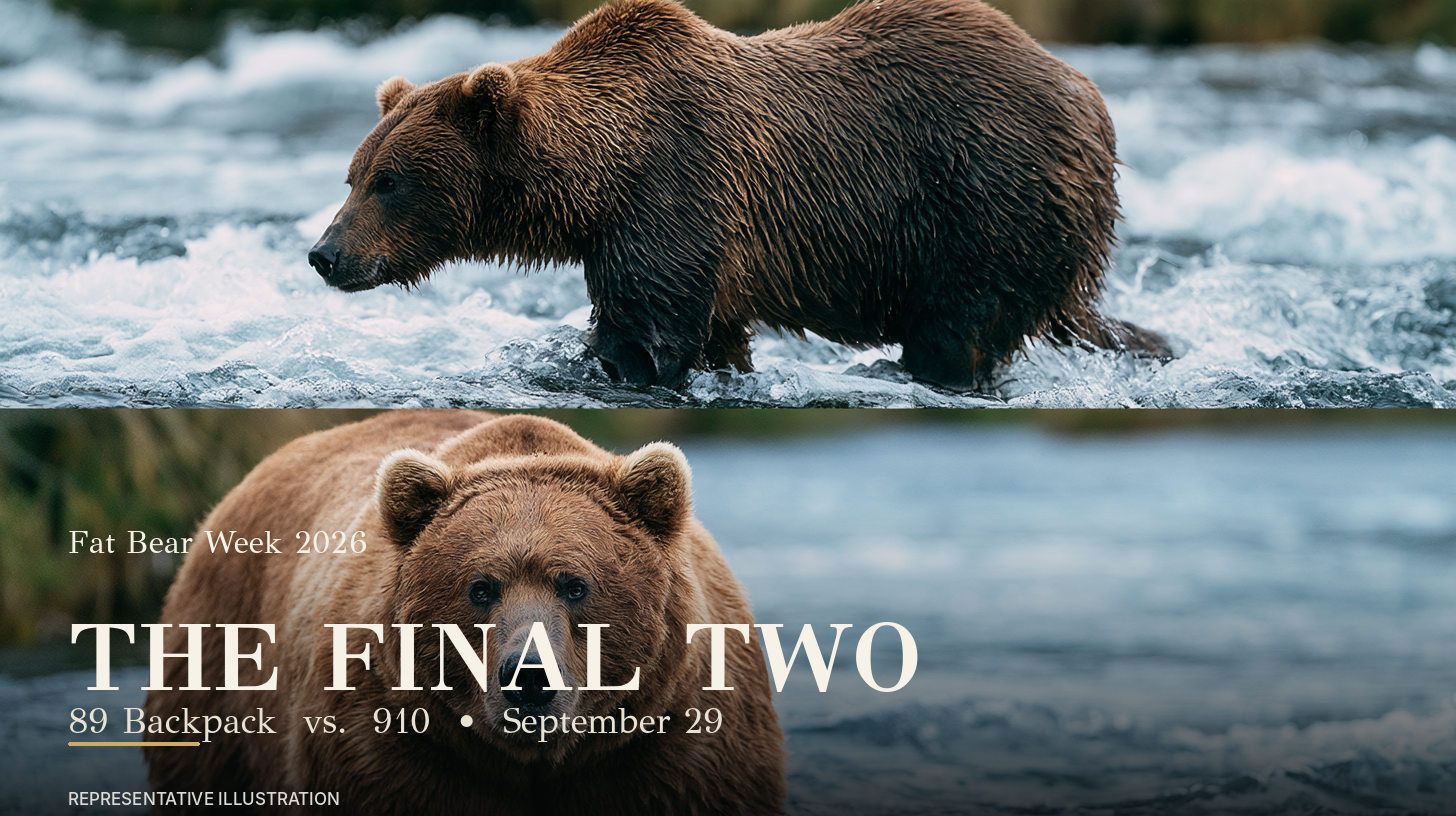
Bear 910 and 89 Backpack will meet in the Fat Bear Week 2026 final on September 29. Both have a place in the event’s family history: 910 is the daughter of two-time winner 409 Beadnose, while Backpack is the son of 2019 champion 435 Holly.
The four-bear semifinal field narrowed Monday when Backpack edged past 164 Bucky and 910 defeated 132 Family. Neither finalist has won the main tournament before. Whoever wins will join their mother among its champions.
Final voting is scheduled for noon to 9 p.m. Eastern on Tuesday, September 29, equivalent to 8 a.m. to 5 p.m. Alaska time. Voting is hosted on the official Fat Bear Week page, which also publishes the results.
Explore’s September 28 semifinal totals show how differently the two finalists advanced:
| Advancing bear | Votes | Eliminated entry | Votes |
|---|---|---|---|
| 910 | 110,385 | 132 Family | 36,428 |
| 89 Backpack | 79,945 | 164 Bucky | 75,805 |
Backpack’s margin was 4,140 votes. Bear 910 finished 73,957 votes ahead of 132 and her three cubs, ending the last family entry’s run. Bucky’s elimination also closed a tournament in which he had already knocked out defending champion 32 Chunk and then 151 Walker.
The semifinal numbers measure separate votes, not a head-to-head test of the finalists. They don’t carry into the championship, and they don’t establish which bear weighs more. Fat Bear Week is a public choice among bears whose bodies and circumstances aren’t identical.

The mothers behind the finalists
Backpack was born in 2006, years before Holly won her title. His nickname dates to his cubhood, when he sometimes made river crossings on his mother’s back.
Holly’s care became especially important in 2007. Her yearling had an injured front leg that he wouldn’t put weight on. In a 2013 National Park Service account, ranger Michael Fitz described how Holly adjusted to her cub’s limited mobility. She fished around the river mouth, away from the greater concentration of large bears at the falls, and appeared to slow her movements so he could follow.
By September 2007, the leg had healed. The following year, Backpack was living independently. That history gives his adult photographs a context a before-and-after summer comparison can’t supply: the bear filling the frame once needed his mother to accommodate an injury.
His fishing habits still change with the season. The park’s current profile places him at the falls in early summer and along the lower river in autumn. It describes an adult who isn’t as dominant as some of the other males using the waterfall.

Bear 910, known by her number rather than a nickname, was born a decade after Backpack, in 2016. Beadnose’s two titles came in 2015 and 2018.
Her daughter, 620, wasn’t the only cub she raised. In 2023, 910 took in her niece 609, whose mother is 909. That litter became independent in late spring 2025. Since then, 910 has been without dependent cubs and has fished at locations including the top of Brooks Falls.
Her current condition doesn’t confirm that she’ll have another litter. But for a female that does give birth, autumn fat has an additional job. Brown bears can deliver cubs inside their winter dens and nurse them while going without food themselves. The energy available to a mother therefore matters beyond keeping her own body functioning.
The ways bears catch salmon change with opportunity, too. At Brooks Falls, the waterfall temporarily concentrates migrating fish. Later in the season, dead and weakened salmon provide feeding opportunities farther downstream. Being able to keep finding food as those conditions change helps a bear keep building reserves.

The setting makes these long histories possible. Brooks River connects through the Naknek watershed to Bristol Bay, and its salmon bring bears back across seasons. Researchers record individual animals’ movements and behavior, while the webcams let people follow some of those same lives from a distance.
Fat Bear Week grew from a one-day Facebook event, Fat Bear Tuesday, on September 30, 2014. The weeklong competition followed in October 2015. This year’s final now connects that voting tradition with two bears whose mothers also appear in its record of winners.
The schedule for the bears themselves is less tidy. Most Katmai bears enter their dens in October or November, then live on stored energy without eating or drinking. September’s photographs show what they’ve accumulated so far, not the end of their feeding season.
For both finalists, the weeks after the vote still matter. They can keep feeding before denning, building the reserves that must last through months without another meal.
Leave a comment