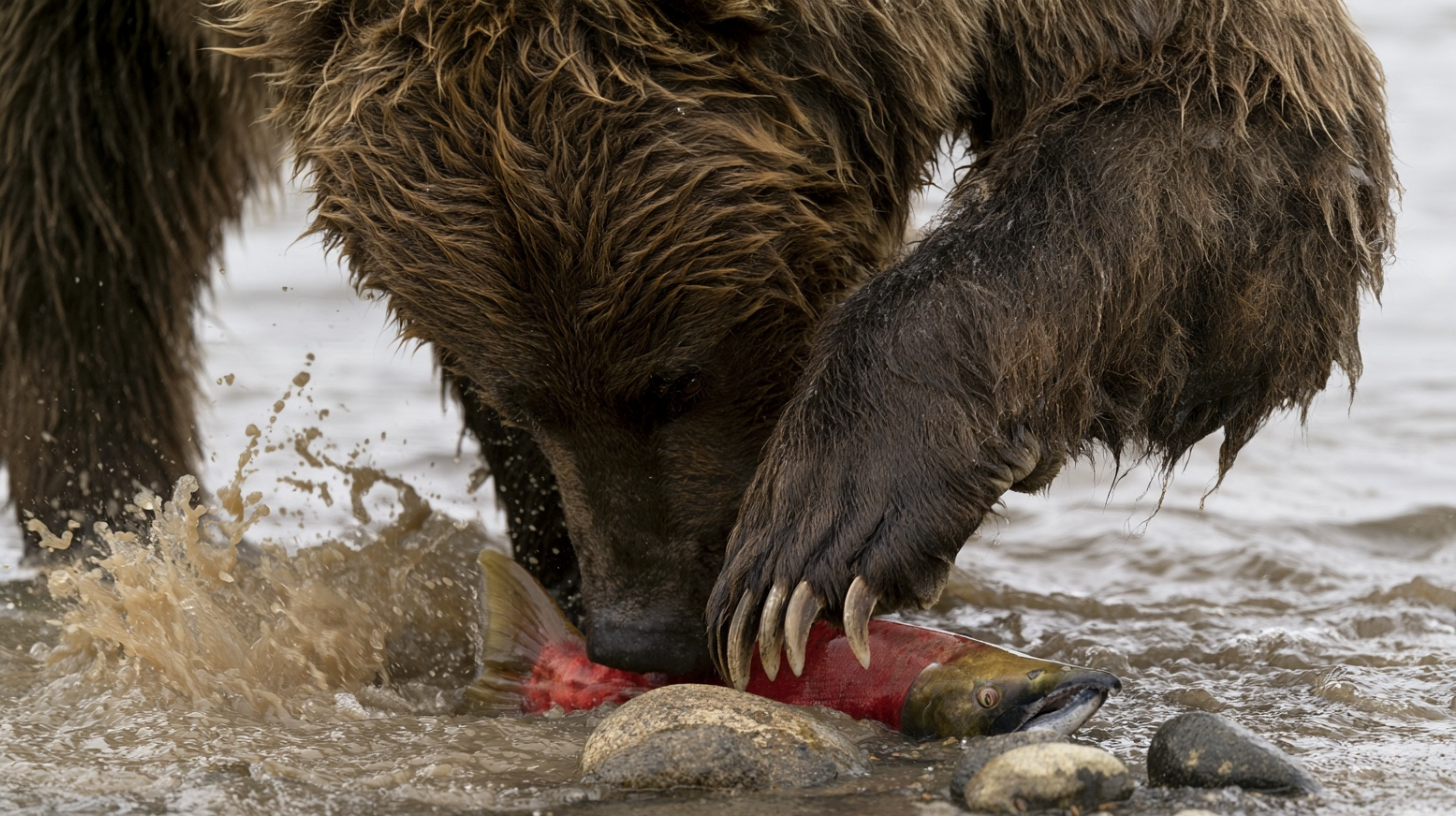
Bear 910 has reached the Final Fat Four of Fat Bear Week 2026 with one of the simplest labels in the bracket. No Chunk, Backpack or Bucky. Just three digits.
That has become one of the most repeated questions around this year’s tournament, especially now that 910 is headed for a September 28 semifinal against Bear 132’s family. She reached the semifinal by defeating her sister, 909, 104,545 votes to 26,766. For people meeting her through the bracket, the obvious question is why such a well-known bear still doesn’t have a conventional name. Explore.org’s official Fat Bear Week page confirms the current bracket and results.
The short answer is that 910 already has an official way to be identified.
At Brooks River in Alaska’s Katmai National Park and Preserve, bears are assigned identification numbers so park staff can distinguish and monitor individuals. A nickname can become popular later, but it isn’t required and it doesn’t replace the bear’s identification in the park’s records.
The National Park Service has explained that the numbered system is deliberately neutral. Human names carry associations. A cuddly-sounding nickname can make a wild animal seem more like a pet, while an intimidating one can push people toward the opposite assumption. Random numbers avoid some of that baggage. The park has discussed that reasoning in its explainer on why some Katmai bears have names and others don’t.
That doesn’t mean every famous Katmai bear stays number-only. Bear 32 is widely known as Chunk. Bear 89 is Backpack. Bear 151 is Walker. Others, including 909 and 910, are still presented by Explore.org simply by their numbers.

And 910 doesn’t appear to be waiting for someone to finish naming her. For a bear watched over many seasons, a number can become memorable enough to work like a name on its own. NPS has made the same point about Bear 747, whose number eventually became inseparable from his public identity.
Nor does “910” describe her sex, age, family or tournament position. It is an individual identification number, not a biological code.
That clears up another recurring question: 910 is female.
Explore.org’s current 2026 profile identifies her as a large adult female with dark brown fur, a prominent brow ridge and relatively short ears that point forward. She was born in 2016.
She also isn’t 409 Beadnose or 151 Walker.
Beadnose was her mother and won Fat Bear Week in 2015 and again in 2018. Walker is an adult male who appears elsewhere in the 2026 field. Explore reports that Walker and 164 Bucky both courted 910 during this summer’s mating season.
If readers have seen the name “Bead,” that can create another mix-up. That informal nickname has been used for Bear 620, 910’s biological daughter, not for 910 herself.
A number can carry an entire family history
The family behind those three digits is one reason 910 has become so recognizable.
She and Bear 909 are sisters, both daughters of Beadnose. During summer 2022, the sisters and their young began traveling together in an unusually close family grouping. The following year, after 909 separated from her daughter 609, 910 adopted her niece while continuing to raise her own daughter, 620.
That timing is worth getting right. The two families began spending extensive time together in 2022. The actual adoption followed in 2023.

It left 910 caring for her biological cub and her sister’s daughter at the same time, a striking chapter in a family already familiar to longtime bear-cam viewers.
The young bears eventually became independent. Explore says 910 separated from the litter in late spring 2025. Since then, she has been able to move and fish without dependent cubs, including at Brooks Falls.
There is even a behavior viewers can use to recognize her.
When 910 fishes along the lip of Brooks Falls, she makes repeated head lifts that Explore describes as peculiar to her behavior there. She apparently doesn’t perform the same movement elsewhere along the river.
It’s a small detail, but it helps explain why a bear doesn’t need a human nickname to become individually familiar.
That familiarity is also what Fat Bear Week’s expanded 2026 bracket is built around. The event began as a one-day vote in 2014 before expanding into a weeklong bracket. Today, viewers compare the bears’ seasonal transformations and vote for the animal they believe best represents successful fattening for winter. The comparison is intentionally subjective because an adult male, a solitary female and a mother supporting cubs face very different demands.

At Brooks River, salmon provide a concentrated source of energy during the relatively short feeding season. For the bears, the body fat being celebrated isn’t cosmetic. It is stored energy for hibernation, when they spend months without feeding. Females can face the additional demands of pregnancy, giving birth and nursing.
And what does the Fat Bear Week champion actually win?
No extra salmon. No physical trophy. No special treatment from the park.
The crown is symbolic. National Park Service material has been explicit that the bears themselves don’t receive anything for competing in or winning Fat Bear Week. The event exists to draw attention to the bears, their survival and the ecosystem supporting them.
That separation between the contest and the animals matters. Fat Bear Week gives people a reason to learn individual histories, but 910 isn’t competing in any sense that matters to her. She is fishing, building reserves and responding to the same pressures that shape every wild brown bear at Katmai.
Her next appearance on the human-made bracket comes September 28, when she faces 132 and her cubs for a place in the championship. The other semifinal sends 164 Bucky, who ended Chunk’s title defense, against 89 Backpack. The championship follows on September 29.
Whatever happens in that vote, the answer to the question that prompted this story won’t change.
Bear 910 doesn’t lack a name. At Brooks River, three digits are enough to carry a decade of family ties, fishing habits and survival.
Leave a comment