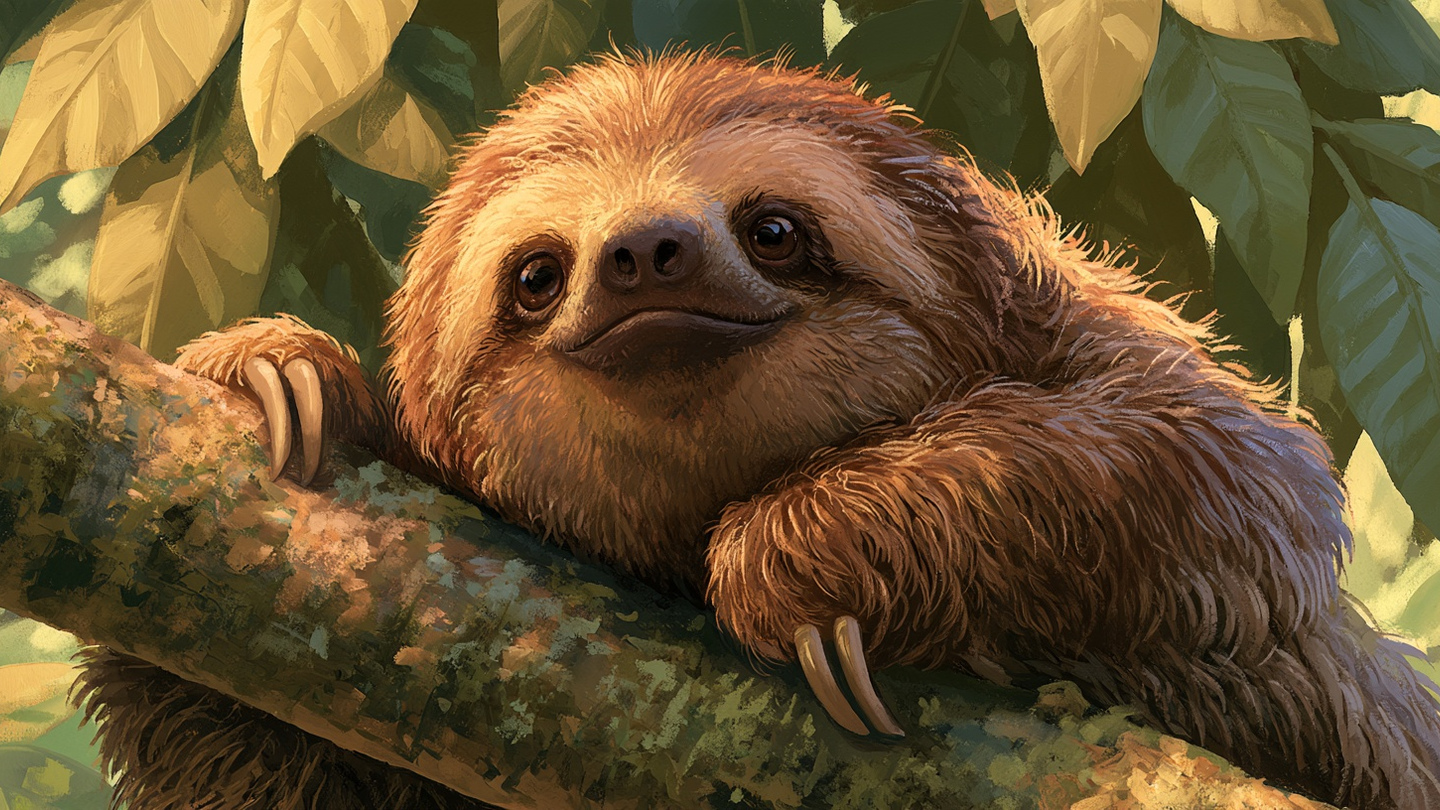
A two-toed sloth born to Aluna and Sol on October 25, 2026, has ended a 16-year gap in sloth births at San Antonio Zoo. In its November 4 announcement, the zoo reported that the mother and her newborn were doing well.
As of November 5, 2026, Discvr hadn’t independently confirmed the baby’s name or when visitors would be able to see it.
The zoo’s announcement photograph shows the baby nestled against a plush sloth, its small face emerging from the toy’s shaggy fabric. There’s a practical piece of sloth biology behind that instinct to hold on. Long before a young sloth can travel through the trees alone, it needs a dependable grip.
Aluna was the baby in the zoo’s photographs just a few years ago. Born on February 14, 2023, she appeared in a zoo video with Santa that December, when she was about 10 months old. By the time her own infant arrived, she was three years and eight months old.
News of her pregnancy had appeared in local coverage on October 22, three days before the birth. The 16-year milestone refers to the zoo’s gap between sloth births. Pregnancy in two-toed sloths can extend for almost a year.
A life that starts with holding on
A newborn sloth has more equipment than its size might suggest. Its eyes are open, it has fur and teeth, and its claws have already formed. San Diego Zoo Wildlife Alliance describes a gripping reflex that allows a newborn to climb toward its mother’s abdomen. From there, it can nurse while holding onto her fur.
The “two-toed” label refers to the front feet, which each have two digits. Each hind foot has three. All four limbs can help them hold onto a surface, whether that’s a mother’s fur early in life or a branch later on.
For the baby, its mother is a moving surface to cling to as well as a source of milk. Young sloths spend months being carried against her body. Their early view of the world comes from that close position, with nearby branches and leaves gradually becoming things they can reach for themselves.
That proximity also helps introduce them to food. Infants sample leaves near their mothers’ mouths, the Sloth Conservation Foundation explains, even while they’re still drinking milk. Feeding develops through overlapping stages: a baby can investigate solid food while continuing to nurse and ride on its mother.
Exploration begins without a complete break in contact. A young sloth may stretch toward a leaf or branch with some of its limbs while keeping others attached to its mother. As it grows, it spends more time beside her. Learning to move through the canopy involves many small releases and new holds.
The need for contact helps explain why soft objects sometimes feature in professional sloth care. In a 2024 account of its husbandry work, the National Aquarium described raising a sloth named Xeno after his mother died when he was about six weeks old. Staff used stuffed animals as supports and carried him in a baby sling, keeping up the close physical contact a young sloth needs.
Xeno’s caregivers eventually placed a stuffed surrogate among the branches of his new habitat. That gave him a place to cling as he began spending time there.
That documented case shows how a plush can serve a practical purpose. San Antonio’s photograph, however, doesn’t establish the specific care arrangement for Aluna’s baby.
In the wild, having something to hold depends on the forest around them. Trees provide routes between feeding and resting places. When woodland is cleared or broken into isolated patches, those routes become harder to follow. Sloths face habitat loss and fragmentation, along with risks from roads and illegal wildlife trade.
Both living two-toed sloth species are classified as Least Concern in the IUCN’s 2022 assessments, as summarized by San Diego Zoo Wildlife Alliance. Keeping their habitat connected still matters. It’s a challenge shared by other tree-dependent Amazon mammals, whose daily movements and feeding depend on the forest remaining accessible.
San Antonio Zoo works with Indigenous artisans in Peru through its Project Selva program. It purchases locally made arts and crafts to help provide income that doesn’t depend on selling timber or extraction rights. The program’s stated aim is to support Amazon communities in retaining their forests.
For a growing sloth, the route from mother’s fur to independent movement is a succession of small steps: reaching a little farther, tasting a leaf, finding a branch that will hold.


Leave a comment