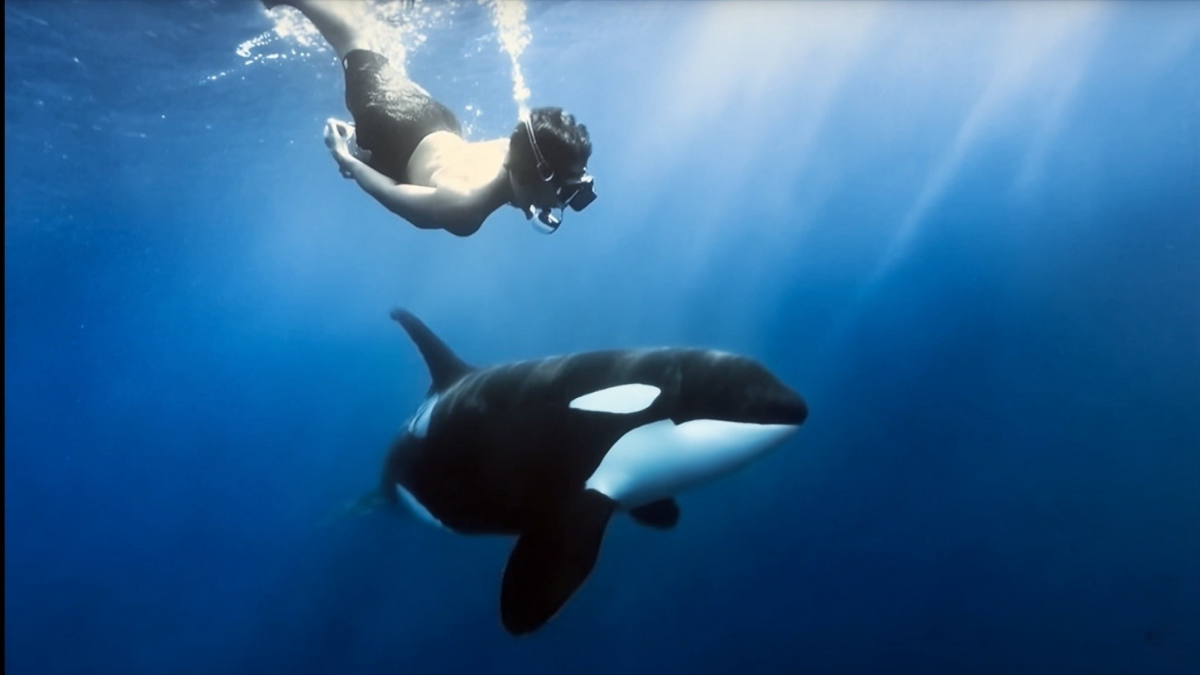
In the cold hush of the open ocean, a diver floats, barely moving, as a black fin cuts through the water. It belongs to an orca, a killer whale with the power to shatter seals, chase down great whites, and pull penguins from ice. Yet it approaches slowly. Curiously. And leaves.
This scene is not rare. Despite thousands of recorded encounters, wild orcas have never fatally attacked a human. Not once.
They easily could. These apex predators are fast, strong, and brilliant. They coordinate in pods like wolves, communicate across miles with clicks and whistles, and have been known to learn hunting tactics from their mothers and pass them down for generations. So why do they always hold back with us?
One answer is: we’re not on the menu. Orcas are surprisingly picky eaters. Some populations specialize in fish. Others in seals. But each pod tends to stick with what it knows. Humans, biologically, don’t fit the pattern. We’re too lean, too unfamiliar, and not worth the energy. Marine biologist Erich Hoyt puts it bluntly: “They are really conservative in terms of whatever they learned from their mothers and their pod about what constitutes food.”

A choice, not an accident
But diet alone doesn’t explain the full story. What fascinates scientists even more is how orcas behave around people. A 2025 study documented more than 30 cases where wild orcas approached humans to offer them food, dropping dead fish, squid, even stingrays in front of divers or boaters. Sometimes, the orcas would wait. And if the person didn’t take it, they’d toss it back like a game.
These food-sharing gestures are deeply social behaviors within pods. Orcas share food to build relationships. When they extend that to humans, it suggests they might view us not just as neutral, but as potentially part of their social landscape. One researcher said simply, “That they also share with humans may show their interest in relating to us as well.”
This is where orca culture becomes central. Like humans, orcas pass down customs. That includes diet, dialect, and group behaviors—possibly even social norms. Some scientists now believe that among wild orcas, there is a learned, shared rule: do not harm humans.
And it’s a rule they’ve followed with remarkable consistency. Even when orcas exhibit aggressive behavior toward boats—as seen in recent rudder attacks off Spain—they have never attacked the humans onboard. In every case, the boat was the target. The people were ignored.

A fragile peace in captivity
In captivity, however, this behavior changes. All fatal orca attacks on humans have occurred in marine parks. These confined animals suffer from stress, isolation, and unnatural conditions. Experts widely agree that the aggression seen in captive animals, such as those in tanks, is a response to captivity, not a reflection of their natural behavior.
Contrast that with indigenous traditions, and the story becomes even richer. Among the Tlingit, Haida, and other coastal peoples, orcas are known as Blackfish—sacred beings, spirit brothers, and ocean guides. One famous legend tells of Natsilane, a man who carved the first orca and instructed it to never harm humans. That command, the story goes, still holds.
Science might frame it in terms of culture and cognition. Oral tradition frames it as a pact. Either way, the result is the same. Orcas, with all their power and precision, choose not to attack us.
They don’t have to be our friends. But they’ve chosen not to be our enemies.
And in a world that often forgets how to coexist, that choice might be the most powerful thing of all.


Leave a comment