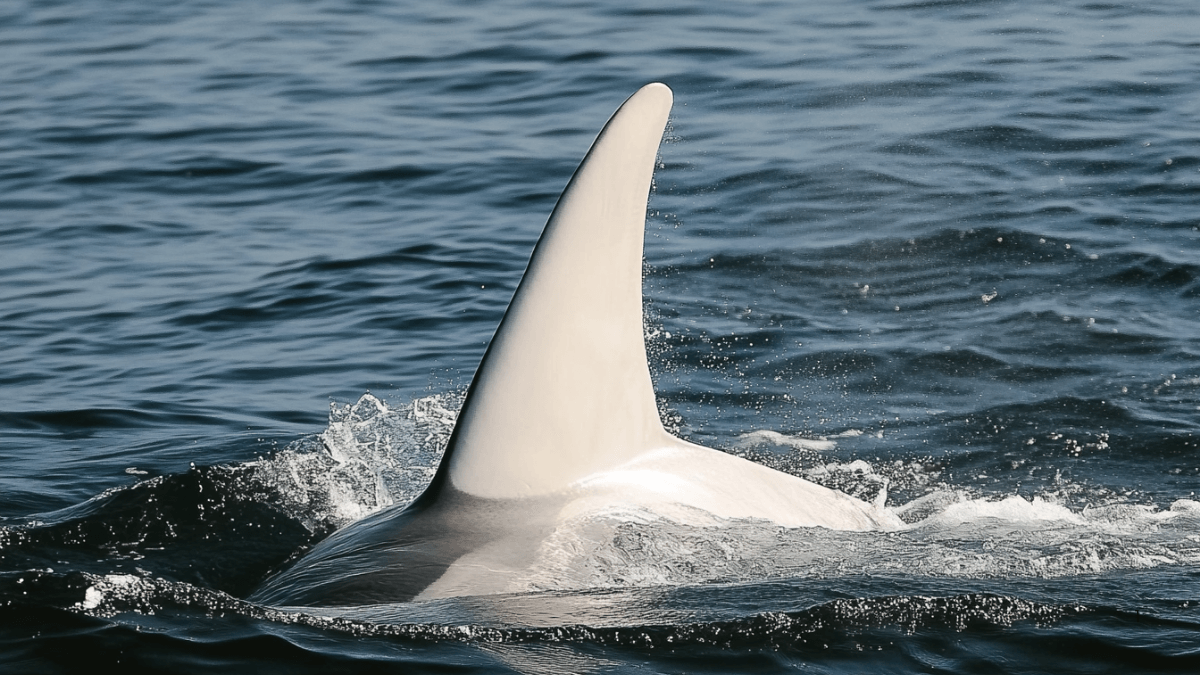
A brisk wind cut across the deck of the small tour boat in Rausu, Hokkaido, as Japanese photographer Noriyuki Hayakawa steadied his camera. He’d been documenting orcas here for years, often spending weeks at a time at sea, hoping to capture something extraordinary. One day, he got his wish, but it came in an unexpected shade.
“This is the first time I’ve encountered a white orca after 15 years of photographing orcas in Rausu (Hokkaido, Japan),” he said, recalling the day he spotted a nearly cream-colored male orca gliding with a typical black-and-white pod. The sight was so startling that Hayakawa froze, heart pounding. He managed to take a few pictures, and when he checked them afterward, his legs felt weak from excitement.
“My legs were shaking as I photographed the white orcas I met for the first time. [It] looks like a golden-ish cream-colored orca synthesized into a blue sea. I still think it was a dream,” he shared online.
A Rare Pair
Days later, he returned to the same waters, scanning the horizon for another glimpse of the white whale. To his surprise, he found two, a male and a female, both shimmering like ghosts against the choppy sea. Their pod, a large group of orcas, swam alongside them as though nothing was out of the ordinary.
Skepticism arose as soon as he posted the images. Internet viewers pointed fingers, questioning if the photographs were fake, or if the creatures had been digitally bleached. “We have received comments such as ‘Fake?’, ‘Composite?’, ‘Did they make them white with Photoshop?’, but we have done absolutely nothing of the sort,” Hayakawa clarified.
Albinism vs. Leucism
Like many who saw the photographs, Hayakawa first wondered if the orcas might be albino. But he noticed a simple clue that suggested otherwise: “The eyes appear black.” True albinism typically manifests in pale or pink eyes, so these whales likely have leucism, a partial loss of pigmentation. While leucism leaves a strikingly light coat, it preserves darker eyes and can leave faint markings on the body.
Though orcas are top predators, having such pale skin could make certain animals more conspicuous in the wild. For now, these white orcas seem fully integrated with their group, free to navigate the icy currents as they always have. Hayakawa hopes that by sharing his images, people will recognize these whales as genuine and appreciate just how exceptional they are.
The experience has also drawn worldwide attention to Rausu’s waters, reminding us that nature can still surprise even the most dedicated observers. Looking back on the day his lens found that first flash of cream, Hayakawa acknowledges it was a moment years in the making. Sometimes, it just takes a little patience—and a touch of luck—to witness something that truly stands apart.
You can follow Noriyuki Hayakawa’s work on his website, Instagram, or X.
Leave a comment