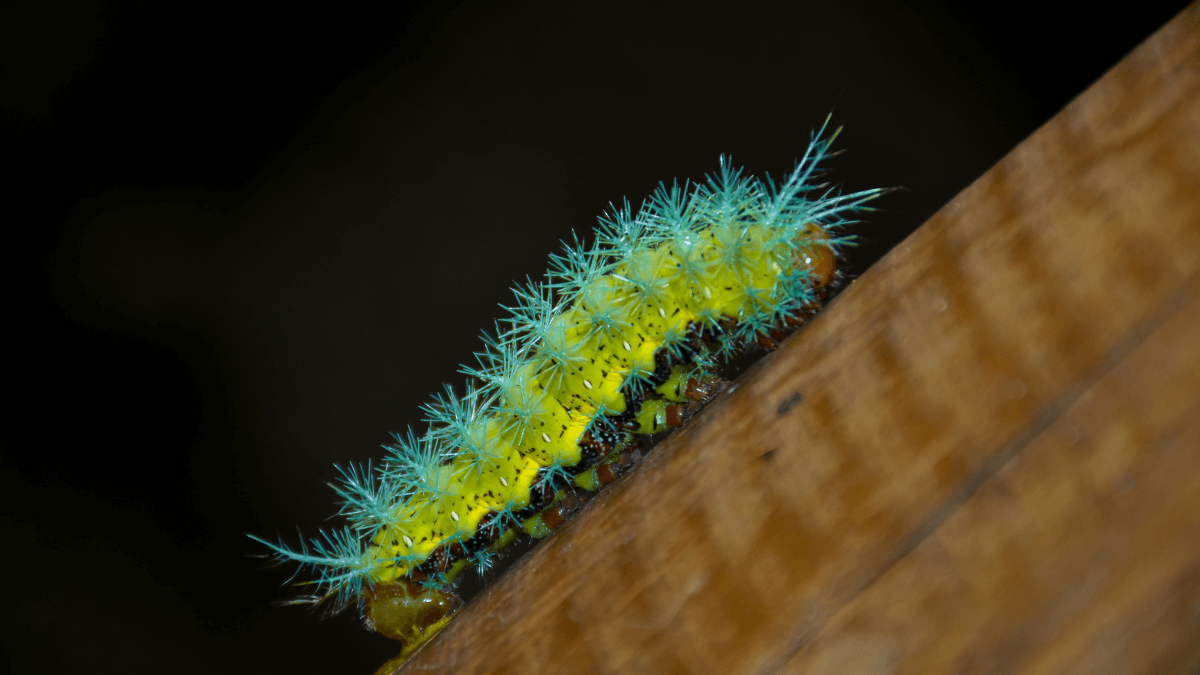
Saturniidae moth caterpillars are as remarkable as their adult counterparts. With a family that includes some of the largest moth species known, you may be curious about the appearance of their larvae.
As a caterpillar, a Saturniidae features a range of vivid colors and unique physical characteristics. Typically, they are stout and cylindrical, with a considerable size of 50 to 100 mm in their final instar. This size not only makes them fascinating but also easy to spot.
These larvae often sport spiny or hairy tubercules, giving them a textured appearance that can be quite stunning to observe. Their bodies are sometimes adorned with bright and contrasting patterns of stripes or patches, which serve as both camouflage and warning signs to predators. The Saturniidae caterpillars transform into moths that are not only significant in size—ranging from medium to very large—but they’re also essential for their role in various ecosystems.
Your understanding of these caterpillars is crucial to appreciating the intricate life cycle of moths in the Saturniidae family.
Observing how the larvae feature physical adaptations like reduced mouthparts and dense bristles gives you a glimpse into their survival strategies. These attributes not only facilitate their growth into majestic adult moths but also showcase nature’s diversity and complexity.
Physical Characteristics of Saturniidae Caterpillars
The Saturniidae family’s caterpillars display distinctive features essential for their survival. Here’s what you should know about their size, coloration, and defensive traits.
Size and Shape
Saturniidae caterpillars are characteristically large and stout. They can grow to a length ranging from 50 to 100 mm by the final instar, with a cylindrical body that is slightly flattened. The body shape aids in their movement and makes them easily recognizable.
Coloration and Markings
The appearance of these caterpillars varies, with many species exhibiting whitish or translucent skin during the early stages of development. As they mature, the caterpillars can develop vivid coloration and distinct markings that sometimes include tubercles. These markings and colors play a significant role in camouflage and mimicry, helping to keep the caterpillars safe from predators.
Defensive Features
In terms of defense, Saturniidae caterpillars are equipped with spines or hair-like setae. These features can be potentially irritating to predators and may contain toxins. Such defensive attributes are crucial as they deter predators, allowing the caterpillars to survive long enough to undergo metamorphosis into moths.
Saturniidae Lifecycle and Development
The life cycle of the Saturniidae moth, from its beginning as an egg to its final metamorphosis into an adult, is a fascinating process. During this time, you’ll witness the transformation from a tiny larva to a majestic moth.
From Egg to Larva
When a female Saturniidae lays her eggs, they are often placed strategically on a host plant. Emperor moth and luna moth species can lay up to 200 eggs. These eggs are typically round, slightly flattened, and have a smooth, translucent surface.
After hatching, the larvae, commonly referred to as caterpillars, start their life by consuming the leaves of the host plant. This feeding period is critical for their growth.
- Appearance: Saturniidae larvae are known for their striking colors and spiny bodies.
- Diet: The caterpillars have a voracious appetite for the host plant’s foliage.
Pupal Stage and Cocoon
As the larvae mature, they proceed to pupate, spinning a protective silken cocoon in which they will undergo metamorphosis. The cocoon is often thick, serving as a safe haven from environmental threats. Inside, the pupa stage begins, and the caterpillar transforms over time, preparing to emerge as an adult moth.
- Cocoon location: Depending on the species, the cocoon may be spun on the host plant or in leaf litter.
- Duration: The pupal stage can vary in length, often depending on environmental conditions and the species’s specific life cycle.
Emergence as Adult Moths
The final stage of the Saturniidae moth’s life cycle is the emergence from the cocoon as an adult moth. This stage is marked by significant physical changes.
Adult moths exhibit vibrant wing patterns, often with eye-catching eyespots to deter predators. They are sexually mature and ready to mate, completing the life cycle. Interestingly, adult Saturniidae moths generally do not feed, as they do not have functional mouthparts.
- Wings: Upon emergence, adults display broad, brightly colored wings.
- Antennae: Males typically possess larger, more feather-like antennae than females, which are essential for detecting pheromones.
Habitat and Diet
In examining the Saturniidae moth caterpillars, your understanding of their habitat and diet plays a crucial role in grasping their ecological significance and biological needs.
Preferred Habitat
When you venture into the world of the Saturniidae moth caterpillars, you’ll find these creatures thriving in a variety of environments. North America is home to many species, as are forests and woodlands globally.
In these habitats, the caterpillars prefer trees and shrubs as their mainstay, seeking out specific host plants that provide the nutrients necessary for their growth and eventual metamorphosis.
- Types of Habitats:
- Deciduous forests
- Temperate woodlands
- Tropical and subtropical areas
- Characteristics:
- Moist, with abundant vegetation
- Presence of host plant species
Dietary Habits
Your Saturniidae moth caterpillars are veritable eating machines with a diet strictly comprising the leaves of various host plants.
Common among these are oak, maple, and sweetgum trees, which offer the caterpillars ample nutrition.
You’ll notice that the larvae don’t stray far from their birthplace–they feed on the plants on which their eggs were laid, maximizing their growth potential before pupation.
- Host Plants for Caterpillars:
- Oak (Quercus spp.)
- Maple (Acer spp.)
- Sweetgum (Liquidambar spp.)
- Feeding Behavior:
- Voracious feeders during larval stage
- Stay on or near host plants
Role in Ecosystem and Interaction With Humans
Your understanding of the Saturniidae moth caterpillars extends beyond their appearance when you consider their place in nature and their interactions with human activities. The focus here is on their environmental impact and their economic and cultural significance.
Environmental Impact
Saturniidae moths play a crucial role in various ecosystems as both pollinators and a food source for other animals.
As caterpillars, they often have a specific host plant they feed on, which can help to maintain the health of those plant populations. However, in some instances, an abundant Saturniidae caterpillar population might cause damage to forestry or agriculture by defoliating trees.
The pheromones released by Saturniidae moths are vital for their mating rituals and have implications for ecological research and monitoring.
Economic and Cultural Significance
From an economic perspective, certain Saturniidae moths are interesting due to their silk-producing abilities.
Although not as extensively exploited as the silk from Bombyx mori (the domestic silk moth), the silk spun by Saturniidae species, known as wild silk, has been used in textile production in some cultures.
Culturally, Saturniidae moths have fascinated humans with their size and beauty, often featured in artwork and storytelling. In some regions, they are integral to indigenous cultures, either symbolically or as a resource.
The interactions between humans and Saturniidae moths and caterpillars are multifaceted, influencing natural ecosystems, human economies, and traditions.
Frequently Asked Questions
Saturniidae moth caterpillars are known for their distinctive features and growth patterns. This section will answer common questions about their appearance, diet, and other unique characteristics.
How can one differentiate Saturniidae moth caterpillars from other caterpillar species?
You can distinguish Saturniidae moth caterpillars by their large size, fleshy bodies, and sometimes vibrant colors or patterns. Many possess spines or tubercles, and they typically have a less hairy appearance than other caterpillar families.
What types of plants do Saturniidae moth caterpillars typically feed on?
Saturniidae moth caterpillars often feed on a variety of plants, including trees and shrubs like willows, maples, and oaks. Their specific diet can vary widely by species and local vegetation.
Are there any distinctive features that Saturniidae moth caterpillars possess?
Yes, Saturniidae moth caterpillars frequently have distinctive eye spots or colorful markings to deter predators. They also may have unique spiny projections or tubercles along their bodies.
Can Saturniidae moth caterpillars vary in appearance, and if so, how?
Saturniidae moth caterpillars can vary greatly in color, pattern, and size depending on the species and development stage. They may change in appearance as they grow, with early instars looking notably different from the final larval stage before pupation.
What is the size range for Saturniidae moth caterpillars during their growth stages?
The size of Saturniidae moth caterpillars ranges from a few millimeters upon hatching to substantial lengths of upwards of 10 centimeters in their final larval stage. This makes them one of the largest caterpillar species.
Is there a risk of poisoning when handling Saturniidae moth caterpillars?
Most Saturniidae moth caterpillars are not poisonous. However, some species can have spines or irritating hairs. These can cause discomfort or an allergic reaction upon handling.
It is advisable to avoid direct contact or to handle them with care.


Leave a comment