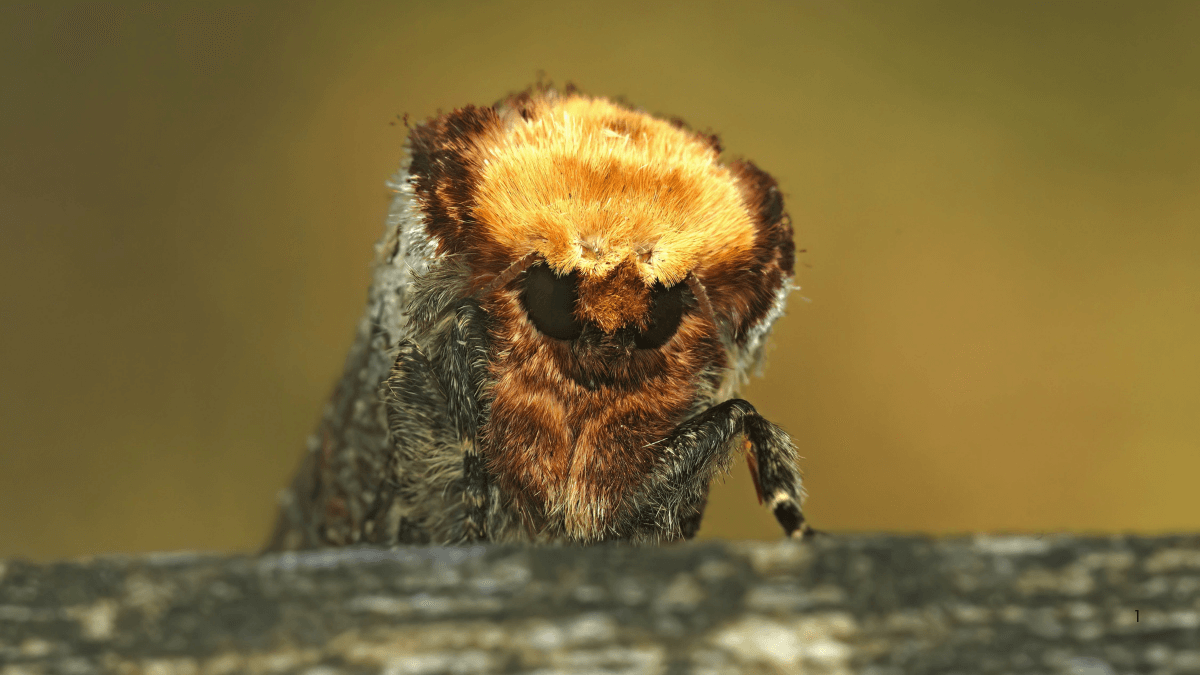
At first glance, the Buff-tip moth (Phalera bucephala) looks uncannily like a snapped birch twig.
When at rest, it folds its wings tightly against its body in a narrow, cylindrical posture.
The front of its body and wing tips are colored a pale buff, mimicking exposed wood.
The midsections of the wings are shaded with silvery-grey mottling that perfectly matches lichen-dusted bark.
This combination of wing shape, coloration, and posture produces one of the most convincing natural disguises in the animal kingdom.
This camouflage isn’t just about hiding in the background.

The Buff-tip moth exemplifies a strategy known as masquerade — being seen, but misidentified as something uninteresting.
A bird might spot the moth and dismiss it as a twig.
Unlike crypsis, where invisibility is the goal, masquerade succeeds by exploiting the viewer’s assumptions.
The Buff-tip moth tricks the brain, not just the eye.
Camouflage without spectacle: The quiet brilliance of nature
The Buff-tip’s resting posture is key. During the day, it remains motionless, aligned along branches or even fence posts.
Its buff-colored head and wing tips simulate the freshly snapped ends of a branch. On a silver birch, its preferred host, the illusion is so complete that even trained naturalists may overlook it.
This evolutionary marvel didn’t emerge overnight. Slight mutations offering better camouflage likely conferred survival advantages over generations.
A moth that looked vaguely twig-like was less likely to be eaten. Eventually, selection pressures sculpted a form that doesn’t just blend in but convincingly pretends to be something else.
The Buff-tip’s evolutionary journey highlights how predator vision drives prey design. Birds, the main daytime predators of moths, develop mental “search images” for prey.
The Buff-tip doesn’t try to avoid detection entirely — it aims to be categorized as a harmless stick. This is evolution’s sleight of hand.
And the Buff-tip isn’t alone. Nature abounds with camouflage specialists.

Leaf insects mimic foliage so precisely they seem photosynthetic. Owls like the Eastern Screech-owl blend into tree trunks, their feathers mottled like bark, eyes closed to mere slits.
Other moths adopt disruptive patterns or flash warning colors. But the Buff-tip goes minimalist.
No flash, no flair — just silence, stillness, and the perfect lie.
By night, Buff-tips become active, fluttering under the cover of darkness to mate and feed. By dawn, they vanish again into their disguise.
Their caterpillars are anything but subtle — fuzzy, gregarious feeders that sometimes strip whole branches of leaves.
But the adult moth relies on the opposite tactic: survival by subtraction.



Leave a comment