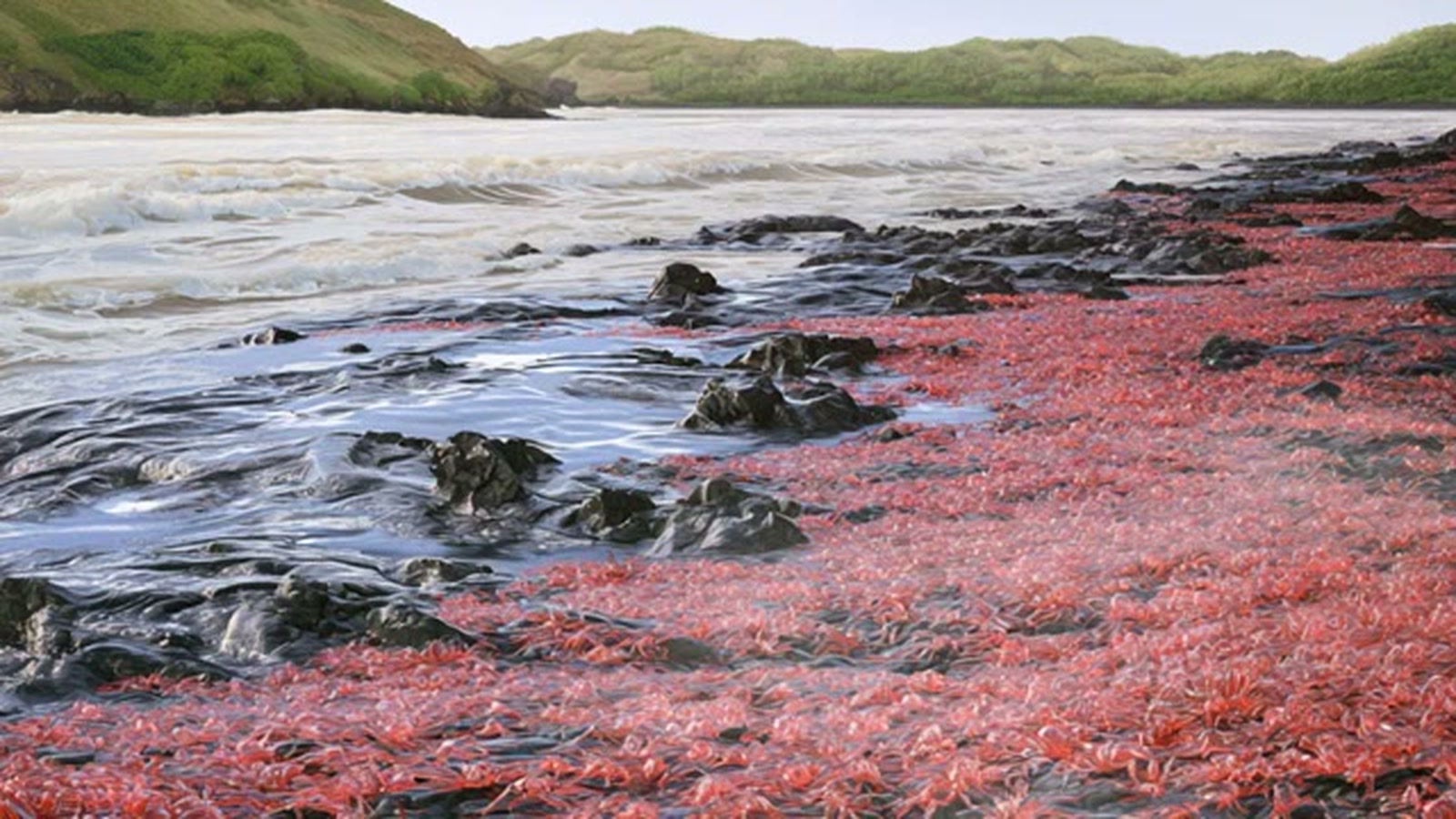
By January 16, 2026, millions of tiny, translucent red crabs were coming ashore at Flying Fish Cove and beginning a steep journey toward Christmas Island’s rainforest. Each was only a few millimeters wide. Together, they covered rocks, roads and the edges of homes.
This was the least dependable part of the island’s famous crab migration. Adult red crabs travel to the coast every breeding season, but most years almost none of their young make it back from the ocean. A mass return happens only once or twice in a decade. Those rare generations matter because red crabs help determine what grows on the island and where.
The cycle begins with rain. When the wet season moistens the forest, adult crabs emerge from their burrows and start moving toward the sea. Males generally leave first. Near the coast, they dig burrows where mating takes place, and females remain there while their eggs develop.
Rain starts the journey, but the moon and tide set its deadline. Females release their eggs before dawn as a high tide begins to recede during the moon’s last quarter. Each female can carry as many as 100,000 eggs, and the eggs hatch as soon as they touch seawater. The official migration account from Christmas Island National Park describes clouds of larvae being pulled away from shore by waves and the outgoing tide.

The larvae remain at sea for about a month, developing through several stages before becoming shrimp-like megalopae. This marine nursery is the great bottleneck in the red crab’s life cycle. The larvae become food for fish, manta rays and whale sharks.
Currents and ocean swell can carry an entire generation away from the island. In a favorable year, enough survivors are brought back toward shore at roughly the right stage of development. In other years, residents may see only scattered juveniles or none at all.
That is why the January 2026 return stood out. Park officials couldn’t produce an exact count, but estimated that millions had reached the island. The scale was consistent with the kind of exceptional recruitment event that keeps a population going through several lean years.
A generation that still has a mountain to climb
Reaching Christmas Island is only the beginning. The megalopae gather in shallow coastal pools, then molt into land-dwelling baby crabs about five millimeters across. From there, they move inland for roughly nine days, climbing wet limestone, crossing roads and working their way toward the forest plateau.
Some routes rise past sea cliffs about 80 meters high. Rangers use barriers, temporary road closures and leaf blowers to move the delicate crabs away from vehicle tires without crushing them. The island’s human routines bend around the migration because a single busy road can cut across the path of an entire wave.

Once inside the rainforest, the juveniles nearly disappear. They spend much of their first three years hidden in rocky crevices, leaf litter and forest debris. They grow slowly and generally need four to five years to reach sexual maturity. The crabs that came ashore in early 2026 may not join a breeding migration of their own until around 2030 or 2031.
Their survival will affect far more than the next spectacle at the coast. Red crabs eat fallen leaves, fruit, seeds and seedlings. Their burrows turn and aerate the soil, while their waste returns nutrients to the forest floor. In this respect, they resemble other animals that rebuild forests from the ground up. A field experiment on Christmas Island found that seedling emergence was 21 to 29 times higher in plots where red crabs were excluded, evidence of how strongly they control the rainforest understory.
The crabs also link the forest to the sea. Their spawning transfers a large pulse of food into coastal waters, supporting fish and visiting filter feeders. Similar movements of nutrients across the ocean can shape ecosystems far beyond the animal making the journey.
The next cycle is already underway. Adult red crabs began moving again in November 2026, guided by fresh rain toward another lunar spawning window. They can release an extraordinary number of eggs, but abundance at the shoreline can’t guarantee a generation will return.
After the next spawning, the larvae will spend about a month beyond the reef, carried through currents and exposed to countless hungry mouths. Only when the coast begins to turn red again will anyone know whether the ocean has sent the island another rare generation.
Featured image: Editorial illustration.


Leave a comment