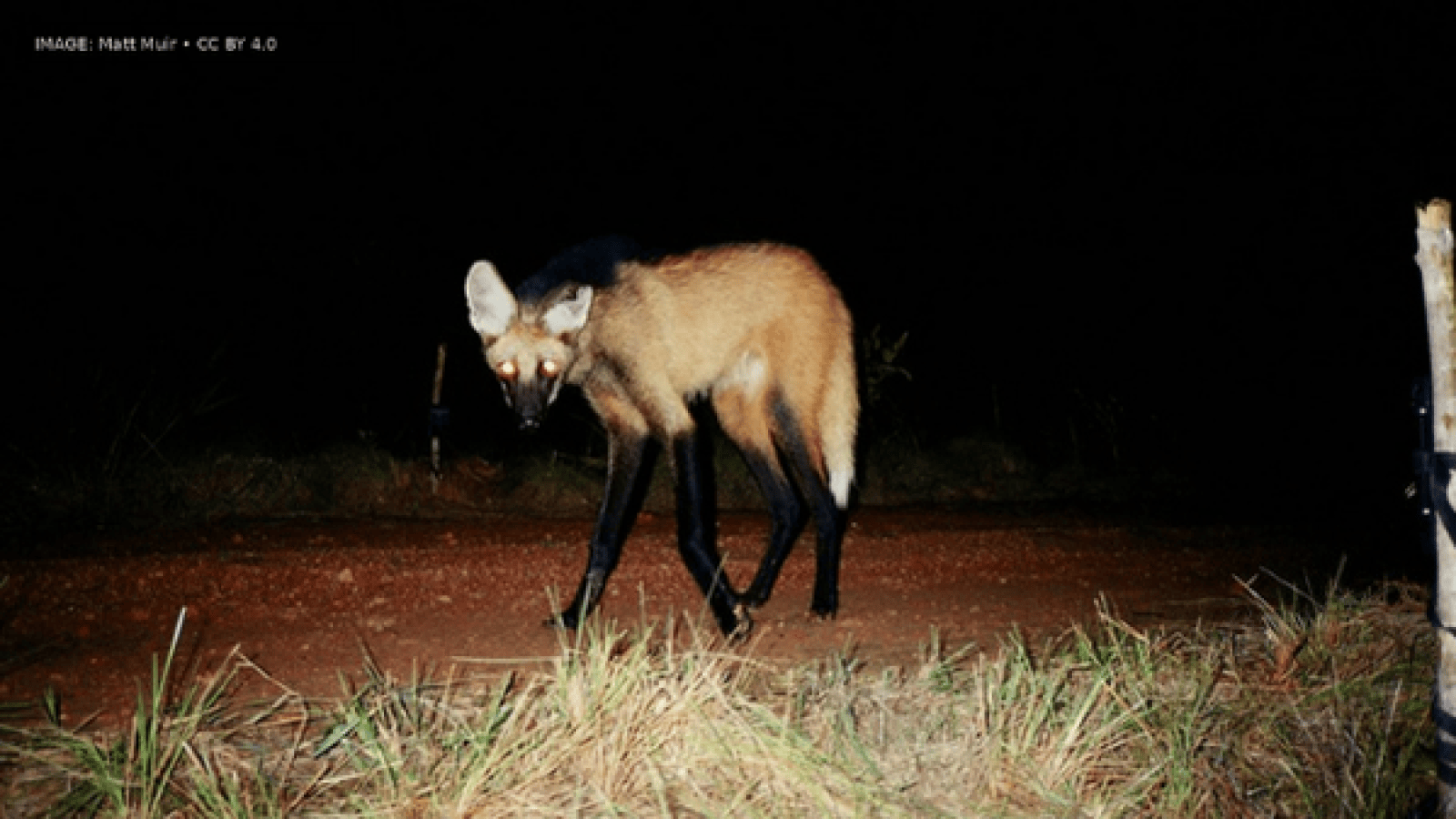
At first glance, the animal seems assembled from familiar parts: the reddish coat of a fox, oversized ears, black legs and the height of a small deer. Then the proportions stop making sense.
That unfamiliar silhouette explains why viewers of a recent Discvr video called it everything from a dog and dingo to a hybrid or AI creation. The species is real. It is the maned wolf, Chrysocyon brachyurus, a South American member of the dog family.

The name is misleading. A maned wolf is not a true wolf in the genus Canis, and it’s not a fox. It is the only living species in its own genus, Chrysocyon. It is not a mixture of the animals it resembles. It represents a distinct surviving branch of the canid family tree.

Bush dog image: Vassil via Wikimedia Commons, CC0 1.0.
Common names often create this kind of confusion. A raccoon dog is not a raccoon either. The label usually reflects appearance, not a precise evolutionary relationship.
The most surprising clue to the maned wolf’s identity comes from an animal that looks almost nothing like it. A bush dog is low to the ground, broad-bodied and short-legged, with partly webbed feet. Yet a 2022 comparative genomics study that sampled every living South American canid species placed bush dogs and maned wolves together as sister lineages.
One relative became tall and narrow in open country. The other evolved a compact body suited to dense cover and water. Their shared ancestry is much easier to see in their DNA than in their silhouettes.
Two relatives built for opposite worlds
An adult maned wolf stands about three feet at the shoulder but usually weighs only around 50 pounds. That mismatch between height and mass helps explain its almost weightless, stilted appearance.
Its native landscapes include South America’s grasslands and savannas, especially the Cerrado. Long legs let the animal step through tall, stiff vegetation with less of its body pushing through the stems. They also lift its eyes and enormous ears above some of the cover.
Those legs are useful, but they do not turn the maned wolf into a grassland greyhound. It generally hunts by walking, pausing and listening rather than chasing large prey over long distances. When a rodent or insect moves under the grass, the wolf can rotate its ears toward the sound, tap the ground and pounce.
 IMAGE: William Stephens • CC BY 4.0
Photo: William Stephens via Wikimedia Commons, CC BY 4.0.
The diet is even less wolf-like than many viewers expect. Maned wolves eat small mammals, birds, eggs, reptiles and insects, but fruit can form a substantial part of their meals. One of their best-known foods is the lobeira, a tomato-like fruit whose common English name is the wolf apple.
Eating fruit also gives the species a quieter ecological role. Seeds survive passage through the digestive system and are deposited elsewhere in droppings, while the animal’s appetite for rodents and insects helps shape small-prey populations. It is both a predator and a seed disperser.
Maned wolves usually forage alone. A male and female can share a territory, but they may spend much of their time apart. They communicate across distance through scent marks and a deep roar-bark rather than the long group howls associated with gray wolves. Seeing one by itself does not mean it is lost.
The species’ native range extends through Brazil and into parts of Bolivia, Paraguay, northern Argentina and southern Peru. It is classified as Near Threatened globally. Habitat conversion, road collisions, disease and conflict involving domestic dogs all place pressure on wild populations.
None of this requires a hybrid explanation. The maned wolf’s odd outline is the result of a South American canid lineage adapting to open vegetation, scattered prey and an unusually mixed diet over millions of years.
The family twist remains the best reminder not to judge kinship by appearance: the towering maned wolf’s closest living relative is the short-legged bush dog.
Maned wolf images: Matt Muir via Wikimedia Commons, CC BY 4.0, cropped and resized for the featured and portrait formats. Additional in-body photograph: William Stephens via Wikimedia Commons, CC BY 4.0.

Leave a comment