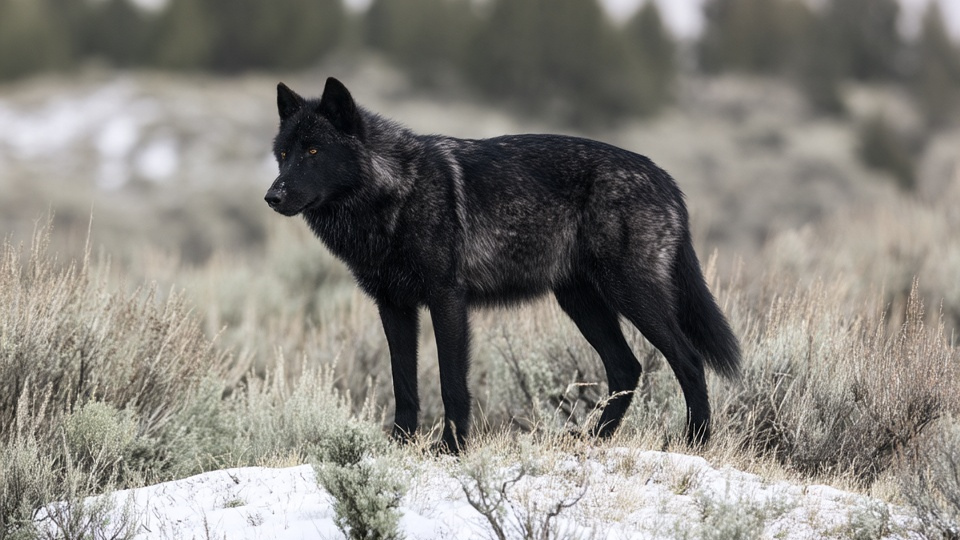
A black, collared wolf born in Yellowstone National Park was shot by a hunter in Montana on September 23, 2026. The Billings Gazette reported that wolf watchers identified him as 1273M, a male associated with Yellowstone’s Rescue Creek Pack.
Wolf hunting is prohibited inside Yellowstone. Park wolves that cross onto state-managed land in Montana become subject to state regulations, including hunting during designated seasons. That division shapes how Yellowstone manages wild animals: staff may still monitor the animals and share data with state agencies, but the park’s hunting prohibition doesn’t apply in WMU 313.
No public, case-specific report reviewed from the National Park Service or Montana Fish, Wildlife & Parks names the harvested wolf. State records show that one wolf was harvested in Wolf Management Unit 313, the small district bordering Yellowstone near Gardiner, and that the harvest filled its one-wolf quota.
By February 2024, Yellowstone’s capture records listed 1273M as an adult black male with the Rescue Creek Pack. Biologists replaced his GPS collar during that capture, continuing a research trail that reached back to 2019, when he was born into the Junction Butte Pack.
Some watchers called him “Tripod” or “Trouble.” Those informal names came from an early encounter in which the curious young wolf picked up a tripod left beside a road, then followed after a visitor recovered it.
The lasting part of that story was Yellowstone’s response. As 1273M continued approaching vehicles and people, staff put him through weeks of nonlethal aversive conditioning in spring 2020. The park later reported a clear change: he began keeping away from people and roads.
The unit closed two days after the reported shooting
Montana’s final 2026 regulations opened the general wolf season on September 15. WMU 313 had a separate quota of one wolf, and the rules required the unit to close after 24 hours’ notice once that quota was reached.
The Billings Gazette placed the shooting on September 23. Montana FWP then issued a closure notice on September 24, stating that the quota had been reached and that hunting and trapping would stop at 11 a.m. on September 25. The agency’s live harvest table records one harvest against a quota of one.
That chronology clears up a discrepancy in later retellings. September 25 was the effective closure date and the day Yellowstone watchers publicly shared the identity of the dead wolf. The best available reporting dates the shooting two days earlier.
The public record doesn’t give the exact kill site or its distance from Yellowstone’s boundary. It places the harvest in WMU 313, which covers part of Park County near Gardiner. The shooting occurred during Montana’s general wolf season, and FWP counted the harvest toward the unit’s quota.
Similar jurisdictional shifts appear elsewhere. Discvr’s recent examination of hunting rules in Alaska’s national preserves showed how adjoining federal lands can carry sharply different rules even when wildlife moves through them as one landscape.
The Gardiner Basin serves as winter range for northern Yellowstone’s ungulates and is comparatively accessible to people. Yellowstone’s 2025 annual report cites those conditions when explaining why most hunting and trapping deaths of park-pack wolves occur along this stretch of the Montana boundary.
Those losses have repeatedly appeared in the park’s records. Yellowstone documented 19 wolves from monitored packs harvested outside the park in 2021. In 2024, it recorded 12 wolves from park packs killed by hunters in Montana. The figures vary by year, but the boundary has remained a recurring source of mortality.
The most recent full population snapshot counted 84 wolves in Yellowstone at the end of 2025, spread across seven packs and one newly formed group. At least 36 pups were born, and 17 remained alive at year’s end. That was the park’s lowest annual pup-recruitment total since 1996. Researchers considered it likely part of natural variation rather than assigning it a single cause, though they noted disease as one possibility.
Montana’s hunting rules apply to radio-collared wolves, too. A collar allows researchers to follow movements, identify individuals and understand what happens when a pack leaves the park. Montana requires the collar from a harvested wolf to be returned to the state.
The two public records leave different impressions. Yellowstone followed 1273M across years of changing behavior and pack life. Montana recorded one anonymous harvest, enough to close WMU 313. The link between them comes from wolf watchers who said the dead animal was 1273M.
Leave a comment