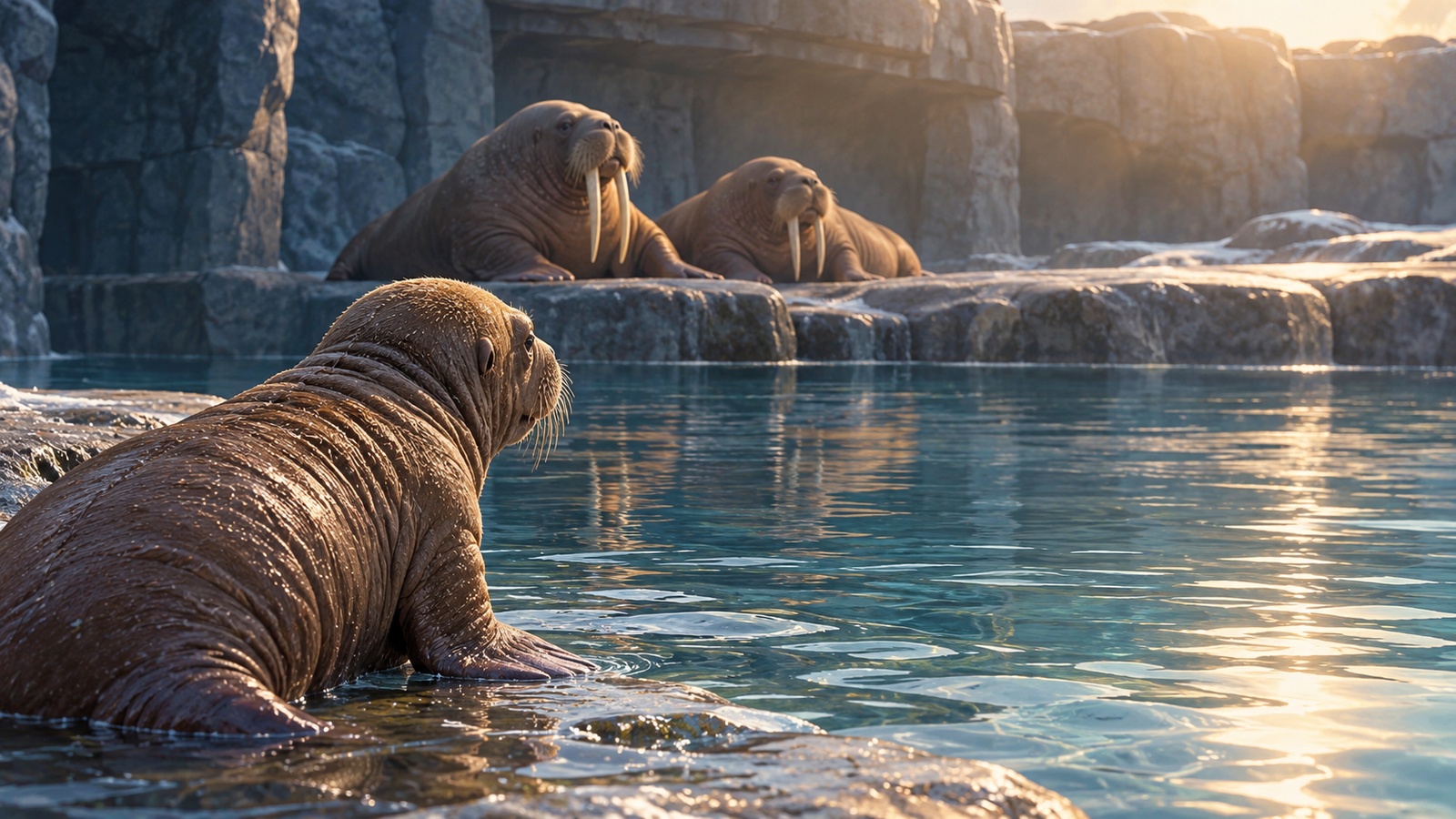
Annautaq arrived in Florida with a future already sketched out: quarantine, bottle feedings and, when his caregivers judged him ready, slow introductions to three resident walruses. The five-month-old Pacific walrus had already survived a remote rescue in Alaska and weeks of intensive rehabilitation.
One week after SeaWorld publicly described that plan, one of those animals was gone.
SeaWorld announced on October 28, 2026, that Kaboodle, a 23-year-old Pacific walrus, died while undergoing a medical procedure related to a chronic gastrointestinal condition. She had raised two daughters and later became a surrogate to rescued young walruses, including Uki. That history was one reason the Orlando herd appeared especially promising for Annautaq.
Annautaq and Kaboodle never met. What disappeared was a possibility built into his placement: an orphaned calf learning beside an adult female who already knew how to care for young walruses.
The search for that kind of social setting began after Annautaq was found alone near Point Lay, Alaska, in September 2026. A large gathering of walruses had cleared the beach as storm-driven surf intensified. Researchers Tony Fischbach and Violet Anniskett later came across the calf between the weathered remains of two adults. Those animals were never identified as his parents, and no one has established how he became separated from his mother.
Scavenging birds were closing in, and polar bears had also been seen nearby. With approval from wildlife authorities and support from the local Iñupiaq community, the researchers guided the calf to an unused building and stayed with him until travel became possible. His evacuation eventually carried him by aircraft and vehicle to Seward, more than 800 miles from the beach.
When he entered care on September 14, staff estimated his age at five months and recorded a weight near 200 pounds. They gave him fluids and treated several shallow wounds. He was otherwise responsive and stable enough for the team to begin considering his longer-term needs.
During the next few weeks, Annautaq ate steadily, gained about 20 pounds and no longer needed critical rehabilitation. Recovery, however, did not make him a realistic candidate for release.
In the wild, a young walrus may remain beside its mother well into its second year. Feeding is only one part of that time together. The mother also provides protection, close contact and the everyday social learning that comes from living beside another walrus. Keeping an orphan alive requires intense human contact, and that necessary familiarity can make life back in the wild unsafe.
Before Annautaq, the Seward center had admitted only 11 orphaned Pacific walrus calves since opening in 1998. Its staff could supply formula, veterinary treatment, enrichment and almost constant companionship. The center did not have other walruses for him to live with.
His case resembles other rescues that lead to permanent care: ending the immediate crisis is only the first step. The animal still needs a safe place to grow, compatible companions and people prepared for years of specialized care.
The permanent-placement question reached beyond which facility had an open pool and qualified veterinarians. Specialists considered the ages, temperaments and backgrounds of the animals he might eventually join. SeaWorld Orlando offered three distinct possibilities.
At two years old, Uki had already completed the same broad passage from an Alaska rescue through rehabilitation in Seward. Garfield, 44, offered a much longer view of that path: he too had entered human care as an orphan from Alaska. Kaboodle offered a different kind of experience. She had raised calves and had already helped a rescued youngster settle into a walrus group.
Why Kaboodle was part of the plan
Kaboodle was born at SeaWorld San Diego in 2003 and moved to Orlando in 2011. Her crossed tusks were visually distinctive. For Annautaq’s future, though, her experience around calves carried far more weight.
The Orlando park recorded its first walrus birth in 2017, when Kaboodle delivered Ginger. Her second daughter, Kora, arrived two years later. When Uki arrived after her own Alaska rescue, she and Kaboodle formed a close relationship, and SeaWorld described the older animal as a surrogate mother.
None of that guaranteed the same connection with Annautaq. Introductions between walruses are gradual, and caregivers cannot assign a relationship in advance. Kaboodle’s presence simply created a rare opportunity: an adult female with experience responding to both biological calves and an orphaned youngster.
In its October 21 placement account, the Alaska SeaLife Center said the walruses already living at each candidate facility mattered, including their ages, personalities and experience with calves. Orlando stood out because it offered both another young walrus and an experienced adult female.
Annautaq left Alaska on October 1 for the nearly 4,000-mile trip to Orlando. Once there, he began a monthlong quarantine and continued receiving care at all hours. SeaWorld said he could take as many as six bottles a day while adjusting to his new surroundings.
After quarantine, caregivers intended to let him meet Uki, Garfield and Kaboodle at a pace set by his behavior. They would watch whom he approached, where he appeared comfortable and how the resident animals responded. The plan depended on observation rather than a guaranteed pairing.
With Kaboodle gone, the maternal option built into the original plan disappeared before introductions started. Her death also changed the social world of Uki, who had already formed a bond with her.
As of October 30, SeaWorld had not announced a replacement for Kaboodle, released a revised introduction schedule or confirmed that Annautaq had met Uki or Garfield. Both remain potential companions, but the experienced adult female originally expected to help with his transition is no longer part of the group.
For now, Annautaq remains between stages. The crisis on the Alaska coast is behind him, and the people responsible for his care have supplied protection, treatment, food and near-constant company.
What comes next cannot be planned with the same precision as a transport route or feeding schedule. Caregivers can create safe opportunities for the animals to meet. Annautaq, Uki and Garfield will determine what kind of family grows from them.
Leave a comment