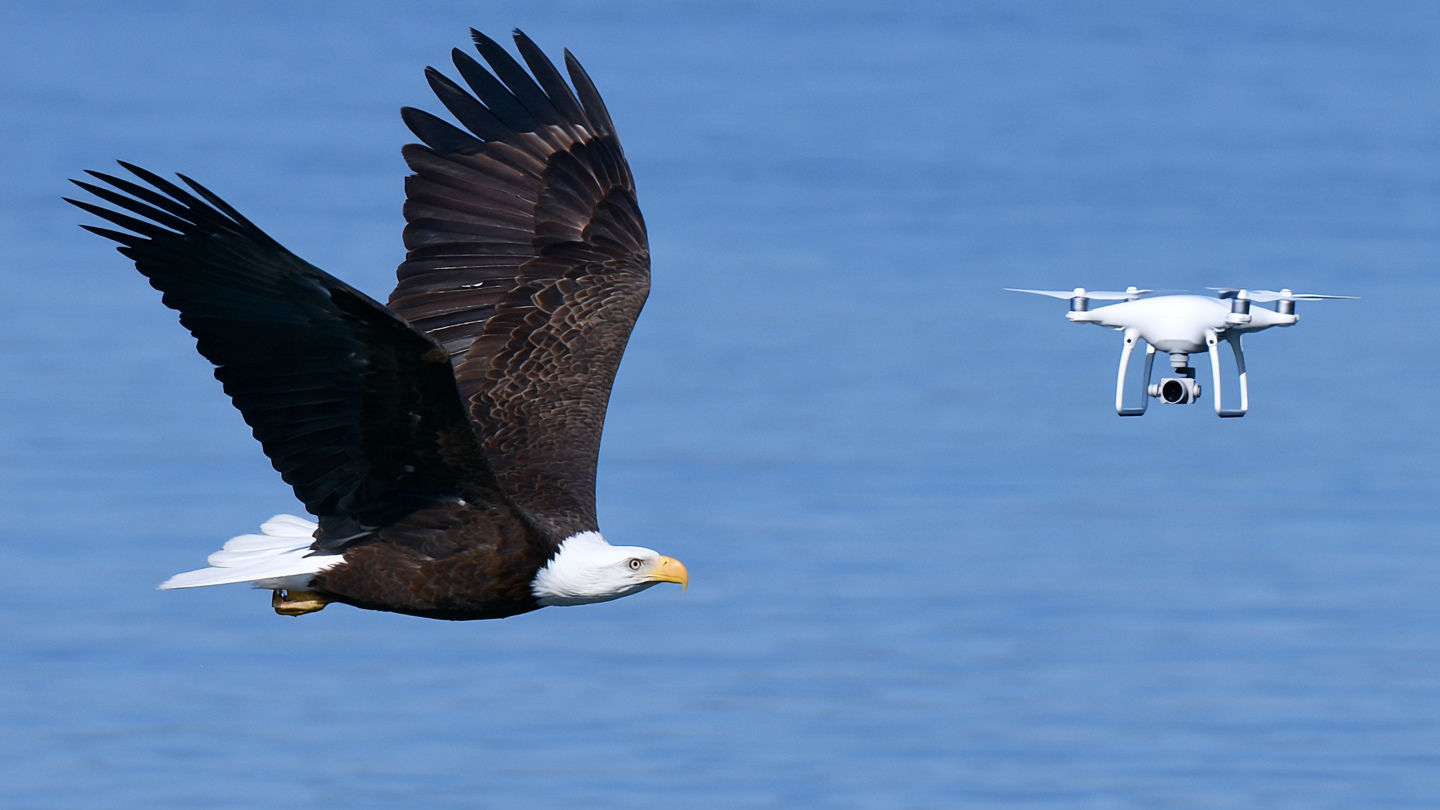
Hunter King’s drone sent 27 warnings in 3.5 seconds as it fell toward Lake Michigan. One indicated a missing propeller. An eagle had struck the aircraft during a shoreline survey, leaving the pilot with flight data and a search to organize.
The encounter happened on July 21, 2020, over Lake Michigan, south of Escanaba in Michigan’s Upper Peninsula. King, an environmental quality analyst and drone pilot, was surveying shoreline erosion for the Michigan Department of Environment, Great Lakes, and Energy, known as EGLE. The aircraft was a Phantom 4 Advanced, which EGLE valued at $950.
It was work the shoreline needed. Lake Michigan-Huron reached record monthly average water levels that June, July and August, while flooding and erosion damaged coastal areas. King’s aerial survey was intended to help communities understand and cope with the high water.
He’d already made three mapping flights in the area that day. About seven minutes into the fourth, satellite reception became unreliable, so he called the drone home. The signal recovered. Then the aircraft began spinning.

The agency’s account of the flight puts the strike at 162 feet above the lake. The drone’s speed fell abruptly from 22 mph to 10 mph, and it began spiraling downward within half a second.
King looked up from the spinning camera view and saw the departing eagle. A couple nearby told EGLE they’d watched it hit something, without realizing the object was a drone. All three said the bird appeared uninjured as it left.
The aircraft kept sending information during its fall. Its final transmission came from 34 feet above the water.
There’s no onboard video of the strike. EGLE said the camera wasn’t recording during that return flight, although King had been watching its live view. What survived in the flight record was a sequence of speeds, heights and warnings.
The couple helped King search, but they couldn’t find the aircraft. Its reported position put it about 150 feet from shore in water only four feet deep. Tannin had darkened the lake enough to make searching underwater difficult.
Arthur Ostaszewski, who coordinated EGLE’s drone program, returned with snorkeling equipment and a kayak. Unable to see through the water, he tried feeling for the aircraft with his feet, working through the soft lakebed in a grid. After two hours, lightning forced him to stop.

The search ended, but the drone program had to adjust
On August 18, 2020, the third search succeeded with less difficulty than the team expected. Winds and currents had cleared the water. Brian Eustice, a geologist, joined technicians Brian Lower and Mike Priebe for the attempt. They brought sonar and an underwater camera, only to find the drone visible near its last reported position.
It lay upside down in the muck. A propeller was missing, but the team saw little other obvious damage from the encounter. The damage report and memory card went to Lansing for evaluation.
EGLE also began considering how to keep its aircraft and nearby raptors from colliding again. By September 2021, its drone program’s follow-up described several precautions: checking locations for eagle nests and perches, developing evasive maneuvers, and considering larger aircraft. Some drones had eyes painted on them.
The team was looking at how an eagle might perceive the machine. Its earlier proposals included changing the aircraft’s appearance so it looked less like a gull. Why the Michigan eagle struck remains unknown.

Ostaszewski reported that the program had avoided eagles over the preceding year. The update didn’t isolate which precautions had helped. Its drones continued other environmental work, including inspecting landfills, assessing wetlands and collecting information in places staff couldn’t easily reach on foot.
The U.S. Fish and Wildlife Service says there’s no distance at which drone observation of eagles or their nests is known to be safe. Big Bear’s fixed eagle cameras offer a way to follow their lives without flying a camera toward them.
EGLE’s own coordinator put the goal more simply in the 2021 update: “Together we soar – as far away from eagles as feasible.”
The images in this article are visualizations and do not depict the actual eagle, incident or locations described.