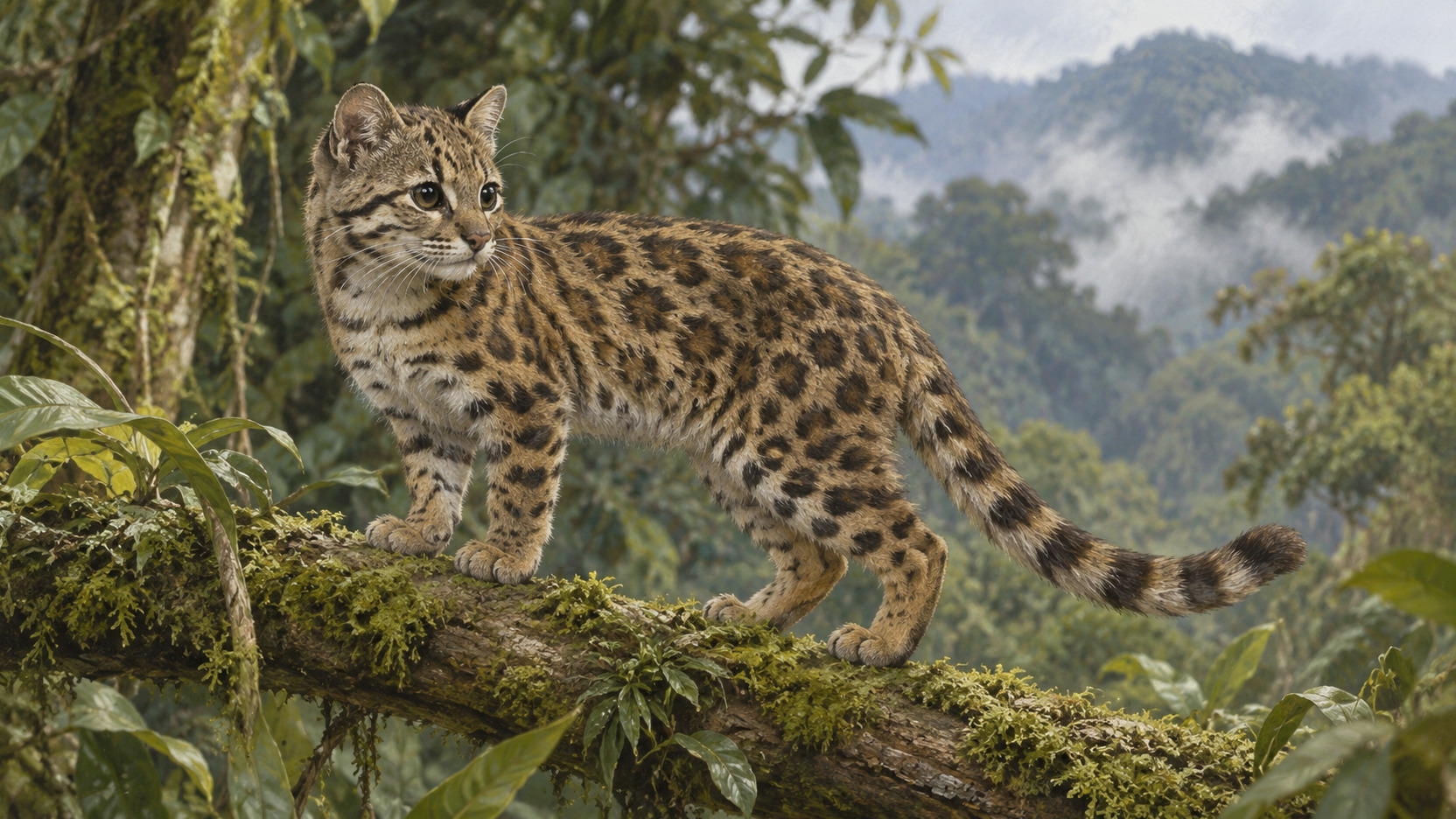
Before scientists settled on Leopardus tilcayo, people in Bolivia were already calling the small wild cat tilcayo. Its formal description, published September 17, 2026, preserves that local name while recognizing an animal with a distinct evolutionary history.
The announcement adds to the recent wildlife discoveries in South America, but discovery doesn’t always begin with an unfamiliar animal. Sometimes it begins by questioning the identity assigned to one people have known for years.
In this case, a cat living at Bolivia’s Senda Verde wildlife sanctuary helped prompt that question. A family had taken it in as a kitten, believing it was domestic, before eventually bringing it to the refuge. The male is now about 10 years old.
He’s about 18 inches long, excluding his tail, and weighs roughly 3 pounds. Those measurements describe this individual, not an established average for the species.
View National Geographic’s post about the discovery
Biologist Paola Nogales-Ascarrunz initially thought the animal was Leopardus tigrinus, another tiger cat. While preparing a booklet in 2019, she noticed that its large rosettes didn’t match a reference photograph from Brazil. The comparison gave her a reason to investigate beyond its appearance.
That investigation became part of a broader comparison of genomes from 38 cats in the genus Leopardus, using both living animals and museum material. The number matters: these weren’t 38 tilcayos, and the study wasn’t a census of the new species.
The study in Current Biology supports recognizing five species within the tiger-cat group. Their genetic analysis places the split between tilcayos and other tiger cats at approximately 1.4 million years ago. Its scientific description is new; the evolutionary separation it records is ancient.
Comparing the cats’ DNA helped resolve a problem that photographs alone couldn’t settle: similar-looking animals don’t necessarily belong to the same species. The study distinguishes their histories rather than simply sorting them by the size of their spots.
A species identified, a population still uncounted
The announcement has been described as the first entirely new cat species in more than a century. The researchers distinguish this from giving species status to an animal that already had a historical scientific name. Recent cat taxonomy makes an unqualified century-long claim less straightforward.
The clouded tiger cat, Leopardus pardinoides, for example, carries a name dating to 1867 despite its recent recognition as a separate species. Another proposed species, Leopardus narinensis, was named in 2023. Its status remains disputed, and the Mammal Diversity Database currently includes it within L. pardinoides.
For the tilcayo, the more urgent unknown is how many live in the wild. Study co-lead Jonas Lescroart says there isn’t yet a population estimate. The researchers’ evidence includes two living individuals they examined and limited camera-trap records. That doesn’t mean only two animals remain.
Early observations offer clues, not a complete account of its life. Rodent remains in scat suggest part of its diet, while camera records suggest greater nighttime activity. Its known habitat lies in Bolivia’s Yungas forests on the eastern slopes of the Andes.
Nogales-Ascarrunz identifies forest clearing, agricultural expansion, human-caused fires and mining as pressures on those mountain forests. Lescroart says the team has contacted the IUCN about assessing the five tiger-cat species separately. That prospective review shouldn’t be mistaken for an already assigned threat category for the tilcayo.
The recovery of the Iberian lynx shows why species-specific knowledge matters. Its conservation efforts have addressed prey availability, habitat and causes of mortality. The tilcayo still needs the fieldwork that would establish its distribution and population size before comparable priorities can be fully defined.
Recognizing the tilcayo doesn’t, by itself, tell conservationists which forest patches support breeding populations or how well those populations are connected. It tells them which animal they need to investigate. The next task is to find where it lives, how many there are and what those places need to keep it there.


Leave a comment