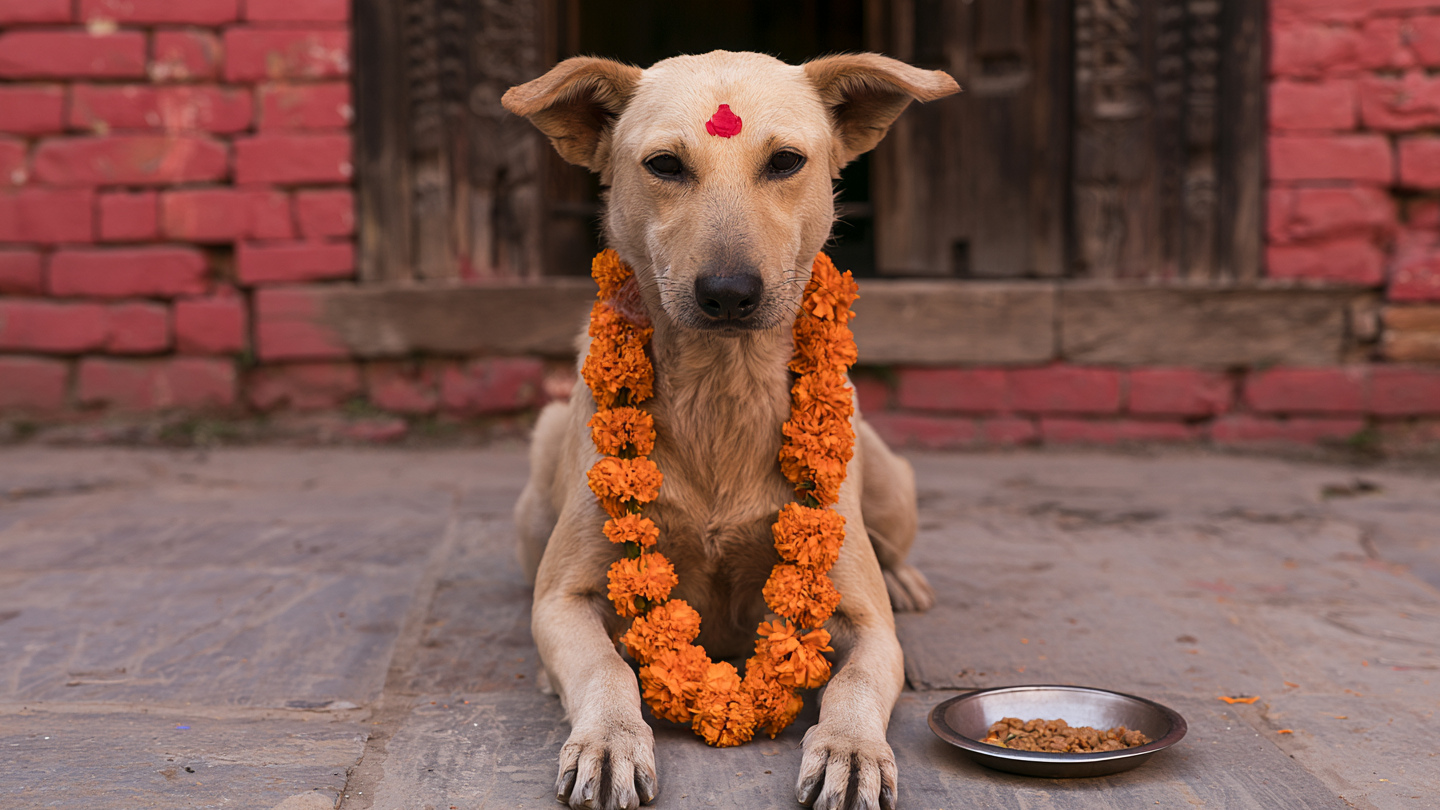
People in Nepal honored pet dogs and animals living on the streets with flower garlands, tika blessings and food on November 8, 2026. Shelters joined in, and working dogs had ceremonies of their own.
Kukur Tihar extends beyond the family pet. A dog can belong to a household, work beside a police officer or live among neighbors who feed it. Ownership isn’t a condition for inclusion in the observance.
The orange marigolds are its most recognizable detail. People drape the flowers around dogs’ necks, apply a red tika to their foreheads and offer food. These gestures express respect for animals valued as companions and guardians.
The observance belongs to Tihar, a Hindu festival celebrated over five days in Nepal. Kukur Tihar’s date follows the lunar calendar and usually falls in October or November. In 2026, it coincided with Laxmi Puja, when homes were lit to welcome the goddess of wealth.
The Nepal Tourism Board’s account of Kukur Tihar points to a story from the Mahabharata. Yudhishthira reaches the entrance to heaven with a dog that has followed him. Offered admission without his companion, he refuses to leave the animal behind. The dog is then revealed as a divine figure testing his character.
Loyalty becomes a demand on the human, too. Even at the entrance to heaven, Yudhishthira’s treatment of the dog is what counts.
Hindu traditions also connect dogs with Yamaraj, the deity who rules over death. They act as his messengers and watch over the passage into his realm. The festival’s attention to dogs draws on those sacred associations as well as their everyday presence in people’s lives.
On November 8, 2026, Nepal’s embassy in India held a Kukur Tihar program attended by diplomats, staff and families. Dogs received garlands, tika and treats as the embassy introduced the tradition to its guests.
A working partner or a neighborhood dog
Ahead of the 2026 ceremony, the Kathmandu Post profiled Leo, a Labrador chosen for an outstanding-police-dog award after a search deployment following flooding. He had spent 20 days assisting the search teams.
Nepal’s police dogs have several specialties. Some help find missing people or track suspects; others detect drugs or explosives. The newspaper’s interviews with Nepal Police officials describe routine health checks, exercise and daily training, as well as a process for finding adopters when dogs retire. Before entering training, prospective police dogs undergo veterinary screening.
That work depends on the relationship between dog and handler. A garland and a medal give the partnership a public moment, while much of the care happens away from an audience.
Footage published by The Financial Express on October 20, 2025, shows a separate force, Nepal’s Armed Police Force, honoring its dogs during that year’s Kukur Tihar. Handlers present garlands and food alongside demonstrations of the dogs’ training.
For a dog living among neighbors, care can involve several households rather than a single owner. Nepali Times has described community dogs as animals that receive food, and sometimes a place to stay, from the communities around them.
An injured community dog may need treatment without needing to leave its neighborhood permanently. Animal Nepal describes a program in which dogs recover at its treatment center and return to their communities once healed. Some animals remain in its care for life.
The organization also sends a mobile team to treat sick or injured dogs where they live, taking more serious cases to the center. Its population-management work includes catching dogs for sterilization and rabies vaccination before returning them to the locations where they were found.
For some dogs, fostering is a step toward a permanent home. Animal Nepal says vulnerable dogs and puppies may enter its adoption program, and it supports adopters with vaccinations, minor treatment and sterilization during the first year.
A dog returning to its familiar street has a different future. It still needs people there willing to feed it, notice an injury and call for help. Kukur Tihar gives that dog a place in the celebration, even when no one can call it their own.

Leave a comment