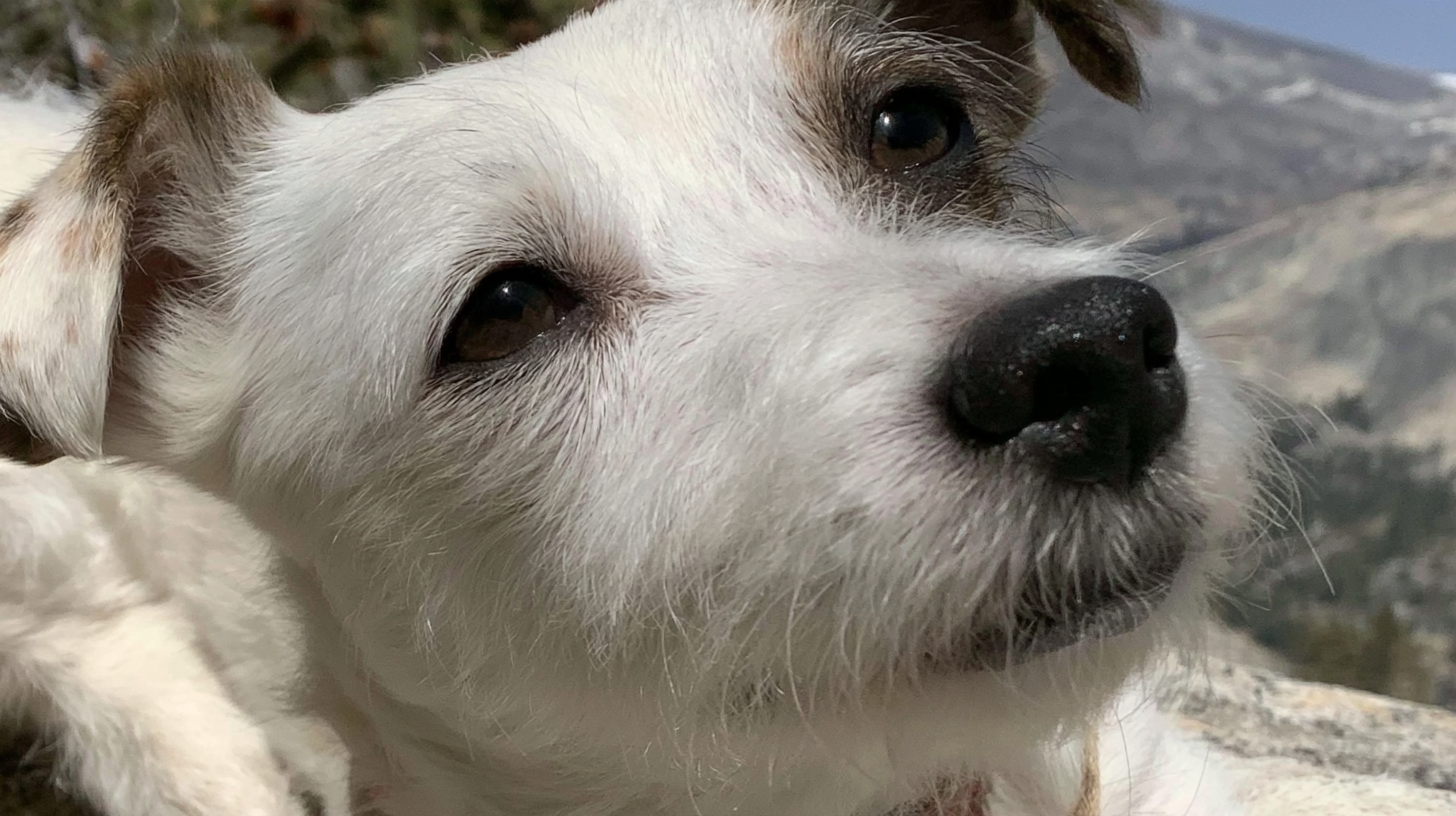
A photograph taken October 9 showed a small white dog in Yellowstone National Park with a purple collar still around her neck. For the people searching for Luna, the image offered welcome evidence that she was alive at that moment. It also showed the problem that has defined the search: she could be seen, but not safely reached.
Yellowstone already raises difficult questions about helping animals in the park. Luna’s case is different from the plight of an injured wild animal. She’s a 10-year-old, roughly 18-pound Jack Russell terrier from California, and her rescuers believe they’ve identified an area she returns to. They still have to persuade her to enter a place where she can be caught without another chase.
Luna disappeared on September 10, 2026, during her family’s stay in the Canyon Village area. Katie Boucher, president of Montana’s Norris Ark Training & Recovery Center, says the family had left Luna inside a cabin while visiting Norris Geyser Basin, where pet dogs aren’t permitted. A Do Not Disturb sign was reportedly on the door. According to Boucher, a housekeeping employee entered anyway and Luna escaped. Staff then reportedly pursued the frightened dog for about two hours, pushing her farther from the cabin.
That account comes from the rescue leader, not an independently established account of every person involved. There’s another important piece of context: Yellowstone’s published pet rules and the lodging concessionaire’s own policy both prohibit leaving pets unattended. A Do Not Disturb sign doesn’t override those rules. The circumstances deserve care rather than an easy assignment of blame.
Her family searched for about a week before returning home, according to Boucher. The search continued. Luna was reportedly spotted on September 13 and again on September 20. Since then, rescue volunteers and park workers have described repeated sightings near Canyon Village, including security-camera footage showing her inside a business. The October 9 photograph offers a dated glimpse, but no photograph alone can tell us what she’s eating, where she sleeps or how well she’s coping physically.
The unusual difficulty is that people can be close to Luna and still make it harder to catch her. Boucher says attempts to call or approach her have sent her running. In ordinary life, calling a pet’s name is a gesture of reassurance. For some lost dogs, it has the opposite effect.
The Missing Animal Response Network’s guidance on lost dog behavior explains that dogs frightened by separation or repeated capture attempts can become wary of people, sometimes even their owners. A familiar voice doesn’t always overcome the animal’s immediate urge to move away. That doesn’t establish Luna’s exact mental state, but it provides a useful explanation for why another search party may be less helpful than a quiet, consistent recovery plan.
Boucher believes Luna’s early life may have prepared her to live outdoors. She says the dog spent roughly her first year as a stray before being adopted. That history might help explain her movements and apparent ability to stay out of sight, but it’s no guarantee of survival. A dog appearing on camera after dark isn’t evidence that she’s well nourished or protected from the next storm.
For now, the most reliable clues are repeated reports from a relatively small area. Rescuers have deliberately withheld the details of where Luna may be sleeping. Publicizing the location could bring curious visitors into a place that the team needs to keep calm.
The trap, the bears and a shrinking rescue window
The recovery plan depends on Luna approaching a humane enclosure of her own accord. Boucher has described using a Missy Trap, a large, adaptable pen with a gate that can be triggered when the intended animal is properly inside. The design came from The Retrievers, a lost-dog recovery organization that developed it for dogs unwilling to enter conventional small traps. The organization’s instructional video demonstrates the trap design, not Luna’s actual recovery effort.
In many missing-dog searches, food helps draw an animal to a trap. Yellowstone changes that calculation. Boucher says food bait could attract bears and other wildlife, creating risks for Luna as well as the people monitoring the enclosure. In a region where people and grizzlies share territory, drawing a wild animal toward a small dog could create a second emergency. Her team has instead described using familiar scents while observing the dog’s movements and waiting for the right opportunity.
The waiting is intentional. A mistimed gate closure or an unexpected human approach could make Luna more suspicious of the same location next time. The equipment’s ability to close doesn’t mean a capture is imminent. Whether the team can watch and trigger it reliably in Yellowstone’s patchy communications environment is another practical constraint.
There is urgency, but the frequently repeated claim that Yellowstone itself closes in a week isn’t correct. Boucher has said her team may have to suspend field operations around October 19 because of accommodations, deteriorating weather and access limitations. The National Park Service’s published 2026 schedule places the seasonal closure of most Canyon-area roads to ordinary vehicles after October 31. Some roads in Yellowstone remain open year-round. An earlier end to this recovery attempt is a team-specific operational deadline, not the closing of the national park.
October conditions are already exposing Luna to cold nights, snow and risks associated with wildlife. Those hazards are real, but predictions that she will certainly die when the rescuers leave are not supported. Neither is the opposite promise that her experience as a stray will see her safely through winter. As of the October 13 reporting review, no independently confirmed recovery announcement had been found.
The public’s most useful role is unusually restrained. Boucher is asking anyone who happens to see Luna not to chase her, call to her or put out food. Instead, note the time and place, take a photograph if doing so doesn’t involve approaching, and text or call Norris Ark at 406-946-2825; Yellowstone park dispatch can also receive reports at 307-344-2643. These instructions don’t invite people to travel into the search area; they help the trained team use sightings from those already there.
Behind every new sighting is the same unresolved question. Luna has repeatedly been visible in a place where finding an animal might seem like the hardest part. Bringing her home now depends on allowing a frightened dog to choose, at last, to come close.
Leave a comment