For several days in July, one of Bear 132’s three young cubs was missing.
No one saw how the cub became separated from its mother and siblings at Brooks River in Alaska’s Katmai National Park and Preserve. What happened afterward turned one of this year’s Fat Bear Week family entries into something more complicated than a before-and-after weight-gain story.
The cub was seen moving through the river corridor alone. At times it approached other bear families. Instead of finding protection, it was ignored or driven away. Bear 132, meanwhile, still had two other spring cubs to feed and protect.
Several days later, the missing cub and its mother found each other again in the lower Brooks River area.
Exactly how they reunited remains unknown. Explore.org’s official profile of the family raises the possibility that 132’s long experience at Brooks River helped, while also acknowledging that luck may have played a part. No one witnessed the original separation, and there’s no evidence that allows observers to reconstruct a dramatic search by either bear.
What can be said with confidence is simpler. A first-year cub spent days without its mother in a place occupied by much larger bears, and it eventually returned to a family that is now entering Fat Bear Week intact.
Explore’s September 2021 post shows 747 alongside Grazer and her cubs at Brooks Falls. This archival clip features a different family, not 132’s missing cub.
That matters because a spring cub is nowhere near normal independence.
In Katmai, cubs generally remain with their mothers for about 2½ years. They normally separate during May or June of their third summer. Bear 132’s three current cubs were born only this year.
A separated cub therefore isn’t simply a smaller bear learning to live alone early. It has lost the adult that provides protection, access to resources and the accumulated knowledge of how to move through a landscape crowded with other bears.
Bear 132 already had plenty to manage without the separation.
First identified as an approximately 4½-year-old bear in 2009, she is now among the more experienced mothers known at Brooks River. Her three cubs are her fourth documented litter. Explore describes her as a large female with dark, grizzled fur and a distinctive chevron-shaped patch of fur on her forehead.
Her history also shows how quickly a bear family can change.
In July 2018, the dominant male bear 856 killed one of 132’s cubs. Her surviving cub escaped into a tree and was separated from her for roughly two hours before the two reunited. They remained together for the rest of that summer.
The 2026 separation was different. There is no evidence that another bear caused it, and the cub survived several days on its own. The two events shouldn’t be blended into a single narrative. Together, though, they reveal something that Fat Bear Week’s playful bracket can easily obscure: keeping cubs alive at Brooks River is an ongoing task, not a single dramatic act.
Raising cubs changes the meaning of getting fat
Fat Bear Week celebrates an obvious transformation. Bears arrive looking leaner, consume huge quantities of salmon and enter fall carrying dramatically larger reserves.
For a mother with dependent young, those calories have more than one destination.
Research involving brown bear populations in four parts of Alaska, including Katmai, has found that maternal body size and age are associated with offspring recruitment. Larger mothers were more likely to be observed with surviving dependent young, while age, used by researchers as a proxy for experience, also showed a positive relationship. The researchers cautioned that body condition is complicated by the energetic cost of supporting cubs.
That distinction is useful when looking at 132.
It doesn’t mean her age caused the reunion or that scientists can predict the future of her three cubs from photographs. It does help explain why maternal experience and access to enough food matter over an entire season.
Bear 132’s family has already appeared in Fat Bear history.
In 2021, one of her spring cubs won the inaugural Fat Bear Junior competition. That youngster had been one of two surviving cubs from a litter of three. During that season, 132 rarely brought the family near Brooks Falls, instead using areas farther downstream. The National Park Service suggested that the choice might have offered the young bears greater security, although the bear’s motivation couldn’t be known.
The cub still grew rapidly and eventually advanced from Fat Bear Junior into the main competition. Katmai’s September 25, 2021 announcement marked that earlier litter’s win.
Five years later, 132 herself is making her first Fat Bear Week appearance, this time accompanied by all three of her current cubs.
That is part of a wider change in the 2026 tournament. Brooks River recorded 19 bear families and 37 cubs this summer, according to Explore, and five family groups were included in the main bracket. Discvr’s earlier look at why Fat Bear Week inspires such attachment explored how following recognizable wild animals across years can turn individual histories into part of the event.
132 makes that idea unusually visible.
Someone who watched her raise a Fat Bear Junior champion in 2021 can now watch a completely different litter. The same mother is older. The risks are different. The river is familiar, but the summer has produced another set of events that nobody could have predicted from a bracket.
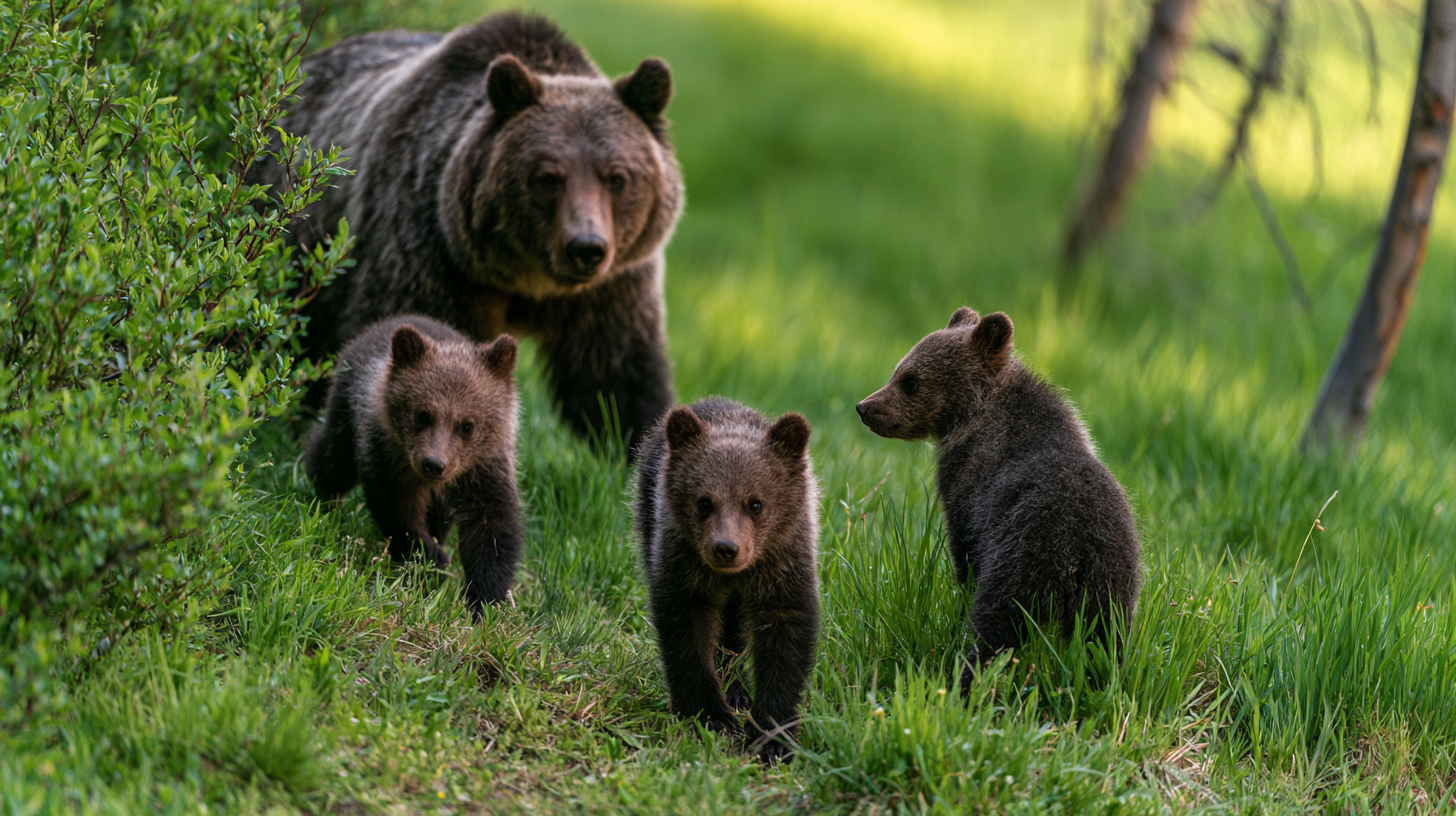
On September 9, photographer C. Loberg captured 132 with all three cubs together in the grass. The image now circulating with the family’s Fat Bear Week story was taken well after the July separation. It shouldn’t be mistaken for a photograph of the reunion itself.
That later date actually gives the image more meaning.
It shows the outcome weeks afterward: three cubs still traveling with their mother as summer neared its end.
Explore also shared this bearcam post in July 2026. It offers context for the bears’ surroundings, rather than a record of 132’s reunion.
The family enters the first round of Fat Bear Week on September 22 against Bear 284 Electra and her two cubs. Voting is scheduled from noon until 9 p.m. Eastern.
There’s no scientific score behind that matchup. A vote for a family group isn’t a measurement of health, maternal skill or future survival. An adult male building reserves for himself and a female feeding and protecting three young animals face different demands, even when the tournament places them on the same bracket.
That difference is part of what makes 132’s season worth following beyond the vote.
Fat Bear Week ends on September 29. For the bears, autumn doesn’t.
The cub that disappeared in July still has years of development ahead before normal independence. Its siblings do too. Their mother still has to reach the den with enough reserves to sustain herself through winter while remaining responsible for dependent young.
By the time 132 and her cubs appeared together in that September photograph, the family had already survived the part of the season that no online vote could decide.

Leave a comment