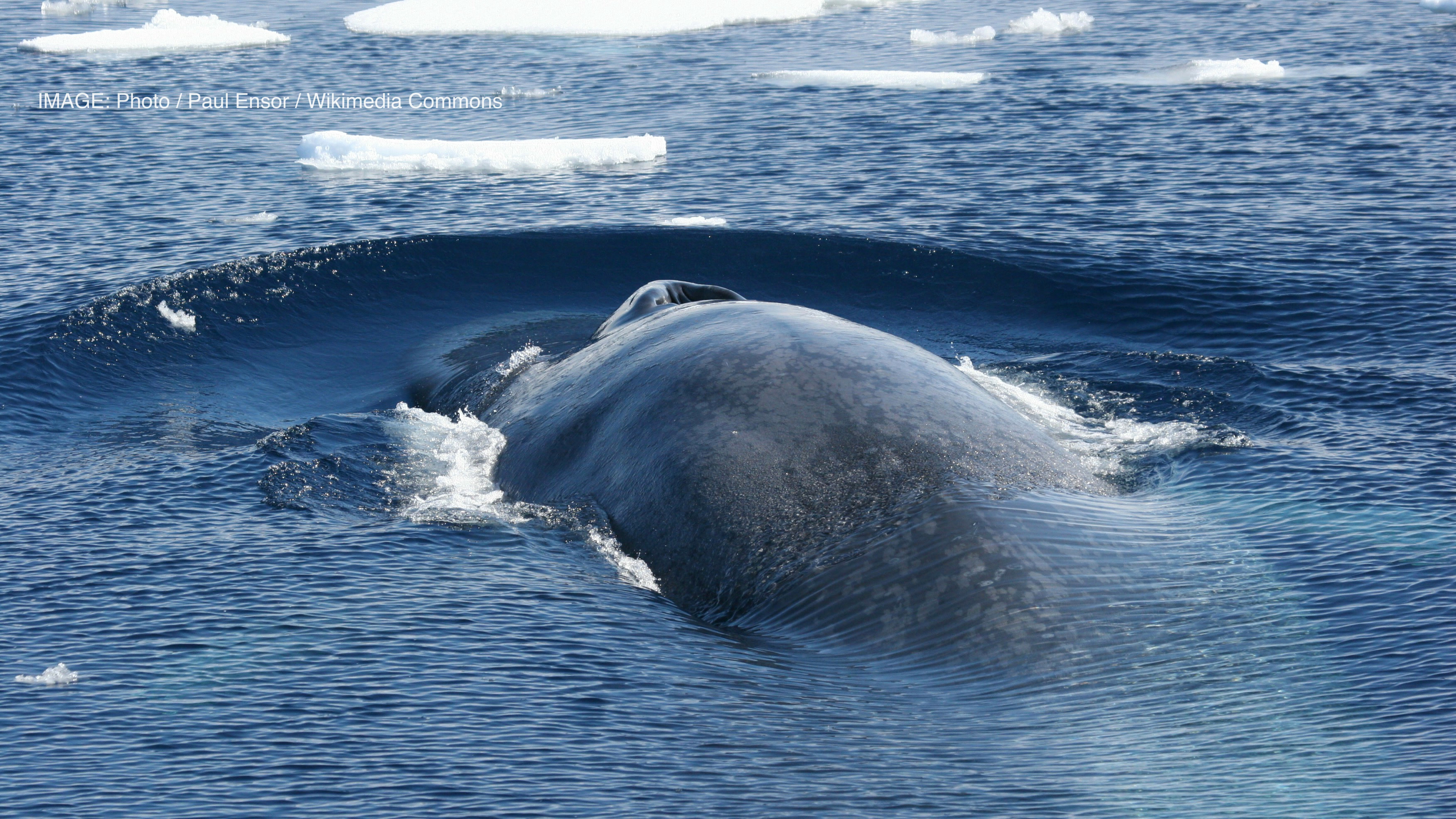
An estimated 418 Antarctic blue whales remained at the population’s lowest point in 1973. A new reconstruction puts their number at about 4,000 half a century later. After industrial whaling nearly eliminated these enormous animals, their population appears to be rebuilding.
The number attracting attention is 4,018. Whale researcher Zoe Rand led the assessment, published November 5, 2026, in Endangered Species Research. The figure is the model’s estimate for 2024 and covers Balaenoptera musculus intermedia, the Antarctic blue whale subspecies.
That apparent precision invites a reasonable question. How could anyone find every blue whale across such an immense expanse of ocean?
Researchers approached the problem by combining records collected for different purposes over many decades. Whaling logs documented animals removed from the population. Shipboard surveys measured how frequently whales were encountered along search routes. Photographs allowed scientists to recognize individuals they had seen before. A population model brought those records together to reconstruct the collapse and subsequent recovery.
On a survey ship, an encounter is useful even when most of the surrounding ocean remains unsearched. Observers record where whales appear relative to a planned route, and analysts use those sightings to estimate density. Accounting for how easily animals can be detected helps turn a limited strip of observations into information about a much larger area.
Photographs add something a distant sighting can’t provide: an individual identity. Blue whales have mottled pigmentation that researchers can compare between images. A whale photographed during one expedition may turn up in a catalog years later, revealing that the same animal has been encountered again.

The pattern of those repeat encounters helps scientists estimate how many whales are represented by the animals they can identify. This requires careful treatment of where photographs were taken, how widely whales move and how likely different individuals are to be photographed. A heavily studied area can produce a misleading impression if it’s treated as representative of the entire population. A separate photo-identification analysis supplied recent evidence for the new assessment.
The model’s central figure of 4,018 comes with a 95% credible interval extending from 1,874 to 8,395 animals. The researchers can estimate the population’s scale while remaining uncertain about its precise size.
The latest photo-identification observations used in the assessment extend through 2018/19. The assessment uses its estimated growth trajectory to project the population forward to 2024. The earlier estimate of 418 is also reconstructed, with uncertainty around the historical low point.
Comparing the two central estimates gives a roughly 9.6-fold increase. Yet the same analysis puts the Antarctic blue whale population before industrial whaling at approximately 206,000. Against that starting point, the latest estimate represents just 1.9% of the former population.
Industrial catches explain the scale of that collapse. More than 30,000 Antarctic blue whales were killed in the 1930/31 season alone. Protection arrived in the 1960s, but illegal Soviet catches continued afterward, with the last recorded Antarctic blue whale catch in 1973/74.
Rebuilding from such a small remnant takes generations. Female blue whales generally give birth every two to three years, according to NOAA Fisheries. Even sustained population growth has a long way to go when almost the entire original population has disappeared. The Antarctic subspecies remains classified as Critically Endangered.
There are also places where the return has become visible. Around South Georgia, a major former whaling center in the South Atlantic, more than 34,000 kilometers of systematic survey effort between 1998 and 2018 produced a single blue whale sighting. A survey in 2020 recorded 38 encounters involving 58 blue whales and identified 23 individual whales from photographs.
The study published in 2020 documented blue whales returning to waters where industrial whaling had devastated them.
The food supply will help determine what happens next
More whales will need more food. For Antarctic blue whales, that means krill, the small crustaceans that sustain much of the Southern Ocean’s animal life. Whether recovering whales can find enough prey depends on where krill gather, how those concentrations change and what other demands fall on the same feeding grounds.

Commercial krill fishing is part of that question. A 2024 Perspective in Nature Communications examined the potential for competition as whale populations recover and the fishery expands. Its authors emphasized the importance of overlap between fishing activity and predator feeding areas, along with major gaps in knowledge about how much recovering whales will consume.
An ocean-wide estimate of abundant krill offers only part of the answer. Food must be available in concentrations that whales can reach and feed on efficiently. The concern is especially relevant when people and predators draw on the same concentrations. How much that competition is affecting Antarctic blue whales remains unresolved.
Whales also influence the system that produces their food. Their feces recycle iron into surface waters, where it can support phytoplankton, the microscopic organisms that krill consume. This is one part of the broader story of how whales transport ocean nutrients.
A 2021 Nature study combined measurements of baleen-whale feeding with calculations of prey consumption and nutrient recycling. It suggested that restoring large whale populations could help restore ecological functions lost during industrial whaling. For Antarctic blue and fin whales, some calculations relied on extrapolations from whales studied elsewhere, leaving room for better measurements in the Southern Ocean itself.
How rising food demand and nutrient recycling will interact is still uncertain. Researchers need to understand both as whale populations and fishing activity change.
The population’s small size raises another concern: what happened to its genetic diversity? A 2012 study led by Angela Sremba found substantial mitochondrial diversity among surviving Antarctic blue whales. Their long lives may have helped preserve variation through a population crash that was recent on an evolutionary timescale.
Historical bones added another perspective. A 2023 study comparing older and modern whale samples found evidence of probable losses of maternal lineages, including in Antarctic blue whales. A population can retain considerable variation while still losing parts of its genetic inheritance. Maternal lineages reveal one part of genetic recovery; assessing inbreeding requires additional evidence.
Antarctic blue whales remain protected from commercial hunting, while other whale hunts continue. Japan’s commercial hunt includes fin, sei, Bryde’s and common minke whales in its territorial waters and exclusive economic zone. Norway permits minke whaling. Iceland’s licensing framework concerns fin and minke whales, alongside the continuing debate over whaling policy in Iceland. Faroese hunts involve long-finned pilot whales and certain dolphins.
Protection from hunting leaves other pressures to address. Vessel strikes and entanglement in fishing gear can injure or kill blue whales. NOAA also identifies pollution, underwater noise and climate change among less-understood potential threats. Their importance varies by region, and their effects on this Antarctic population remain difficult to measure.
Nor does a population model set a dependable date for full recovery. Its long-range projections depend on continued growth and assumptions about how many whales the environment can support. The Southern Ocean that sustained a much larger population before industrial whaling is changing as these animals rebuild their numbers.
Researchers developing the Antarctica InSync “Lost Giants” project propose coordinated survey work focused on 2028. Alongside an updated abundance estimate, they want to investigate feeding, body condition and the habitats whales use through the year.
An updated estimate would show whether the population is still growing. Measurements of feeding and body condition would help explain what the whales need to keep that recovery going.
Featured image credit
Featured image: Paul Ensor, via Oregon State University, Antarctic blue whale (2007), CC BY-SA 2.0. Cropped to 16:9; credit text added.


Leave a comment