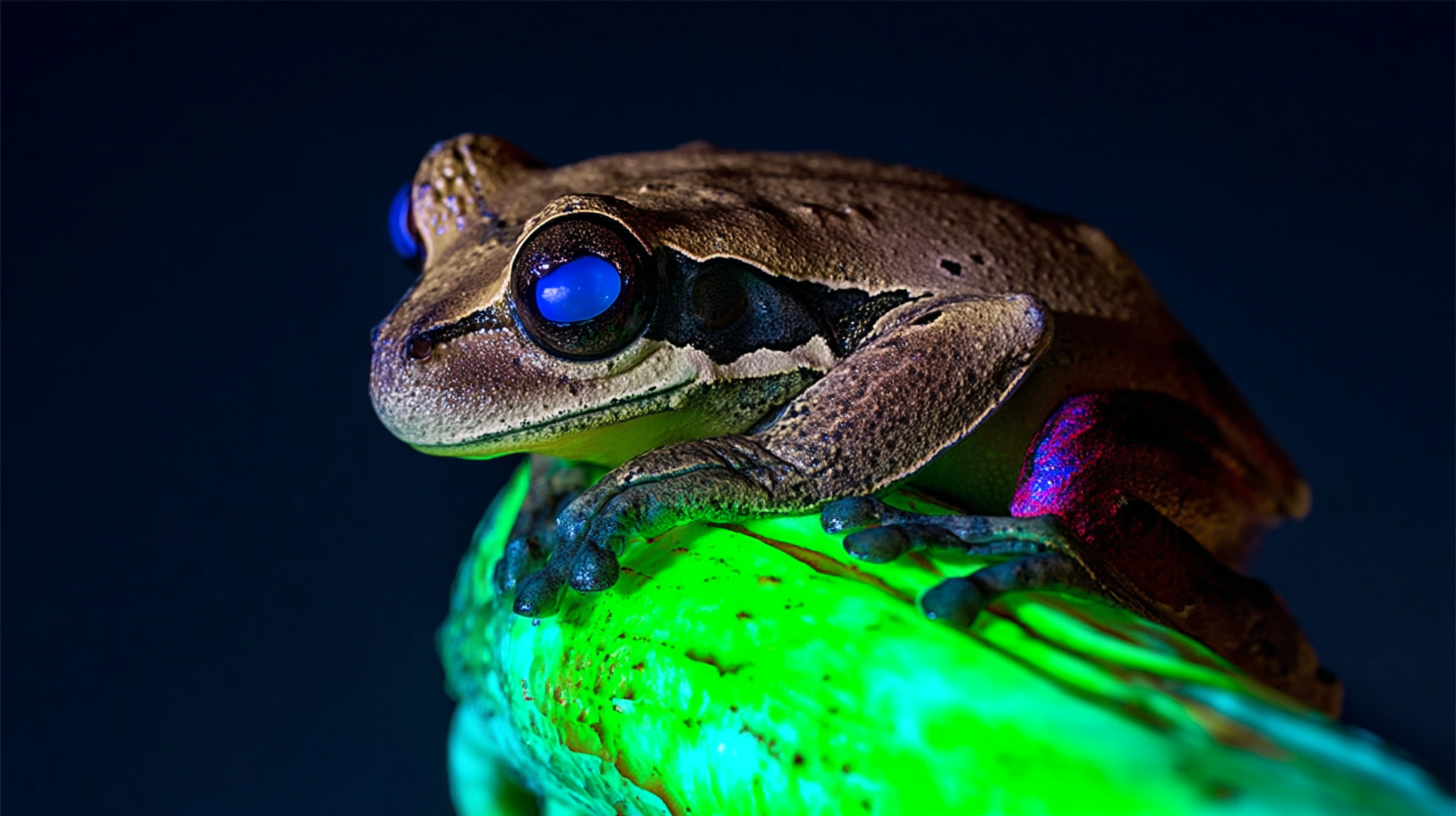
In the highland rainforests of Borneo, where clouds cling to the canopy and the air thickens with night, scientists have stumbled upon something that seems pulled from myth: a frog that glows.
This newly discovered species is the first amphibian ever documented to exhibit true bioluminescence. While some frogs are known to fluoresce under ultraviolet light, this one produces its own soft, bluish-green glow without the need for any external illumination. No blacklight. No tricks. Just living skin that emits light in darkness.
It was found deep within Gunung Mulu National Park, a vast stretch of protected rainforest in northern Sarawak, Malaysia. The park is renowned for its caves and ancient karst formations, but this small, glowing frog is now drawing global attention. During a nighttime field survey near a mountain stream, researchers spotted an unexpected glimmer on a moss-covered log. As they approached, the source of the glow became clear: a tree frog, no bigger than a thumb, quietly pulsing with light. Its faint glow brought to mind a miniature lantern, casting a soft shimmer through the undergrowth.
This glow isn’t just a visual oddity. Biochemical testing confirmed that the light is produced through a luciferin-luciferase chemical reaction, the same natural mechanism found in fireflies and certain deep-sea organisms. This is the first time such a system has been observed in any amphibian, upending long-held assumptions about how frogs interact with their environments at night.
Why would a frog evolve to glow? Scientists are still debating the purpose. One possibility is communication: in the dim rainforest understory, bioluminescence could help frogs locate mates or signal to rivals. Another theory suggests camouflage, allowing the frog to blend into a nighttime landscape already alive with glowing fungi and flickering fireflies. A third, more speculative idea is predation, with the glow potentially attracting insects, effectively working as a biological light trap.
Whatever its purpose, the discovery is a game-changer for evolutionary biology and herpetology.
A glowing mystery in the treetops
The frog, still awaiting its formal name, may represent a one-of-a-kind adaptation, or the first of many secretive species that use light in ways scientists are only beginning to understand. Its body emits light most intensely along its sides and belly, and some researchers believe the glow could be modulated depending on time of night or external stimuli. There’s even early speculation that the glow might increase during mating calls or territorial disputes.
What makes the discovery even more urgent is the fragile state of the ecosystem around it. Borneo’s forests are under relentless pressure from logging, palm oil plantations, mining, and changing weather patterns. Many of the island’s species are endemic, meaning they’re found nowhere else on Earth, and they depend on narrow environmental conditions such as precise humidity levels, cool forest floors, and clean water. Disrupt any one of those factors, and the entire system begins to collapse.
The bioluminescent frog’s habitat, while currently protected, is not immune to these threats. Even a slight increase in nighttime temperatures could affect the delicate balance that allows such a creature to thrive. Scientists warn that without increased conservation efforts, we risk losing species before we even have the chance to understand them.
Yet there’s hope. The frog could become a new flagship species for conservation in Borneo, serving as an emblem of how much biodiversity remains undiscovered and how urgent its protection has become. For researchers, it’s an unprecedented opportunity to study bioluminescence in a land-dwelling vertebrate. For the public, it’s a dazzling reminder that not all the wonders of this planet have been catalogued, named, or explained.
It was like discovering a piece of the night sky blinking on the forest floor.
In a world increasingly lit by artificial glow, this tiny amphibian reminds us that the most extraordinary lights often come from nature itself.
Leave a comment