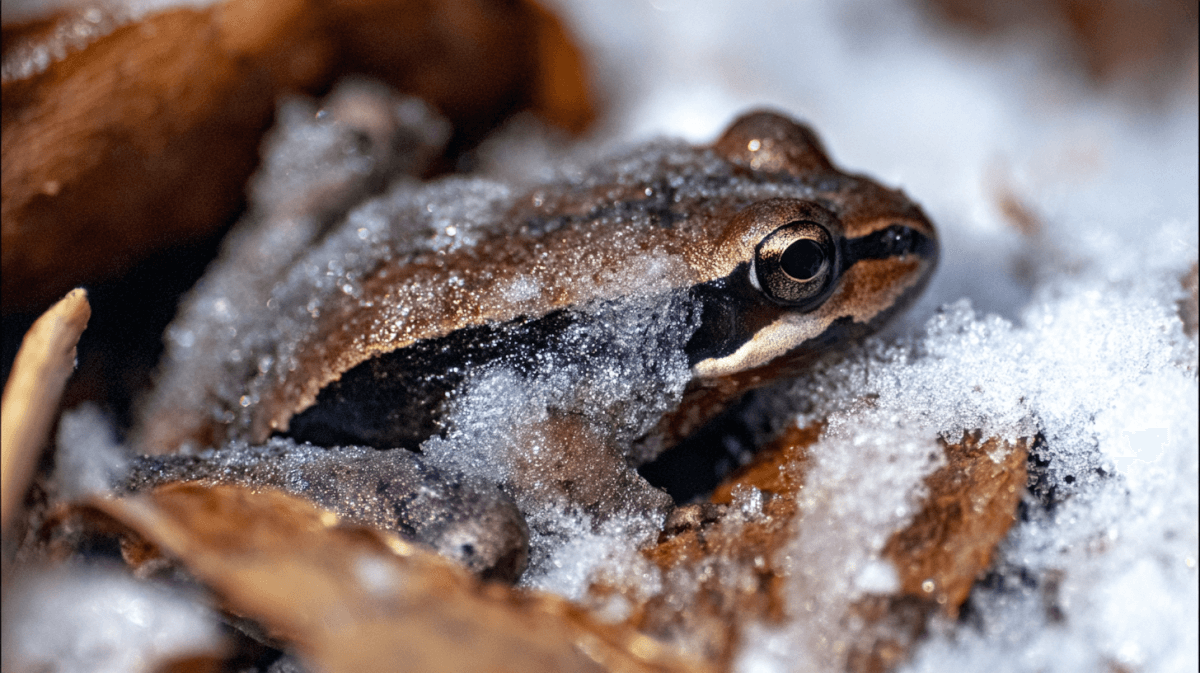
The boreal forest outside Fairbanks sounds like a muted snow-filled cathedral each November, a world muffled by frost and stillness.
Beneath the carpet of fallen leaves and shallow soil, a two-inch amphibian stages one of nature’s most improbable performances.
The Alaskan wood frog (Lithobates sylvaticus) doesn’t burrow deep to escape the cold.
It doesn’t migrate or seek thermal refuge. Instead, it submits.
Ice creeps through its veins.
Water in and around its tissues crystallizes.
The heart stops beating.
Brain waves go silent.
The lungs fall still.
For nearly two hundred days, the animal is, by every clinical standard, dead.
As the first breath of April warms the forest floor, the frog thaws.
Within hours, it’s awake, alert, and hopping, ready to breed as though winter’s death grip never happened.
The biology of resurrection
How it dodges an icy demise is part alchemy, part biological engineering.
The moment freezing begins—typically beneath the skin or in the bloodstream—the liver floods the body with glucose, unleashing a sugary torrent that drives blood sugar levels up to one hundred times the usual range.
Alongside this comes a boost of urea.
This unusual combination works inside the cells, acting as a kind of cryoprotectant.
It prevents the formation of lethal ice crystals within cells while water is drawn out to freeze safely in the spaces around them.
The organs shrink slightly but remain intact, wrapped in a kind of biological insulation that allows them to wait out the freeze without suffering lasting harm.
The real magic happens when the thaw sets in.
As longer daylight hours return and soil temperatures rise, the ice within the frog begins to melt.
It starts near the core, close to the heart.
Within twenty minutes, the muscle shudders, then resumes a slow, steady beat.
The lungs awaken next, drawing in air.
Brain activity flickers back online.
Remarkably, even after months in a frozen state, there’s no sign of tissue damage.
The frog survives not just once, but repeatedly, enduring multiple freeze-thaw cycles in a single season.
It can tolerate temperatures as low as –14°F and a loss of body water approaching 70 percent—numbers that would be fatal to nearly every other vertebrate on the planet.
From frogsicles to future medicine
The implications for human health and science are profound.
While diabetics can suffer organ damage from relatively small increases in blood sugar, the wood frog handles sugar spikes a hundred times more extreme without apparent harm.
This hints at a cellular resilience scientists hope to understand.
Cryobiologists are especially intrigued.
If we could mimic the frog’s cellular antifreeze, we might extend the viability of human organs outside the body.
Current transplantation windows are dangerously short.
Imagine donor hearts, kidneys, or livers surviving for days instead of hours.
That extra time could mean more matched recipients and safer surgeries.
Researchers are already isolating the proteins and pathways that enable the frog’s freeze-tolerance.
They hope to reverse-engineer them for use in human medicine.
A warning from the warming north
There’s also a cautionary tale buried in the frog’s astonishing ability.
Alaska’s winters are changing. Freeze cycles are becoming shorter and more erratic.
That means these frogs are being forced to freeze and thaw more frequently—something evolution may not have prepared them for.
Biologists are watching closely, not just to see how the frogs cope, but to understand how changing seasonal patterns might disrupt even the most extreme adaptations.
If this species begins to falter, it could signal broader instability in Arctic and sub-Arctic ecosystems.
For now, the Alaskan wood frog remains one of evolution’s strangest gifts.
A creature that defies the boundary between life and death.


Leave a comment