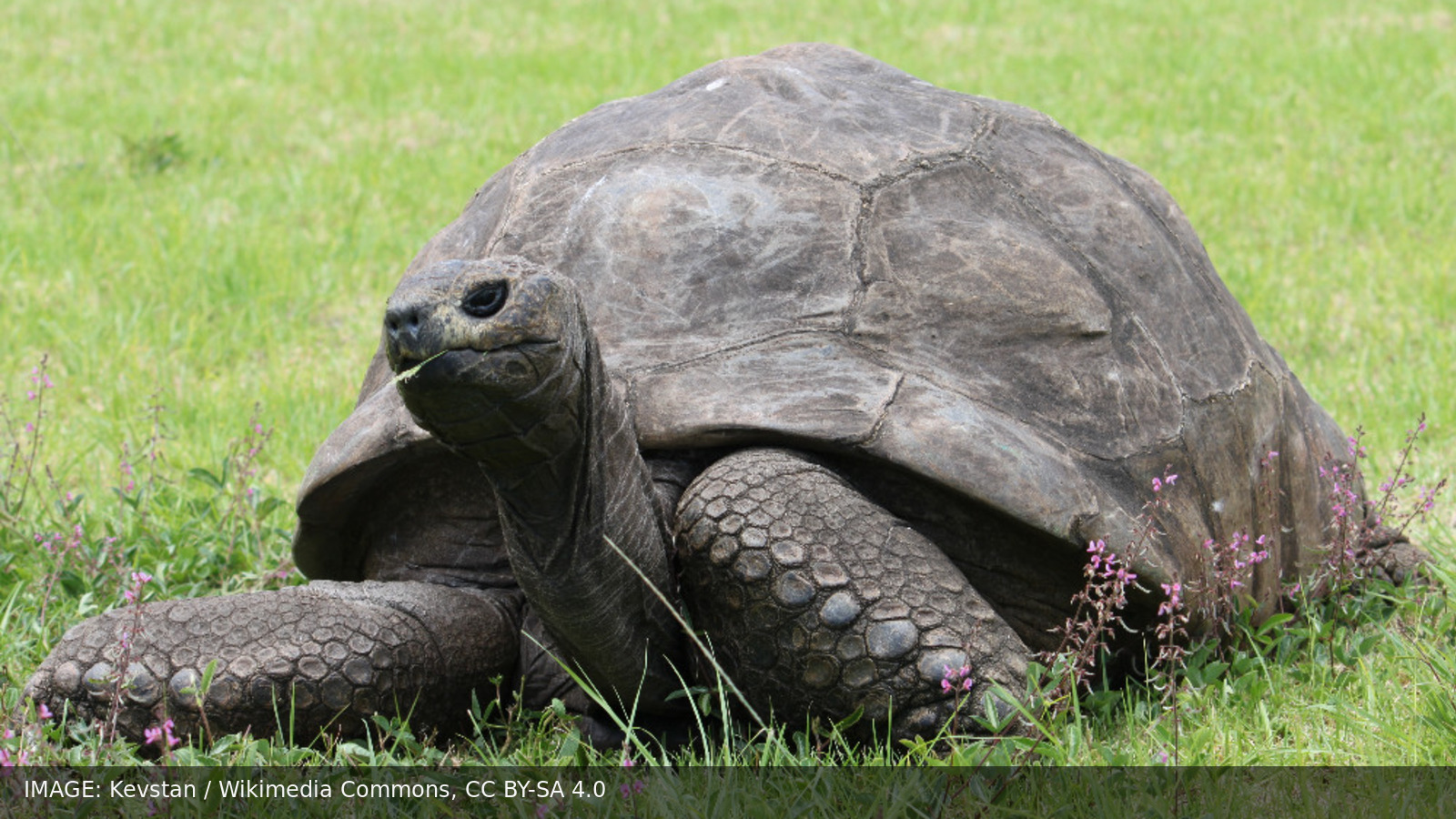
In 2009, an ordinary meal had become a problem for Jonathan, the giant tortoise living at Plantation House on St Helena. The other tortoises could clip grass with their beaks. Jonathan’s beak had grown soft and crumbly, and he was struggling to graze. Veterinarian Joe Hollins found him thin and feared that his long life might be nearing its end.
Jonathan, whose death was falsely reported in April 2026, is now estimated to be about 194 years old. But the animal people feared losing this spring had nearly died many years earlier because of a surprisingly ordinary problem: he couldn’t properly cut grass.
Hollins began providing supplementary food. According to his firsthand account of Jonathan’s recovery, the tortoise gained weight, became more active and eventually recovered a beak sharp enough to cut grass again. It was a practical intervention for an aging animal, years before scientists began explaining his survival in terms of DNA.
This October, a very different account of his longevity arrived: a peer-reviewed study suggesting that parts of the system regulating his genes have remained unusually orderly despite his advanced age.
The two stories belong together. Jonathan’s cells may contain unusual traits that help explain how he reached this age. His veterinary history shows that reaching it hasn’t spared him from physical decline or the need for help.
Jonathan arrived on St Helena from the Seychelles in 1882, already a fully grown tortoise. From that fact, historians and record keepers have inferred that he was at least around 50 years old when he arrived, placing his birth at approximately 1832. Nobody has a record of the day he hatched. Guinness World Records recognizes him as the oldest known living land animal, but his age remains an estimate, not a birthday verified by a birth certificate.
His home is the governor’s residence on a small South Atlantic island. Researchers identify him as an Aldabra giant tortoise, Aldabrachelys gigantea, although accounts of his precise classification have varied. He has outlived generations of human caretakers, and his condition has changed along the way. Cataracts have left him virtually blind, and his sense of smell has deteriorated. His hearing, however, still helps him respond to familiar voices.

The feeding intervention began after Hollins noticed what separated Jonathan from the tortoises around him. They could shear off mouthfuls of grass while he struggled to do the same. Supplementary feeding was followed by an improvement in his condition and the regrowth of a usable beak edge, although the precise cause of the improvement wasn’t established in a controlled trial. Regular supplementary food and health checks became part of his care.
There is no way to calculate how many additional years that attention has given Jonathan. Nor can a feeding routine explain the molecular patterns researchers have now measured. It does show that an exceptionally long life can depend on whether someone notices an ordinary problem before it becomes a fatal one.
What Jonathan’s cells reveal and what they can’t
On October 7, 2026, researchers published a study in Science Advances examining Jonathan’s genome and epigenome. An earlier version had appeared as a preprint in February 2025, so the peer-reviewed publication is the new development, rather than the first announcement of the idea. Among the paper’s contributors is veterinarian Jonathan “Joe” Hollins, whose earlier work helped Jonathan recover.
The study of Jonathan’s DNA and gene regulation asked two related questions. Does his genetic code contain unusual variants associated with the maintenance of cells? And have the chemical patterns that influence how genes are used changed differently from those in younger tortoises?
Getting a sample wasn’t straightforward. St Helena authorities wouldn’t permit a blood draw because of the potential risk to Jonathan. Researchers instead collected material from inside his mouth. They used that DNA for sequencing and compared parts of the result with genetic material from other giant tortoises. A younger Aldabra tortoise named Tank supplied a reference genome that helped overcome limitations in Jonathan’s sample.

The genomic comparison identified 287 genes with certain sequence variants found only in Jonathan among the animals used for that analysis. Some sit in biological pathways involved in DNA repair, telomere maintenance, insulin regulation and cellular defense. Those associations are interesting, but the presence of an unusual variant doesn’t prove that it works better or that it lengthened his life. The researchers also used computational predictions to explore possible effects, which aren’t substitutes for testing the changes in living cells.
The second part of the research is especially revealing. A cell’s genome contains its DNA sequence. Its epigenome includes chemical markings, such as DNA methylation, that help regulate how that sequence is used. Over time, the arrangement of these markings can become more variable. Researchers call one measure of that disorder methylation entropy.
Jonathan wasn’t somehow free of this process. Compared with younger tortoises, his DNA showed widespread age-associated methylation changes and greater disorder across much of the genome. In that respect, the world’s oldest known land animal looks his age.
Yet a smaller group of regulatory regions told a different story. The scientists compared Jonathan’s methylation patterns with those of four other Aldabra tortoises, including animals aged five and 12 and two older adults whose exact ages weren’t known. From 2,895 gene promoters they could compare at adequate depth, they identified 272 where Jonathan and the younger animals showed relatively orderly patterns while the two other older tortoises had more disorder.
Gene promoters help control when nearby genes are transcribed. Many of the 272 regions were associated with functions involving mitochondria, the structures that supply much of a cell’s usable energy, as well as RNA processing and genome maintenance. The finding raises a possibility: keeping regulation reliable in these systems might help an animal withstand some effects of age even as other parts of its biology change.
It remains a possibility. The research couldn’t directly establish how those genes were being expressed in Jonathan’s cells. The sample type restricted several tests, and the team was able to assess only a small fraction of all tortoise gene promoters in this comparison. With one unusually old tortoise and four methylation comparators, the researchers also can’t say how rare the pattern is across the species or whether it caused Jonathan’s longevity.

There was good reason to examine giant tortoises in the first place. Earlier genomic research on Lonesome George and another giant tortoise pointed to genes associated with repair and disease resistance. A 2022 study of 52 turtle and tortoise species in managed collections found very slow or negligible increases in age-related mortality for many of them. Those findings challenge the idea that every animal follows the same pace of aging. They don’t establish that tortoises stop aging or that they can’t become ill.
The comparison matters because giant tortoises of the Galápagos Islands are often used to illustrate extraordinary reptile longevity, though Jonathan belongs to a different island lineage. Long life is an evolved characteristic in multiple tortoise groups. Understanding why any one individual lives so much longer than others is a much harder question.
Jonathan’s new results offer leads for future research into energy production and the upkeep of cellular systems. They don’t offer a human longevity treatment, and his supplementary food isn’t a prescription for people hoping to live longer. Both biological inheritance and living conditions may matter; this study can’t assign each an exact share of the credit.
The researchers can continue testing whether his relatively orderly gene-regulating regions truly protect him. On St Helena, the question that helped save him years ago remains more immediate: is Jonathan still able to feed well, and does he have the care he needs?





Leave a comment