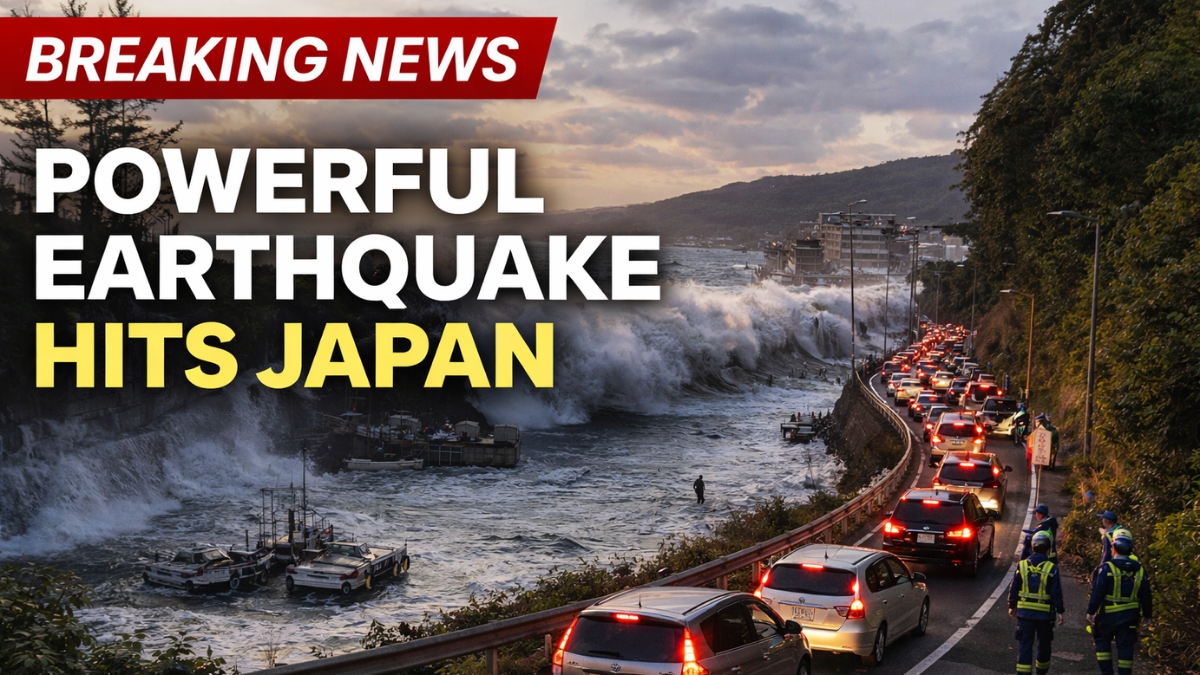
For a few tense hours on Monday, the danger in northern Japan wasn’t only under the ground. It was moving toward shore.
A powerful earthquake struck off the country’s northeastern coast late in the afternoon, triggering tsunami warnings, evacuation advisories, and a familiar kind of unease in communities that know how quickly a seismic event can become a coastal emergency. Japanese authorities initially warned that waves as high as 3 meters, about 10 feet, could reach parts of the region. People in vulnerable areas were told to move inland or climb to higher ground rather than wait to see what the sea would do next.
The quake hit at about 4:53 p.m. local time off the Sanriku coast. Early estimates varied, which often happens in the first hours after a major earthquake, but Japanese and international reporting later converged around a magnitude 7.7 event. Authorities said the tremor was strong enough to halt some bullet train services, close parts of the highway network, and prompt checks at nuclear-related facilities, where no abnormalities were immediately reported.
What followed was serious, but not the worst-case scenario the first warnings seemed to raise. Tsunami waves of about 80 centimeters, roughly 2.6 feet, were recorded at Kuji Port in Iwate Prefecture, and a smaller 40-centimeter wave was observed elsewhere along the coast. Those numbers were far below the 3-meter warning threshold, but they did not make the evacuation response unnecessary. Tsunamis are not a single dramatic wall of water. They often arrive as a sequence of surges, and later waves can be stronger than the first.
That distinction matters, especially in Japan, where the coastline still carries the memory of 2011. Monday’s event was not on that scale, and there were no immediate reports of catastrophic destruction. But the official response showed how much the country’s disaster culture has been shaped by experience. More than 128,000 residents were placed under evacuation advisories across affected prefectures, and local officials treated the threat as real even after the earliest wave measurements came in below the maximum forecast.
Why the warning still mattered
For people outside Japan, a wave under 3 feet may not sound like the kind of event that shuts down trains or sends families uphill. But tsunami risk is measured less by spectacle than by force and timing. Even a smaller wave can push dangerous currents into harbors, river mouths, and low-lying coastal roads. That is why emergency agencies tell people not to judge the threat with their own eyes. By the time the water looks dangerous, the window to move may already be closing.
Later in the day, authorities downgraded the tsunami warning to an advisory, and the broader threat eased. Still, the earthquake left behind more than a brief disruption. Japanese officials also warned of a slightly elevated chance of another major quake in the coming week, increasing the short-term probability of a magnitude 8-class event from around 0.1 percent to 1 percent. That is not a prediction. It is a reminder that in one of the world’s most seismically active regions, one large quake can change how the next few days are viewed.
Japan lives with that reality more than most countries. It sits along the Pacific Ring of Fire, where tectonic boundaries make earthquakes a constant part of life. Most pass with little consequence. Some do not. Monday’s quake appears to have ended without major devastation, but the hours after it struck showed how thin the margin can be between precaution and disaster. The warning may have eased, but the response made clear why no one on that coast could afford to treat it lightly.



Leave a comment