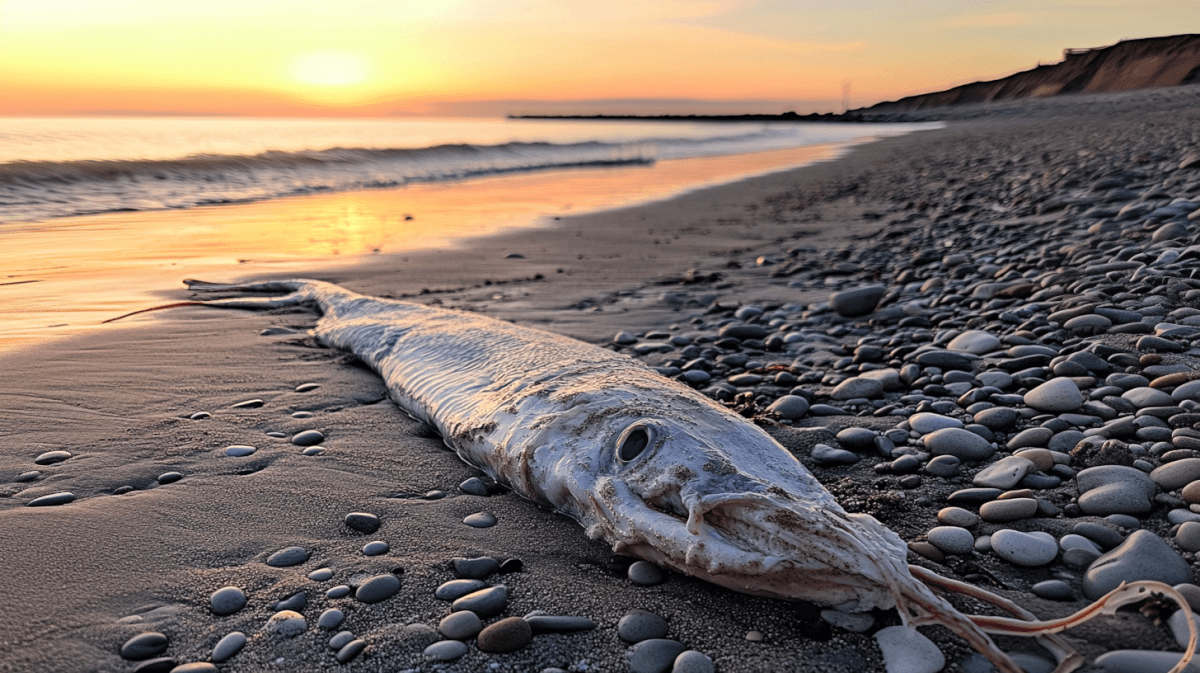
They called it the “doomsday fish,” and for good reason. On February 9, beachgoers in Playa El Quemado, Baja California Sur, Mexico, spotted an oarfish—a massive, silvery creature with a bright dorsal fin and a reputation steeped in folklore. Robert Hayes was among the first to notice it. “That’s an oarfish,” he said. “Holy sh–, they’ve almost never been seen live.”
SEE IT! The rarely seen deep-sea known as an 'oarfish' has washed ashore in Mexico!
— Breaking911 (@Breaking911) February 18, 2025
Legend has it that the creature, known as a 'doomsday fish,' only surfaces from the depths of the ocean when something catastrophic is going to happen. 👀 pic.twitter.com/U5j68io7jx
A Mysterious Oarfish Sighting
Beachgoers watched in awe as the oarfish flailed in the shallows, appearing disoriented. Hayes and others tried pushing it back to deeper water, but the animal repeatedly returned to shore. “We redirected it three times out to the water, but it came back each time,” Hayes told Storyful. Oarfish normally live hundreds or even thousands of feet beneath the surface, which makes their arrival near land a startling event.
According to the Ocean Conservancy, “If one is spotted close to the surface, it typically indicates that the creature is sick, dying or at least disoriented.”
A rare, "doomsday" oarfish was spotted at Baja California Sur beach in Mexico earlier this month, a fish that some believe is a signal of an impending disaster.
— AccuWeather (@accuweather) February 19, 2025
Oarfish are usually found in the depths of the ocean, thousands of feet below the surface. https://t.co/S12UJyL8lB pic.twitter.com/wJ8kppww38
Still, that didn’t curb the fascination. At an estimated 24 feet, this individual was massive enough to impress curious onlookers and prompt calls to a local marine biologist. It finally slipped out of sight, leaving a swirl of questions in its wake.
Myth Versus Science
Legends hold that these rare fish can predict earthquakes and other disasters, a belief partly fueled by reports of multiple oarfish sightings in Japan before the devastating 2011 earthquake and tsunami. Some point to a 4.4-magnitude quake in Los Angeles in 2024 as further evidence, noting that an oarfish had appeared off the California coast soon before. Scientists, however, caution against leaping to conclusions.
“Oarfish sightings may well be correlated with certain changes in the ocean environment,” said Ben Frable of Scripps Oceanography, “but many researchers have suggested this as to why deep-water fish strand on beaches.” Shifts in currents, water temperature, or even illness could draw a deep-sea giant into shallow surf. It’s a testament to how much remains unknown: “We know comparatively little about these fascinating fish,” observed Robert Robins of the Florida Museum.
Whether they’re genuine omens or simply disoriented ocean dwellers, oarfish have captured imaginations for centuries. Their elongated bodies can stretch beyond 30 feet, making them the longest bony fish on record. And because they’re so rarely seen alive, each encounter ignites the question: Why here, and why now?
For Hayes, the moment was unforgettable. He managed to record video of the oarfish lifting its head just inches above the water—a brief, otherworldly glimpse into the deep. Oarfish, it seems, can unite human curiosity and ancient superstition in a single breathtaking appearance. Although researchers may one day unravel the mystery behind these sightings, for now, the legendary “doomsday fish” continues to inspire both dread and wonder wherever it appears.



Leave a comment