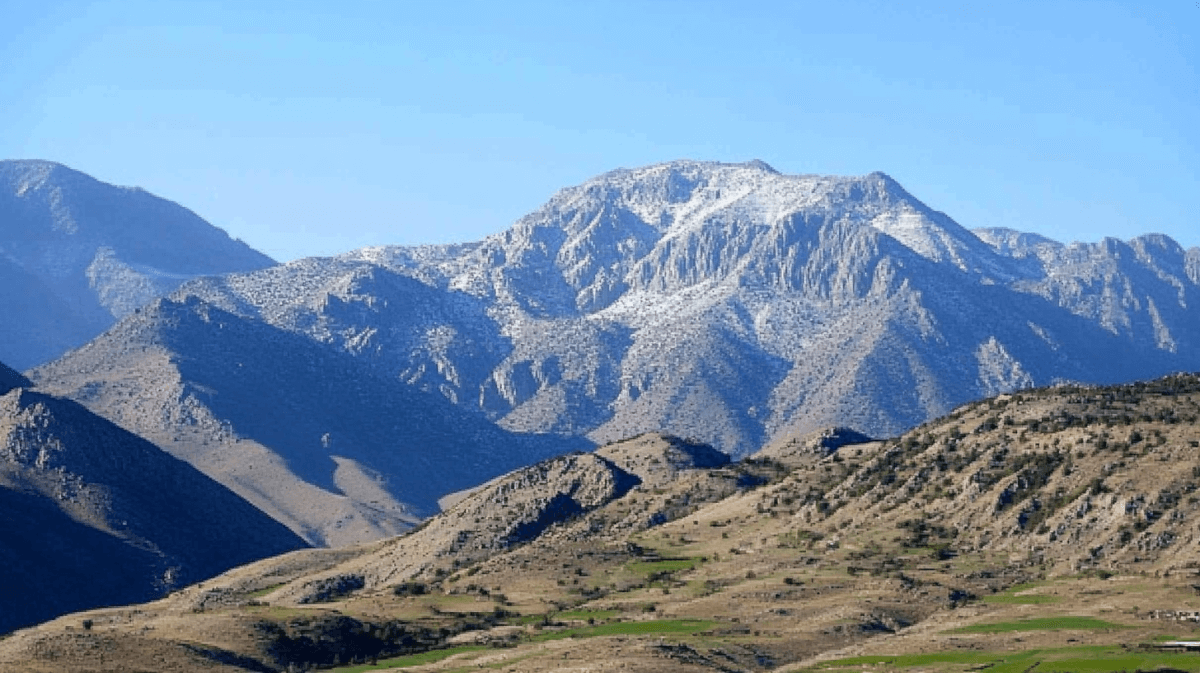
The low rumble of tectonic forces often goes unnoticed in our daily lives, yet a quiet drama unfolds beneath Iraq’s Kurdistan region. Deep underground, the Neotethys oceanic plate is tearing free from the Arabian and Eurasian continents.

By Terpsichores – Own work Source :background : Natural Earth II (public domain) by Tom Patterson, US National Park Servicenational borders : File:NED worldmap 110m.svg by Gringerecoregion shape : File:Western palearctic biomes.svg by Terpsichores, CC BY-SA 3.0, Link
Geologists say this horizontal rupture stretches from southeastern Turkey into northwestern Iran, forming a tear that slowly widens with each passing year.
Some of the most revealing work on this process has come from an international team led by the University of Göttingen. They recently published their findings in the journal Solid Earth, drawing attention to one of nature’s lesser-known stories. Their focus centers on the Zagros Mountains in Iraq and how they’ve shaped, and been shaped by, the underlying plate. When you stand in the Mesopotamian plains, it’s hard to picture the Earth buckling and bending under its own weight. But that’s exactly what’s happening.
Dr. Renas Koshnaw, one of the study’s lead authors, explained it simply. “Given the moderate topography in the northwestern Zagros area, it was surprising to find out that so much sediment has accumulated in the part of the area we studied. This means the depression of the land is greater than could be caused by the load of the Zagros Mountains.” In other words, something else is weighing down the region from below.

By NASA – NASA, Public Domain, Link
That extra force, according to the research, is the still-attached segment of oceanic plate. Beneath the Arabian plate, it’s slowly sinking and pulling down the surface. “This plate is pulling the region downward from below, making space for more sediment accumulation,” Dr. Koshnaw said. The evidence points to an ongoing detachment in the northwestern section where the oceanic plate has already broken loose. In that area, the mountains alone are no longer enough to explain how the land flexes.
These new findings offer more than an intriguing glimpse into geological drama. The implications stretch into practical realms, including how natural resources like sedimentary ore deposits and geothermal energy might be found and tapped. Earthquake risks also loom large. When an oceanic plate breaks away, stresses shift unpredictably, and understanding that process could help communities prepare for seismic events.
By NASA – NASA, Public Domain, Link
A Growing Tear Beneath the Surface
It’s helpful to think of the Earth’s crust as a rigid shell that can bend and crack under immense pressure. Over millions of years, mountain ranges like the Zagros rise up, while ancient oceanic plates get shoved underneath continents. In this particular region, the “subducted” plate has lingered in the mantle far longer than many scientists once believed. Now, it’s snapping off in slow motion.
“This research contributes to understanding how the Earth’s rigid outer shell functions,” Dr. Koshnaw added. The findings are a reminder that beneath familiar landscapes, fundamental forces are reshaping our planet, grain by grain and quake by quake.
Implications for the Future
While the Zagros Mountains capture our gaze with their rugged peaks, the real shifts occur far below our feet. Continued monitoring in Iraq, Turkey, and Iran will be vital. With each new data set, scientists hope to learn more about how a deep tear in an oceanic slab might influence regional water tables, fault lines, and even climate patterns over geologic time.
Ultimately, this drama plays out at a pace humans cannot detect without advanced tools and consistent observation. Yet it underscores a profound message: our planet is a living system shaped by subtle and awe-inspiring forces, and what happens in the hidden rock layers affects life on the surface.




Leave a comment