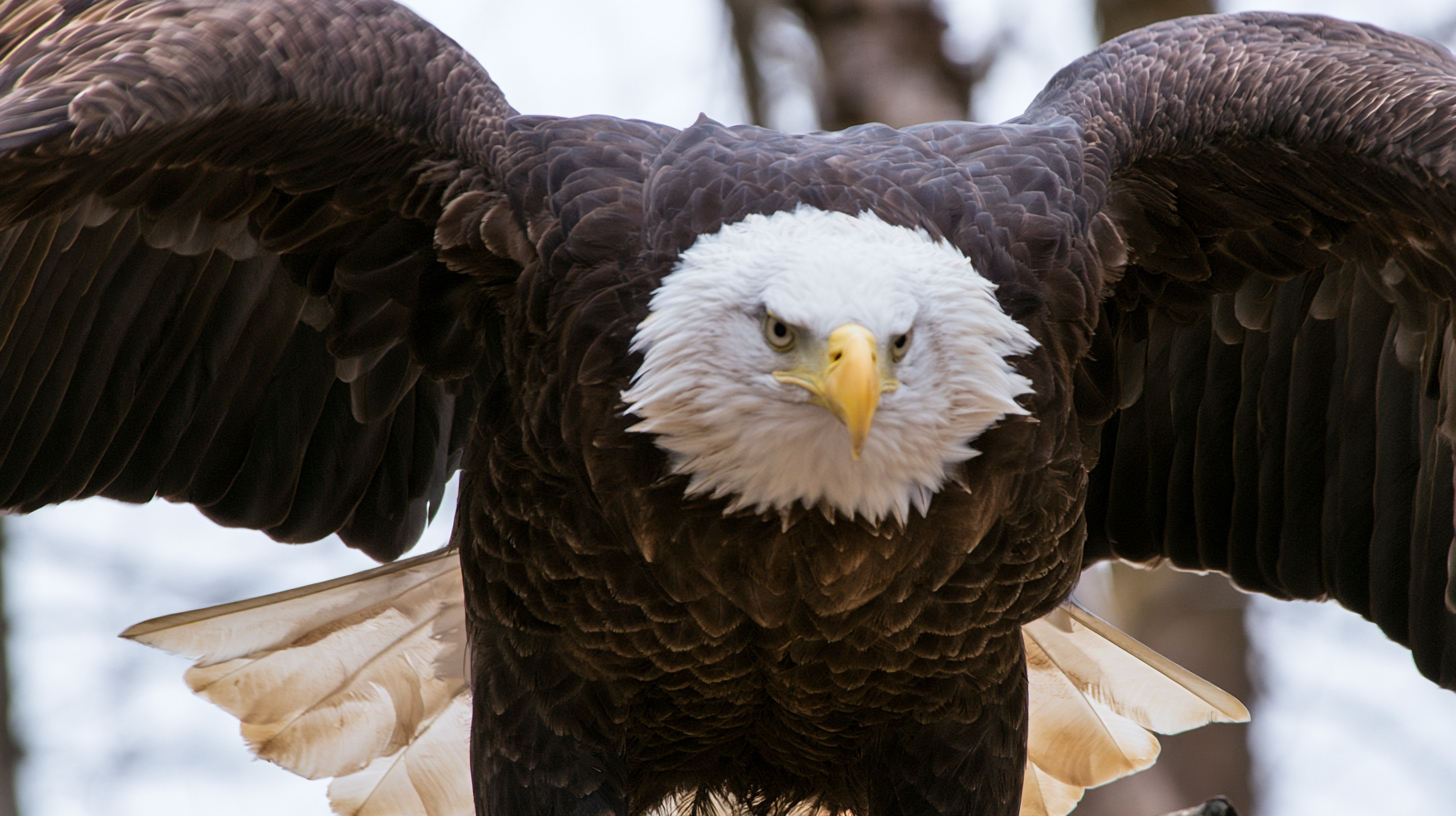
Ojai Raptor Center announced her death on August 10. Her underlying illness and cause of death remain undisclosed.
Jackie, the bald eagle whose life with Shadow unfolded above Big Bear Lake for a worldwide audience, died in the early hours of August 10 after Ojai Raptor Center cared for her for over three weeks. In its official death announcement, Ojai said several days of decline preceded her death, and neither intensive treatment nor input from outside specialists reversed it.
The emergency had begun in mid-July, when an adult bald eagle was found grounded near Dana Point Park. Discvr’s original Big Bear rescue timeline follows those first uncertain days, before Friends of Big Bear Valley publicly identified Ojai’s unbanded Patient 26-519 as Jackie.
Ojai continued using that clinical number because it could not independently authenticate the bird’s identity. Friends of Big Bear Valley, drawing on years of close observation and comparisons of photographs and video, supplied the public identification. Patient 26-519 was an intake number, not a band or tag.
During her final days, Jackie remained critically ill in intensive care. She received oxygen, supportive treatment and continuous monitoring from Ojai’s veterinary team, with consulting specialists involved. The California Department of Fish and Wildlife took custody of her remains. Ojai said it was preparing a fuller account of the treatments and test results with state and federal partners. Those partners included the U.S. Fish and Wildlife Service.
No official source has named a cause of death or a definitive diagnosis. Ojai’s announcement didn’t provide an exact time, say that Jackie was euthanized, report cardiac arrest or announce a necropsy. Those points remain unknown.
The medical crisis was already underway before a brief encounter with two younger eagles. Jackie had been seen on the ground July 16 and 17 and was flying poorly. The later encounter may explain visible commotion, but officials haven’t tied it to her underlying illness or death.
Rescuers collected the eagle early July 18 and transported her to Ojai. She was underweight but alert. Testing revealed severe anemia and inflammation affecting her kidneys, although the kidney problem later improved and renal disease was ruled out. The anemia remained unexplained.
On July 23, a California Living Museum resident named Spirit donated blood for Jackie. Spirit is a bald eagle whose earlier injuries prevent a return to the wild. Jackie’s packed cell volume, the portion of blood made up of red cells, later rose from 8% to 16%. By July 29 she had moved from the oxygen ICU into a regular hospital unit, but Ojai warned that she was still in danger.
The improvement didn’t last. Her red-cell measurement fell again, and clinicians used contrast-enhanced CT imaging and sampled her bone marrow on August 5. She returned to intensive care. By August 9, Ojai reported that the value had fallen below 6% before rising to 9%. Discvr’s earlier explainer on anemia and PCV shows why those numbers described a crisis but could not, by themselves, reveal its cause.
The life the cameras made visible
Jackie’s history wasn’t preserved in a band record. FOBBV’s eagle chronology associates her with a young bird seen in the valley in 2012, but no exact hatch date is documented. The year is an estimate, not a formal age.
A camera went up at the present nest in 2015. Jackie started occupying it while still a subadult in the 2016-17 period. She first paired there with an adult male known as Mr. B. Shadow entered the territory in 2018 and eventually became her mate.
Across those years, the cameras recorded far more than successful hatches. Viewers saw incubation shifts, deep snow, broken eggs, long pauses and first flights. Jackie raised Stormy with Mr. B in 2018. With Shadow, she saw Simba fledge in 2019 and Spirit in 2022. Sunny and Gizmo followed in 2025, then Sandy and Luna in 2026.
The birds were never performers, and the stream offered no promise of a happy outcome. Its power came from duration. People returned often enough to recognize routines and individual behavior, while witnessing how quickly weather, injury or illness could change a wild family’s season. Ojai said Jackie’s story reached millions of people around the world.
That attention also moved beyond the screen. A July 24 campaign announcement said supporters had assembled the full $10 million sought to protect 63 acres at Moon Camp, near the eagles’ territory. More than 25,000 public donations supplied nearly half of the total. Discvr had followed the Moon Camp habitat campaign while the deadline was still approaching. The announcement cleared the way for a purchase, but a later primary source confirming that the property transaction closed hasn’t been located.
Jackie’s death doesn’t change the limits of what the cameras can tell us. They documented her presence, not her private biology. The same care that made her familiar now requires restraint about her final illness.
The nest camera will continue to show wild life as it happens. Jackie’s absence will be part of that record too, alongside the offspring she raised and the habitat work her audience helped carry forward.
Leave a comment