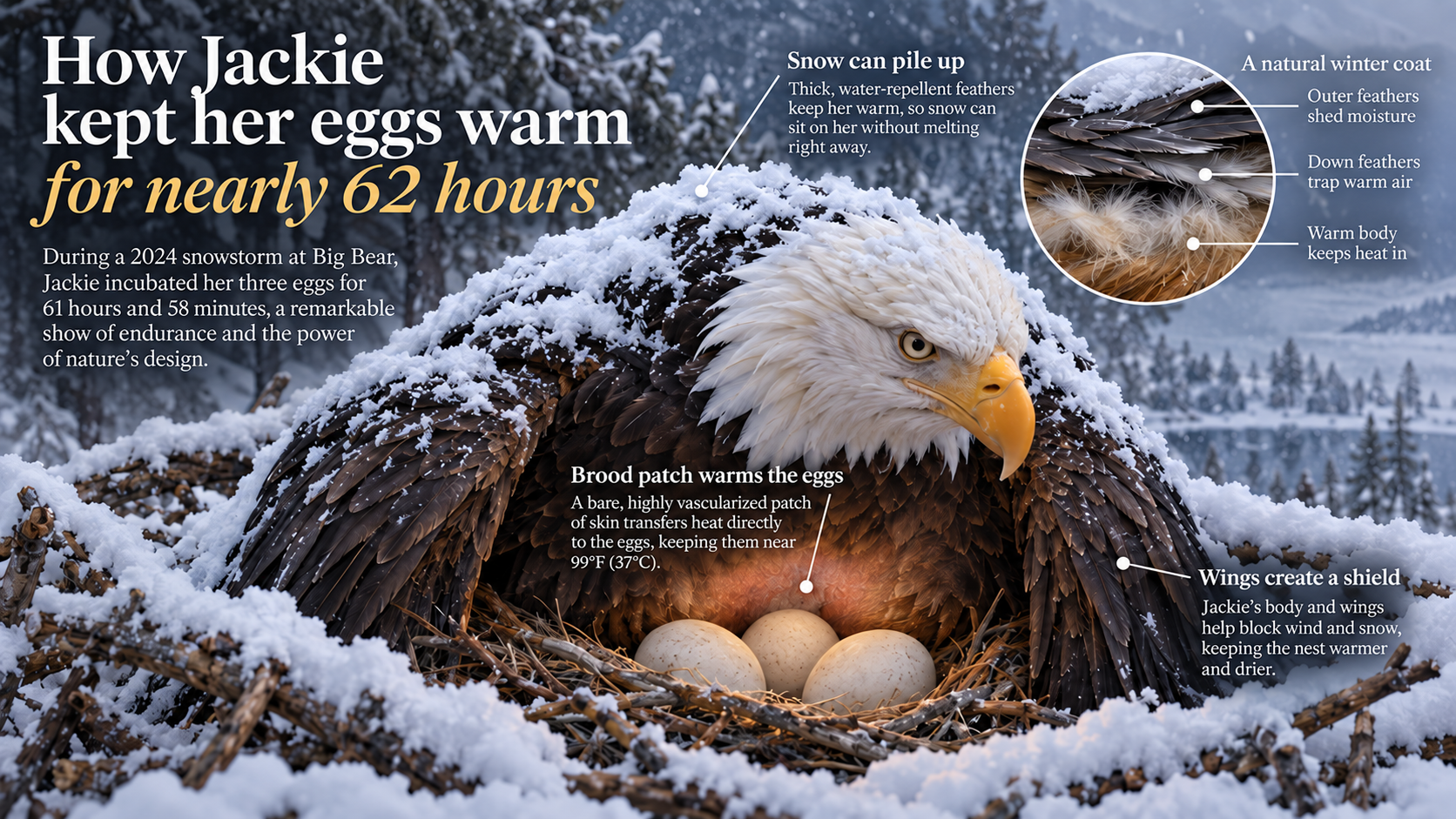
For 61 hours and 58 minutes, Jackie barely left her three eggs as a February 2024 snowstorm buried the Big Bear eagle nest. The remarkable part was not simply that she endured the cold. It was how her feathers, circulation and brood patch worked together to keep a warm microclimate underneath the snow.
At times, almost nothing of Jackie could be seen.
Snow piled across her back and wings until the bald eagle looked like part of the nest itself. Then the white mound would move. Jackie would push her head through, rise, shake snow from her feathers, roll her three eggs and settle back over them.
Friends of Big Bear Valley documented the marathon shift at 61 hours and 58 minutes, the longest uninterrupted incubation shift the group had recorded for Jackie. The nonprofit’s camera captured the entire sequence high above Big Bear Lake in Southern California.
The biology beneath the snow
A bald eagle is built for conditions that would be dangerous for an exposed human. Jackie’s protection began with thousands of feathers arranged in layers with different jobs.
Friends of Big Bear Valley described Jackie as having more than 7,000 outer feathers, with downy feathers underneath. The outer plumage helps keep weather away from the skin, while the softer down traps air close to the body. That trapped air is a powerful insulator because still air transfers heat slowly.
This is why a snow-covered eagle can look colder than it actually is. The Center for Conservation Biology notes that a bald eagle’s internal temperature is around 105°F. Yet good plumage insulation can keep the outer feather surface cold enough for snow to remain there instead of immediately melting.
In other words, the snow on Jackie’s back was not a direct reading of the temperature beneath her feathers. Her warm body was separated from that cold outer surface by layers of insulating plumage and trapped air.
The brood patch: a built-in egg warmer
The most important adaptation for the eggs was hidden underneath Jackie.
During nesting season, both female and male bald eagles develop a brood patch. Hormonal changes cause feathers on part of the lower breast and abdomen to thin or fall away, exposing highly vascularized skin. Warm blood flows close to that bare surface.
When an eagle settles onto its eggs, that skin can make direct contact with the shells. The Center for Conservation Biology describes the familiar little “wiggle” an incubating eagle makes as a way of spreading the brood patch over the eggs and improving heat transfer.
That creates an elegant contrast. Most of Jackie’s body was designed to keep heat in. The brood patch was designed to send heat out, directly into the clutch.
The small movements that mattered
Jackie did not remain perfectly motionless for nearly three days. The camera recorded a repeated maintenance cycle.
- She rose enough to reposition herself.
- She shook accumulated snow from her body.
- She rolled the eggs.
- She settled low again, pressing them toward the brood patch.
On February 9, Friends of Big Bear Valley described Jackie’s storm routine as a combination of “waking, shaking, crop drops and egg rolling,” along with repeated shimmies. The group also nicknamed the way she spread her wings around the clutch her “mombrella.”
The official FOBBV Eagle Log preserves the day-by-day account, including the record shift and the follow-up after the storm.
Why Jackie stayed instead of Shadow
Under normal conditions, Jackie and Shadow shared incubation duties. Bad weather changed the pattern.
FOBBV noted that Jackie was about 25 percent larger than Shadow. That difference mattered with a three-egg clutch because her body could cover more of the nest bowl. During storms, Jackie repeatedly resisted Shadow’s attempts to take over and remained on the eggs herself.
By the morning of February 7, Shadow apparently decided he had waited long enough. He arrived at the nest and stood nearby for more than two minutes. Jackie finally climbed out of the snow-packed bowl, shook and flapped the snow from her wings, and flew away for a break.
Shadow then worked his way over the bank of snow surrounding the bowl and settled onto the eggs.
How could she go so long without eating?
The vigil also carried an energy cost. According to FOBBV, Jackie did not leave the eggs to eat during the record shift. Bald eagles have a crop, a temporary food-storage pouch in the digestive tract, and the group observed “crop drops” during the storm.
That does not tell us exactly how much energy Jackie drew from stored food versus her other body reserves. What the camera does show is that she continued normal incubation behaviors while remaining at the nest for more than two and a half days.
What happened to the three eggs?
None of Jackie and Shadow’s three 2024 eggs eventually hatched.
That outcome should not be blamed on the snowstorm. Friends of Big Bear Valley later reported that the eggs showed no development, but said the reason could not be determined. The organization discussed environmental factors at Big Bear’s high elevation, including oxygen and airflow through eggshell pores, only as possibilities.
So Jackie’s 61-hour, 58-minute vigil cannot honestly be described as saving viable embryos, nor can the storm be identified as the cause of the failed clutch. The remarkable part is what the cameras allowed people to witness: a wild bird using a suite of winter and reproductive adaptations in real time.
Watch the Big Bear nest today
Friends of Big Bear Valley still operates the nest cameras today. These are live current feeds, not footage from Jackie’s February 2024 storm vigil, but they show the same nest-camera system that documented so much of her life.
A defining Jackie moment
The sequence became one of the best-known chapters in Jackie’s years on the Big Bear eagle cameras. After her death in August 2026, Friends of Big Bear Valley again included the nearly 62-hour storm incubation among the moments that defined her life.
What looked from the camera like one snow-covered eagle sitting still was actually a coordinated biological system at work: outer feathers facing the storm, down trapping insulating air, a warm core protected underneath, a bare brood patch transferring heat to the eggs, and a larger body shielding the clutch.
And for 61 hours and 58 minutes, Jackie kept that system in place.
Featured image: Discvr explanatory illustration. It visualizes the biological mechanisms described in the reporting and is not documentary imagery from the Big Bear nest.
Leave a comment