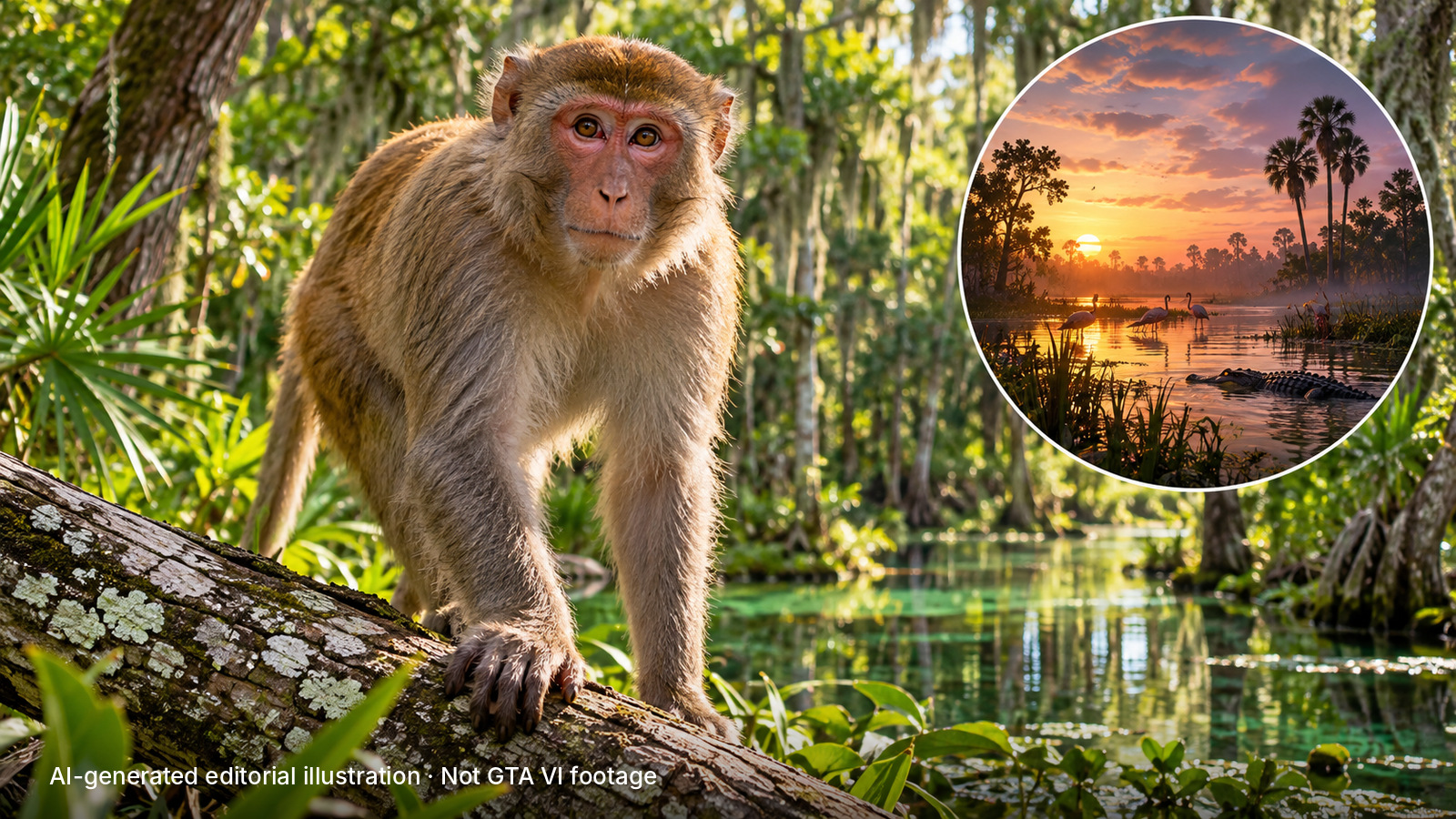
In the 1930s, a Florida boat-tour operator put a handful of monkeys on an island to entertain visitors. There was one problem with the plan: the monkeys could swim. They reached the surrounding forest, multiplied and became part of a wildlife story that still hasn’t ended.
Florida has a talent for producing animal stories that sound invented. In the Everglades, researchers have even deployed robotic rabbits to lure invasive pythons. Now Rockstar Games is borrowing the state’s remarkable mixture of native and introduced wildlife for Grand Theft Auto VI. The monkeys are among the creatures reportedly making the journey into its fictional world.
Rockstar’s new game is set in Leonida, a state inspired by Florida that stretches beyond the neon streets of Vice City into wetlands, coastlines and rural landscapes. On September 29, 2026, Game Informer published details obtained from Rockstar: the game is expected to contain more than 170 animal species across land, water and sky. Its scheduled release is November 19, 2026, so players haven’t yet had the chance to test the wildlife systems for themselves.
The eight animals specifically named in that report offer an unusually revealing portrait of Florida. Four are native to Florida: flamingos, manatees, pelicans and alligators. The other four are animals introduced by humans: rhesus macaques, feral cats, cane toads and green iguanas. Their inclusion suggests Rockstar wants Leonida to feel like more than a collection of recognizable tropical scenery.
Rockstar’s first official trailer shows flamingos over wetlands and an alligator encounter. These are images from its fictional game world, not documentary footage of Florida’s animals.
Consider the flamingo. Pink lawn ornaments have made it a symbol of Florida, but the real bird’s history is far less cheerful. American flamingos once gathered in the state’s southern wetlands in sizable flocks. Hunting for feathers devastated those birds in the late 1800s, and the historical population had effectively disappeared by around 1900. For years, the origin of occasional modern sightings remained controversial because Florida also had captive flamingos.
A scientific review published in 2018 drew on old records and museum specimens to establish that the flamingo belonged to Florida’s natural history. The Florida Fish and Wildlife Conservation Commission recognizes it as a native bird. That distinction matters: a flamingo seen in the Everglades isn’t necessarily a captive escapee.
In August 2023, Hurricane Idalia carried American flamingos into Florida and other parts of the country. Some lingered. When Audubon Florida organized a statewide survey in February 2024, participants recorded 101 wild flamingos, including more than 50 in Florida Bay. The count captured birds observed during a particular survey, not a complete estimate of every flamingo living in the state. It also didn’t establish that a new breeding population had taken hold.

Under the water, another animal tells a very different story about what it takes to remain in Florida. Manatees move between coastal areas, rivers and springs, feeding largely on seagrasses and other aquatic plants. They can travel widely in warm months, but prolonged cold is dangerous for them. When temperatures fall, dependable warm-water sites become essential habitat.
Their recovery is substantial but unfinished. The U.S. Fish and Wildlife Service estimates that at least 8,350 manatees live in Florida, compared with fewer than 2,000 believed to be present in the early 1990s. The survey methods have changed, so those estimates shouldn’t be treated as a simple like-for-like count. Watercraft strikes, degraded seagrass beds and uncertainty about future warm-water refuges remain significant threats. Florida manatees remain protected under the federal listing of the West Indian manatee as threatened.
Pelicans and alligators complete the native quartet named in the preview. Their presence makes ecological sense: Florida’s varied coastal and freshwater habitats accommodate birds that catch fish and large reptiles that exploit marshes, lakes, rivers and even human-altered waterways. The game may reproduce some of those encounters visually. Whether it also models the complicated relationships among those animals, their food and their habitats is a separate question.
The animals humans brought to Florida
The rhesus macaques have an origin that is unusually well documented. University of Florida researchers link the population to Colonel Tooey, a tour operator said to have placed roughly six macaques on a small Silver River island in the 1930s. They swam to the nearby woods, and he reportedly released another six around 1948.
The monkeys are native to parts of Asia, where their adaptability helps them occupy a wide variety of habitats. In Florida, their presence is the result of human introduction. Researchers have documented feeding on plants and experimental quail eggs, but say the actual extent of their effects on native wildlife at Silver Springs remains uncertain. Park visitors are advised to watch from a distance and never feed them. The full history is documented in a University of Florida wildlife review.

A green iguana represents another kind of arrival. Unlike the monkeys released for spectacle, iguanas became established in South Florida after introductions associated with human activity. They flourish around canals and developed areas, where their burrows can undermine embankments and seawalls. Their feeding can also affect native vegetation and other wildlife.
The scale of the state’s response became unusually visible during a cold spell in early 2026. Green iguanas can become immobilized when temperatures drop. Under a temporary Florida wildlife order, members of the public and officials collected 5,195 cold-stunned iguanas over a short removal period. That figure records animals turned in under one special program, not Florida’s total iguana population.
Cane toads present a smaller but potentially more immediate danger. The large amphibians were introduced to Florida and are now found in many central and southern communities. Their skin glands produce a toxin that can seriously injure or kill animals that bite them, including dogs. They’re a reminder that an introduced species can change an ecosystem without looking like a cinematic predator.
The reported inclusion of feral cats adds a familiar animal to this complicated picture. Domestic cats are widespread around people, and free-ranging cats can prey on wildlife. The category alone tells us little about whether GTA 6 will portray those ecological effects, or simply put recognizable cats on its streets.

There is another side to Florida’s wildlife story that a species list can’t capture. Real animals need connected habitat. In southern Florida, wildlife crossings designed to protect animals from traffic help endangered Florida panthers move beneath roads. Manatees need suitable food and warm water. Flamingos need functioning coastal wetlands. A virtual animal can appear wherever a designer places it; a wild one survives only if the landscape still works for it.
Rockstar has described visual advances involving fur, feathers and effects such as iridescence and translucency. Game Informer’s preview also refers to animal-tracking categories called Rare, Discoverable and Legendary. The detailed workings of those systems, and the identities of the rarer animals, remain undisclosed. A reported roster of 170-plus species isn’t proof of a fully simulated food web, and the game hasn’t launched yet.
Rockstar’s May 2025 second trailer provides another look at Leonida’s coastal towns, waterways and surrounding landscapes. The company says the footage was captured in-game on PlayStation 5 and combines gameplay with cutscenes. It offers a sense of the setting, but doesn’t establish how the reported wildlife systems will work.
Still, the decision to include both native animals and species introduced by people makes Leonida an unusually interesting version of Florida. One animal’s presence can represent recovery from historical hunting; another’s can trace back to an ill-judged tourist attraction. Others reveal how roads, boats, pets and altered habitats influence which species thrive. As players explore this fictional state, those real-world histories will continue unfolding in Florida, whether anybody notices the connection or not.
Featured image: AI-generated editorial illustration for Discvr. Not an actual GTA VI screenshot or wildlife photograph.


Leave a comment