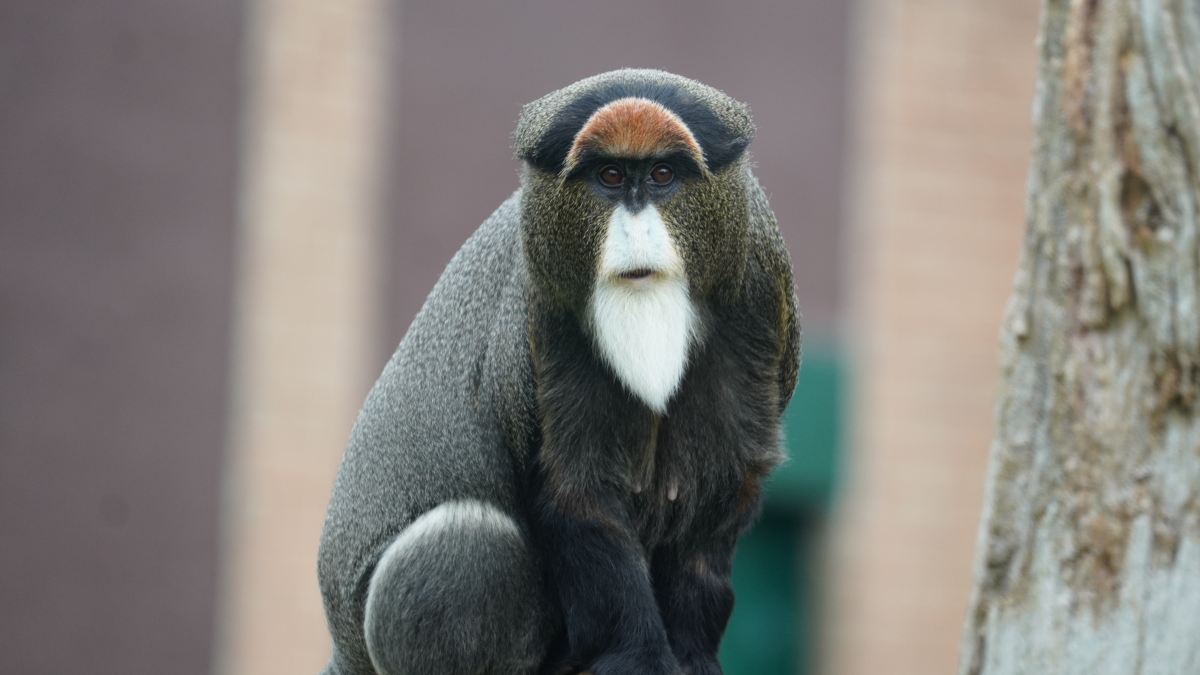
In the flooded forests and reed-filled wetlands of Central Africa, there’s a primate that often feels more rumor than reality. The De Brazza’s monkey, Cercopithecus neglectus, creeps through its swampy home that even researchers struggle to confirm its presence. Its scientific name, “neglectus,” reflects this history: for generations, the species was overlooked simply because it’s so hard to see.
When danger approaches, these monkeys rely on extraordinary stillness. A troop can remain frozen for hours, blending into branches and shadows until the threat passes. Hunters and biologists alike have walked beneath them without realizing the monkeys were watching from above. Unlike the noisy calls of vervets or colobus monkeys, silence is their defense. To encounter them is to glimpse a phantom of the swamp, gone as suddenly as it appeared.

Their ghostly behavior is matched by a striking appearance. Each De Brazza’s monkey wears a thick white beard and an orange crown that glows against its gray and black coat. To human eyes, it lends the animal an elder’s solemn dignity, earning nicknames like “the old man of the forest.” Yet these bold markings aren’t just decoration. They act as recognition signals within their species, helping family members spot one another in dense undergrowth. When a male bobs his head or fixes a wide-eyed stare, the bright beard and brow flash like beacons, silent messages that carry across the troop.
The rest of the coat is subdued: mottled olive-gray fur, black limbs, and a white rump stripe. In the mottled light of the swamp, this camouflage is nearly perfect. The contrast is deliberate. To predators, the De Brazza’s monkey vanishes. To its own kind, its face shines unmistakably through the foliage.
Life in the swamp
Life in a De Brazza’s family group is a study in restraint. Small units of four to ten individuals move quietly through the forest, usually led by a dominant male. At dawn, a deep booming call may echo across the riverbank, announcing his presence.

Beyond that, the forest remains hushed. Communication within the troop depends less on sound and more on posture, stares, and subtle movements. Even aggression is often expressed in silence: a shake of branches, a rigid tail arch, a long fixed gaze.
This strategy sets them apart from their louder relatives. While other guenon monkeys form noisy mixed-species groups, De Brazza’s monkeys keep to themselves, defending their patch of swamp with secrecy and calm. They’ve adapted to survive not through bluster, but through invisibility.

To watch one vanish into the reeds is to understand why they’re called “ghosts of the forest.” They live by a simple code: stay still, stay quiet, stay unseen. In their silence lies their survival, and in their hidden world lies one of Central Africa’s most enigmatic primates.

Leave a comment