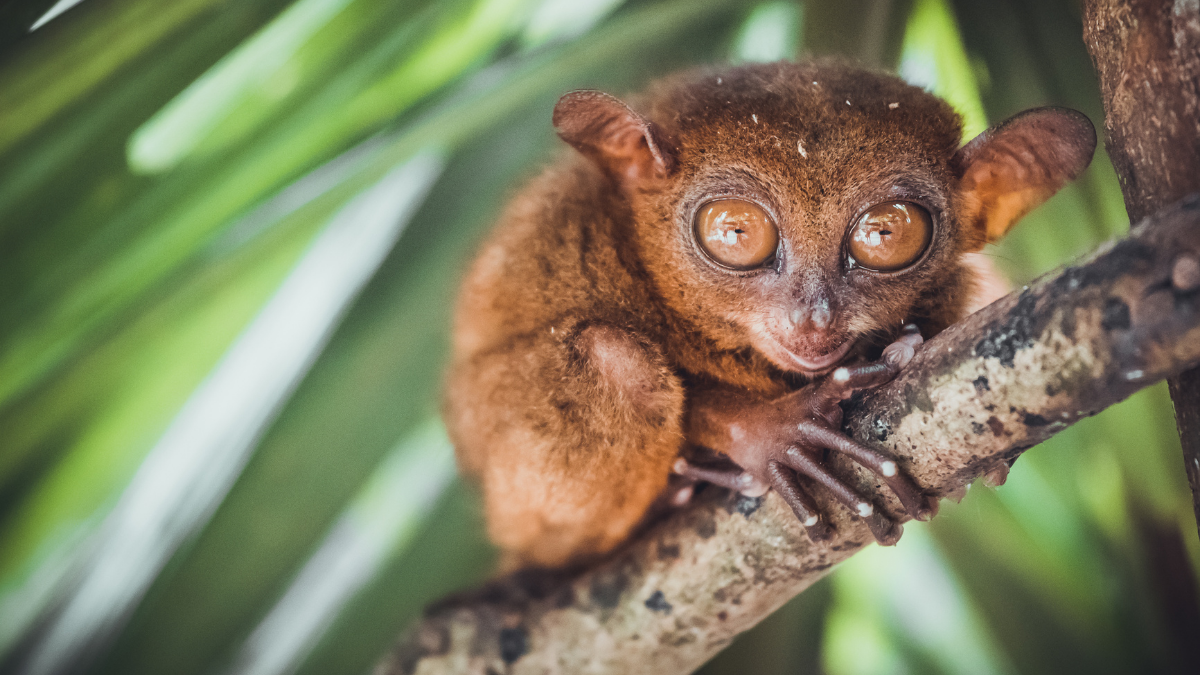
At first glance, the Philippine tarsier (Carlito syrichta) looks almost unreal. Its wide amber eyes, swiveling head, and whisper-quiet movements give it an otherworldly presence in the forests of Bohol and Mindanao. Yet this tiny primate is more than a curiosity. It’s a survivor from a deep evolutionary past and a specialist honed by millions of years in the dark.

From ancient primate to night hunter
The tarsier’s family line stretches back at least 45 million years, making it one of the oldest surviving primates. Fossils show that tarsier-like creatures once lived as far afield as China, Pakistan, and even North America. Remarkably, their teeth are nearly identical to those of their living relatives, which suggests their basic design has worked for tens of millions of years.
Scientists long debated whether tarsiers were closer to lemurs or to monkeys and apes. Genetic studies now place them firmly in the haplorhine branch, alongside monkeys, apes, and humans. That makes them distant cousins who split off early from the line that eventually led to us. Their survival offers a rare window into what early primates may have looked and behaved like.
The Philippine species is especially striking because of its sensory extremes. Each eye is about the size of a golf ball, larger than its brain. Fixed in their sockets, those eyes can’t move — so the animal compensates with a neck that can turn halfway around in either direction. Perched on a branch, it can scan almost an entire circle without shifting its body.
Unlike most nocturnal animals, tarsiers lack the reflective eye layer that helps amplify light. Instead, they rely on sheer size and a dense arrangement of light-sensitive cells to see in near total darkness. Researchers have found that their retinas contain not only rods, which detect light, but also cones, which support color vision. In other words, these primates may still perceive hints of color in the dark, something few other night creatures can do.

Hearing is another of their hidden strengths. Tarsiers can detect sounds up to 91 kilohertz — more than four times the upper limit of human hearing. That sensitivity puts them in the same league as bats and dolphins. For years they seemed almost mute to observers, but recorders later revealed a secret: tarsiers call to one another in ultrasonic frequencies that humans can’t detect. These high-pitched signals may serve as alarms or social calls, safe from the ears of predators.
Their brains are wired to match these extreme senses. A disproportionate share of the Philippine tarsier’s neural real estate is devoted to vision and hearing, while smell is relatively underdeveloped. This skewed architecture reflects their priorities: finding prey, detecting threats, and surviving in the night canopy.

Despite their evolutionary success, tarsiers are fragile in modern times. They don’t adapt well to captivity and often become fatally stressed when handled or exposed to bright light. In the wild, shrinking forests put pressure on their populations, and the species is now listed as Near Threatened. Their story is a reminder that even the best evolutionary designs depend on the stability of the habitats that shaped them.
The Philippine tarsier shows us that specialization can be both a strength and a risk. It has endured for millions of years by perfecting a way of life that few others share: silent leaps, secret calls, and a gaze that cuts through the night. Protecting it today means ensuring that this ancient primate, with its singular adaptations, can continue to peer out from the shadows of its forest home.



Leave a comment