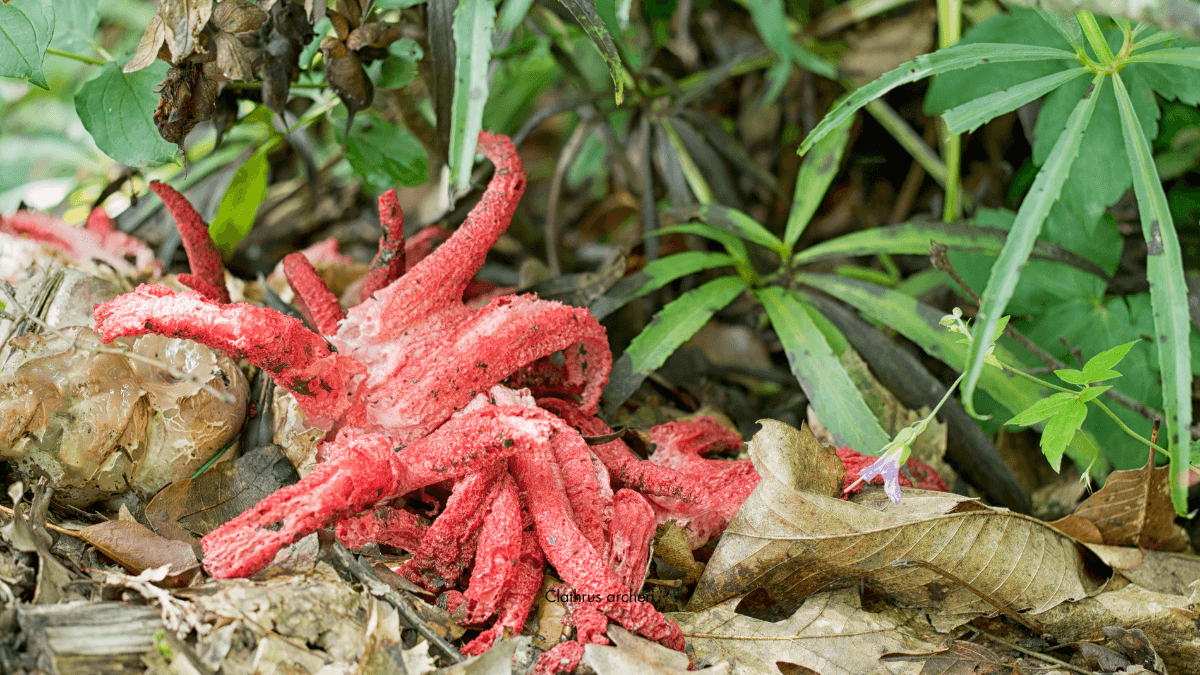
Clathrus archeri looks like it belongs in a fantastical film set. Crimson arms emerge from a small, white egg, then splay outward in a dramatic pose. It’s hard to believe such a creature is a fungus, but this is the so-called devil’s fingers (not to be confused with dead man’s fingers), also known as the octopus stinkhorn. Some think it smells like putrid flesh, summarizing the fungus’s unforgettable impression.
First described in Tasmania, Clathrus archeri bears the name of William Archer, an Australian architect, politician, and naturalist. Many believe the fungus reached Europe in wartime cargo during World War I, hidden among wool shipments or military supplies. Today, it has spread through the UK’s New Forest and beyond, much like an accidental stowaway on a long, unplanned voyage.
Its early form is deceptively plain. The egg-like structure, only a few centimeters wide, sits nestled in leaf litter or bark mulch. As moisture and warmth coax it awake, the fungus cracks open, revealing four to seven red arms, each coated in a spore-laden, dark olive mass called gleba. This material emits a scent reminiscent of decay, luring insects that carry spores to fresh ground. In many forests, these insects become unintentional co-conspirators, helping the devil’s fingers extend its domain far and wide.

By de:Benutzer:Oilys – Originally from de.wikipedia (de:Image:Tintenfischpilz2.JPG; by de:Benutzer:Oilys at 00:30, 26. Okt 2004, CC BY-SA 3.0, Link

A strange arrival
While the fungus is native to Australia and New Zealand, it has taken root in parts of Europe and North America. Accounts from France trace its presence to the mid-1800s, tied to military transports crossing hemispheres. In the UK, it was first noted around the year 2000, and it advanced with surprising speed through regions with suitable forest floors.
Scientists classify Clathrus archeri as saprobic, which means it thrives on decaying organic matter. Warm, moist conditions serve it well, and many foresters regard it as part of the natural cleanup crew. Despite its eye-catching shape, it rarely disrupts local ecosystems. Instead, it enriches them by recycling nutrients, forming one strand of the tangled web that keeps woodlands alive.

Lingering questions
In some areas, the fungus is quite rare. Romanian mountain meadows, for instance, reveal only scattered sightings. Yet in Britain, entire stretches of woodland play host to its fluorescent display. Researchers wonder if this adaptation hints at changing climates, or whether the fungus has simply had more time to establish itself in certain places. Its love of mild temperatures and moderate humidity may help it flourish as global conditions shift.
For those stumbling upon devil’s fingers for the first time, the memory of its rotting stench lingers almost as long as the image of its tentacled form. One startled gardener wrote, “This fungus I found in my garden… smells like putrid flesh!” That odor, though unsettling, is key to its survival. Flies and beetles can’t resist the promise of carrion, and they leave spore-coated legs in their wake.
_(26273567937).jpg#/media/File:Clathrus_archeri,_(devils_fingers)_(26273567937).jpg)
By Bernard Spragg. NZ from Christchurch, New Zealand – Clathrus archeri, (devils fingers), CC0, Link
As scientists continue to monitor the fungus’s spread, they see it as a natural case study in species migration. Clathrus archeri shows how organisms, even those that appear rooted in one hemisphere, can cross oceans under the right circumstances. Its gradual occupation of forests thousands of miles from its homeland reminds us that nature’s boundaries are porous, and it doesn’t always take a dramatic event to move life from one continent to another.
In the end, devil’s fingers stands out as a fungus that both captivates and unsettles. Its arms raise questions about what other surprises lie beneath the forest floor. They also remind us that even the strangest journeys can reshape ecosystems, one spore-dusted insect at a time.
Leave a comment