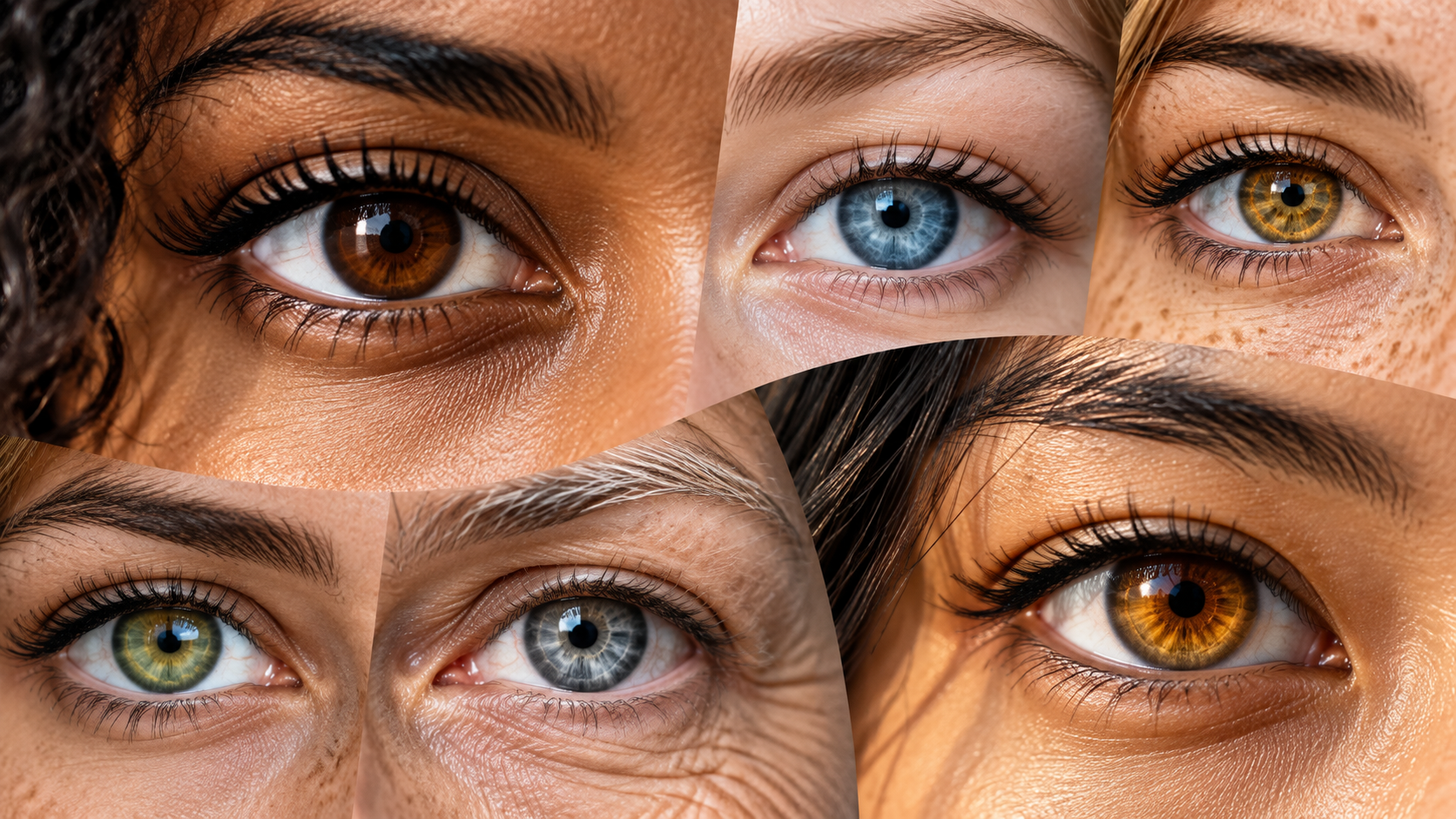
Brown eyes are the global majority, and they come in more than one shade. Some irises look almost black; others have lighter brown tones. Blue, green, gray, hazel and amber broaden the range, although the boundaries between these familiar labels aren’t always clear.
The color belongs to the iris, the muscular ring surrounding the pupil. It’s separate from the different types of tears that lubricate or wash the eye’s surface. To understand the shade of an iris, we need to look at its pigment and how light behaves inside its tissue.
A useful comparison starts with what the color names describe, rather than attaching a worldwide percentage to every possible shade.
| Eye color | How it generally appears |
|---|---|
| Brown | Light brown through very dark brown; the most common human eye color. |
| Blue | A blue appearance produced by light scattering in an iris with little melanin in its front layers. |
| Hazel | A mixture of brown, green or gold, often with different colors across the iris. |
| Amber | A golden or yellow-brown appearance; some classifications include it within brown. |
| Green | A green appearance shaped by pigmentation and light scattering. |
| Gray | A pale gray appearance associated with little pigment in the front of the iris. |
This isn’t a global rarity ranking. Cleveland Clinic’s eye-color guide notes that classification systems differ: a shade counted separately in one system may be grouped with another elsewhere. Before comparing percentages, it matters who was studied and which categories were used.
Green is uncommon, with Cleveland Clinic giving an estimate of about 2% worldwide. That figure shouldn’t be mistaken for a precise census or used to settle every comparison with gray or amber. A claim about the rarest color needs a definition of what counts as a separate color.

Hazel is particularly easy to mislabel because it can contain several colors at once. A brown area near the pupil and greener areas farther out can look different under changing light. Amber generally describes a more uniform golden appearance, rather than that combination of visibly different tones.
The distinction between brown and blue is easier to explain physically. Melanin is a pigment involved in the coloring of our eyes, skin and hair. An iris with abundant melanin in its front layers looks brown. With much less pigment there, the interaction between light and the iris’s structure becomes especially important.
Blue irises don’t need blue pigment. Shorter wavelengths of incoming light are scattered more effectively than longer wavelengths, producing the blue appearance we see. The color is real; the assumption that it must come from a blue substance is what’s mistaken.
That helps explain why a blue or gray iris can look different in two photographs without its pigment having changed. Illumination affects the light returning to the observer. A photograph is useful for noticing a pattern, but it isn’t a standardized measurement of eye color.

Why eye color doesn’t follow a simple family rule
The familiar classroom explanation treats brown as dominant and blue as recessive, as though one gene decided the result. That model leaves out much of the biology. The National Library of Medicine’s explanation of eye-color inheritance describes a trait influenced by multiple genes, many involved in producing, transporting or storing melanin.
Two important genes, OCA2 and HERC2, sit close together on chromosome 15. OCA2 supplies instructions for a protein that helps pigment-producing structures inside cells mature. A regulatory region within HERC2 can alter OCA2 activity, influencing how much pigment develops. Other genes contribute to the final shade.
Parents’ eye colors therefore offer clues rather than a guarantee. Even two blue-eyed parents can have a brown-eyed child, although that’s uncommon. A simple chart based only on the parents’ visible colors can’t capture all the genetic variation involved.
A baby’s eyes add another complication: pigmentation can continue developing after birth. The belief that every newborn starts with blue eyes is wrong. In the 2016 Newborn Eye Screening Test study at Stanford, researchers assessed usable eye images from 192 newborns. Of those babies, 121 had brown eyes and 40 had blue eyes.
Those numbers describe one hospital cohort, not babies everywhere. They still give a concrete answer to the universal claim: plenty of infants already have brown irises at birth. Some children’s eye color changes as they grow, while others keep the color they started with.
In adults, a shift in appearance under different lighting isn’t the same as a lasting change in pigmentation. The distinction between eye structures matters, too. The seasonal changes in reindeer eyes involve a reflective layer behind the retina, not the human iris discussed here.

An iris can also have a persistent pattern of different colors. Heterochromia may involve two differently colored eyes, called complete heterochromia; a contrasting section within one iris, called sectoral heterochromia; or a differently colored ring around the pupil, called central heterochromia.
These patterns aren’t automatically signs of disease. Some are harmless variations present from birth, while others can develop after injury or with a medical condition. Cleveland Clinic notes that the exact population prevalence of heterochromia isn’t known, so a confident global percentage would overstate the evidence.
Albinism needs a separate explanation as well. Reduced pigmentation can leave eyes very pale, and in some cases make blood vessels more visible, creating a pinkish or reddish appearance. Not everyone with albinism has the same coloring. Some forms can include hazel or brown irises, and the condition can also affect vision.
Finally, yellowing in the whites of the eyes isn’t an amber iris. Johns Hopkins Medicine identifies yellowing of the whites as a sign of jaundice, which involves bilirubin buildup and needs medical assessment. The location of a color change is as important as the color itself.
Seek an eye-care professional’s advice about a new or persistent change in iris color, particularly after an injury or alongside altered vision. For a newly different iris, an eye exam tells you more than a rarity chart ever will.



Leave a comment