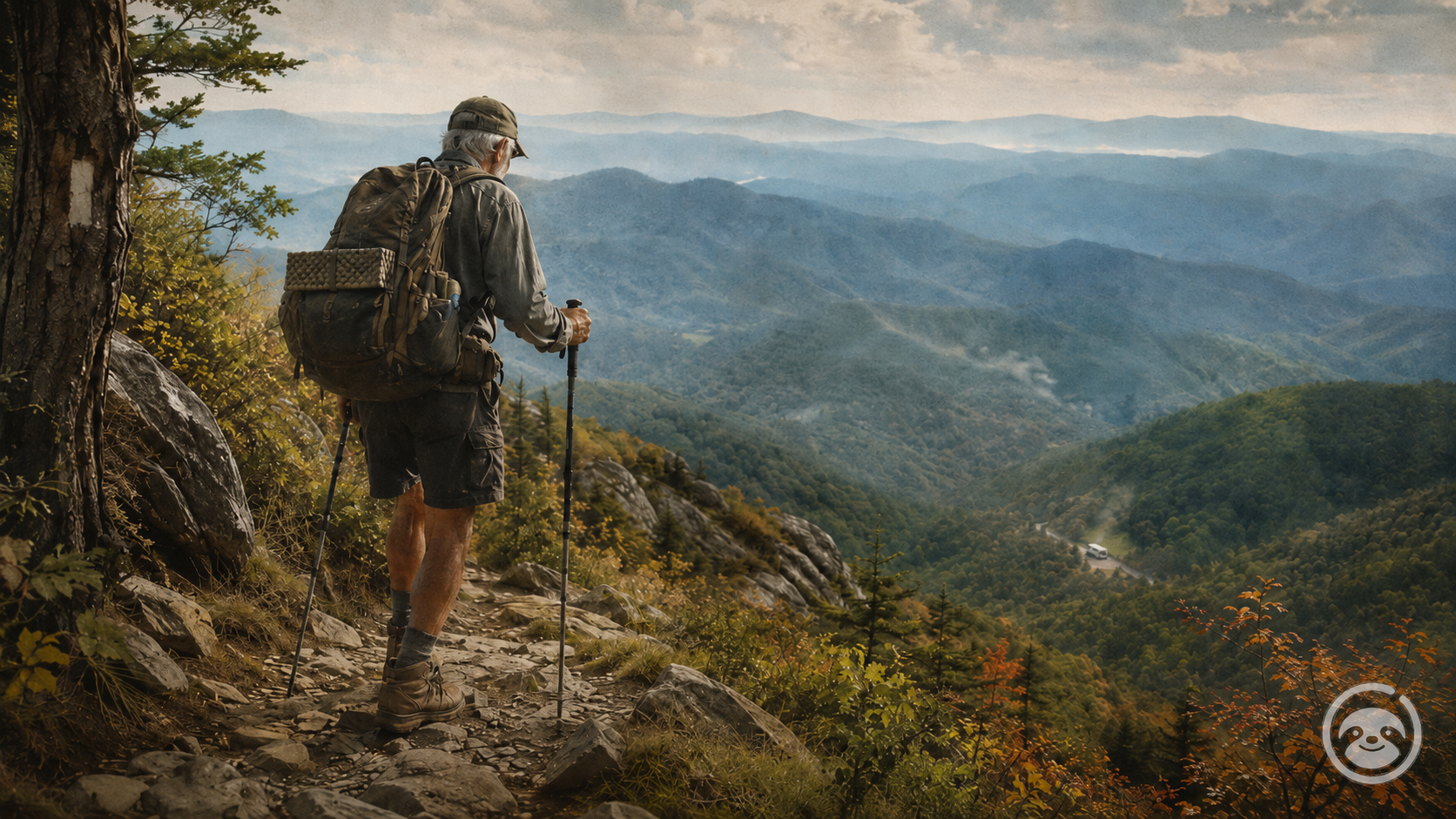
On the Appalachian Trail, a white blaze answers one basic question: Is this still the trail? It doesn’t say where a hiker must begin, how quickly the miles must pass or whether time away cancels the ground already covered.
That distinction explains Dale “Grey Beard” Sanders’s latest journey. He left Harpers Ferry, West Virginia, on September 6, 2025, as the eastern forests approached some of America’s most memorable autumn landscapes. On August 31, 2026, 359 days later, he reached Katahdin in Maine. At 91, Sanders was widely reported as the oldest known person to complete an Appalachian Trail thru-hike.
The finish is easy to compress into a familiar picture: an elderly hiker following one uninterrupted line from Georgia to Maine. That isn’t what happened. Sanders divided the route into legs, changed direction, paused for winter, returned to unfinished ground and completed the full trail within a year. In trail language, he made a flip-flop thru-hike.
Under the Appalachian Trail Conservancy’s standard, coverage and time determine whether a journey counts: a hiker must complete the entire trail in no more than 12 months. For its completion records, the organization doesn’t require a particular order, direction of travel, pace or pack-carrying style. Sanders’s method therefore qualified even though it wasn’t a continuous or nonstop end-to-end walk.
The mileage needs similar care. The Associated Press described a 2,193-mile journey, while the Conservancy lists the trail’s official 2026 length as 2,197.9 miles. The total changes as the footpath is relocated and measured more precisely. The entire Appalachian Trail or roughly 2,198 miles is the clearest description of what Sanders completed.
The meaning of the record was in the returns
Record attempts usually celebrate uninterrupted forward motion. Sanders’s year was shaped by something less tidy: returning. He came back after winter, after medical evaluation, after a death in the family and after doubts about whether the project should continue.
Sanders’s own count reached 71 falls during the campaign. One contributed to a brief hospital stay, and another occurred about 200 yards from the finish. Numbness in his left arm also produced a stroke scare before doctors diagnosed a pinched nerve. He was cleared to hike, but medical clearance didn’t make the decision to continue automatic.
The most consequential interruption happened away from the footpath. Sanders returned to Tennessee after his mother-in-law died so he could be with his wife, Meriam. He considered ending the attempt. She encouraged him to go back.
Sanders often ended a day at a truck camper called Base Camp on Wheels. Volunteers kept that mobile shelter aligned with a route that repeatedly changed place and direction, giving him somewhere to recover, eat and prepare to begin again. The hike was supported, which the Conservancy’s rules permit. Sanders walked the miles, while a wider network helped preserve the possibility of the next day.
That shared effort fits a larger truth about outdoor places sustained by people. Like the landscapes in Discvr’s guide to Yellowstone and Yosemite national parks, the Appalachian Trail can look self-contained from a scenic overlook. In practice, wild landscapes and the journeys through them are sustained by people, planning and repeated acts of care.
One member of Sanders’s support circle carried unusual history. Sanders first set the trail’s reported age mark in 2017, when he completed it at 82. His friend M.J. “Nimblewill Nomad” Eberhart surpassed him in 2021 at 83. Sanders had encouraged Eberhart and walked beside him during that attempt. When Sanders returned for the record, Eberhart helped operate the camper during roughly the first 800 miles.
The sequence makes the word “rivalry” feel inadequate. Each man took the distinction from the other, but each also helped the other reach it. The record moved between friends without turning friendship into a casualty.
Sanders paused to pray after reaching Katahdin. Specialist trail reporting says his team collected witness statements, a daily log, GPS records and time-stamped video for a Guinness World Records submission. Until Guinness announces a decision, oldest known Appalachian Trail thru-hiker is more precise than calling the finish a confirmed Guinness World Record.
Sanders’s journey wasn’t powerful in spite of its interruptions. The interruptions reveal what he actually accomplished. A nonstop march would tell one kind of endurance story. His 359 days tell another: every time the route broke apart, he found a way to enter it again.



Leave a comment