Shadow’s latest nest visitor did not arrive like an intruder. On November 16, 2026, an unbanded adult followed him into the Big Bear nest and stayed for close to an hour. Shadow called, shifted sticks, and kept watching the newcomer even after it left, according to the Friends of Big Bear Valley eagle log.
The encounter came only days after Shadow and Kaydee had been bringing nest material, touching beaks, and spending time together. It also echoed an earlier visit by an unfamiliar eagle in October. This time, the visitor’s size and Shadow’s tolerance led observers to wonder whether it might be female. That remains an informed possibility, not an identification.
Still, the scene raises a remarkable question. Could Shadow, the banded eagle known as Kaydee, and another adult ever share a nest as a family?

The short answer is yes. Bald eagles usually raise young as a pair, but biologists have recorded rare cases in which three adults divide the work of one family.
That behavior is called cooperative breeding. The important evidence is not three eagles appearing in the same place. It is sustained parental work: maintaining a nest, incubating eggs, defending the territory, delivering food, brooding chicks, and feeding them. Published bald eagle cases include trios with two males and one female as well as two females and one male.
A 2016 review by wildlife biologist Neil Dawe found only eight reported examples through 2015. Some were brief. Others lasted across breeding seasons. The small number matters because it keeps the phenomenon in perspective. A trio is biologically possible, but it is not the default shape of an eagle family.

One well-documented trio lived on Santa Catalina Island in California. Researchers saw all three adults defend the territory, incubate, bring food, brood, and feed young. They could not confirm the helper’s sex. They also could not reduce the arrangement to a single explanation. A shortage of open territories, an opportunity to gain breeding experience, or future access to a nest may all make cooperation worthwhile in some circumstances.
The trio that made teamwork visible
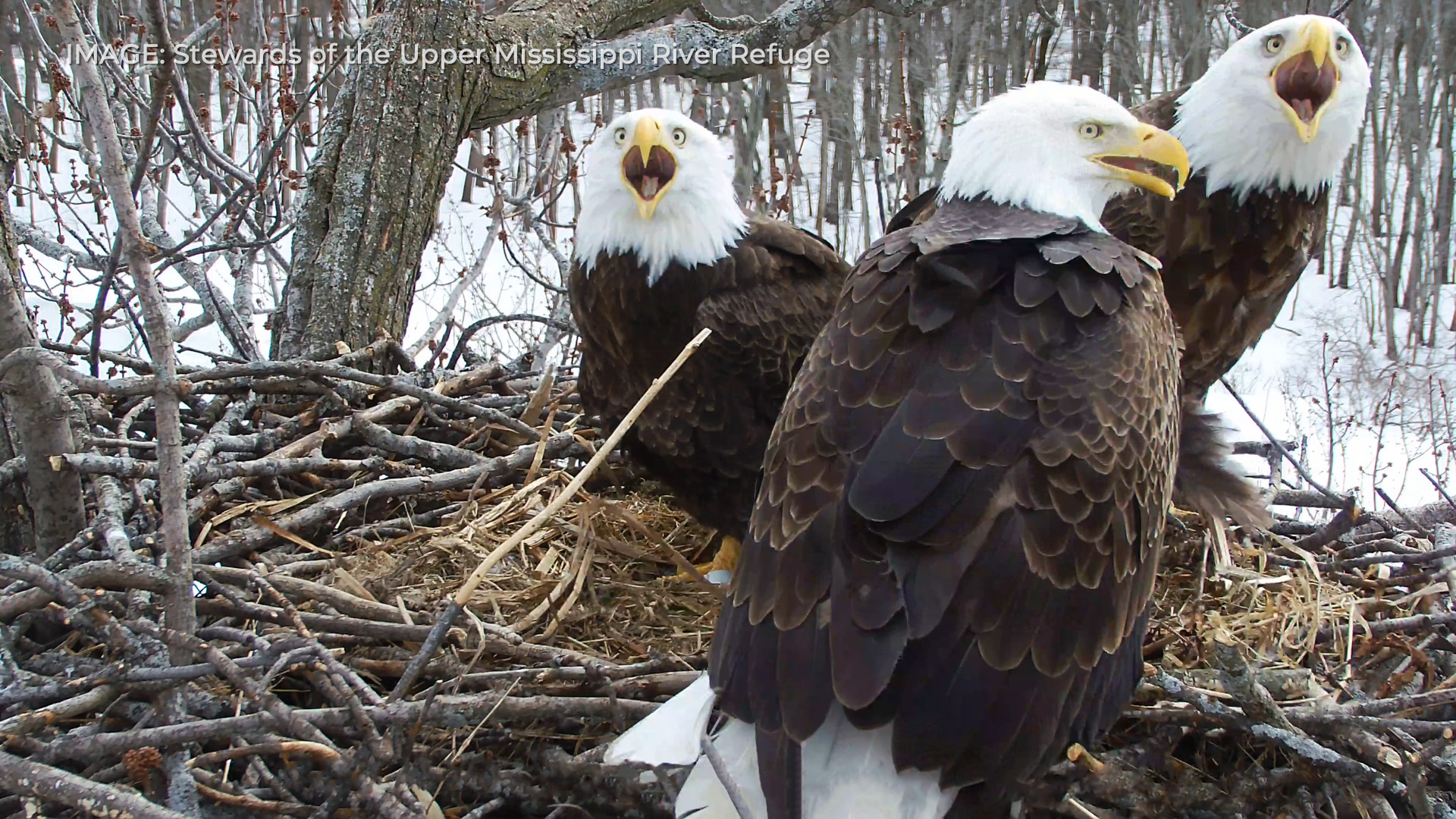
The most famous example unfolded along the Upper Mississippi River in Illinois. The adults became known as Valor I, Valor II, and Hope. By 2016, refuge observers could document all three maintaining the nest, incubating eggs, and caring for young.
The family’s most revealing season came in 2017. Hope disappeared after an attack near the nest while two chicks were still small. Instead of abandoning them, Valor I and Valor II defended the nest, brought food, and raised both eaglets until they fledged. Their response showed that the males were not merely tolerated neighbors. They were functioning parents.

A new female, Starr, later joined the two males. The trio kept sharing incubation and chick care, and three eaglets fledged in 2021. Their 2022 incubation attempt failed. The group is best understood as a historic example now: the Stewards’ nest history says Starr later paired with a new male and the Valors separated.
Cooperation does not automatically reveal paternity. Both Valors were seen mating with the female, but without DNA testing, observers could not know which male fathered which chick. Biology and behavior were two different questions. Whatever the genetic answer, both males did the daily work of parenting.
That distinction is useful at Big Bear. Shadow has already shown how intensely a bald eagle can invest in a nest. He and Jackie shared incubation and feeding through successful and difficult seasons, including the year two eaglets hatched after a long wait. Kaydee’s recent courtship and nest-building behavior suggests a developing bond with Shadow, but the new visitor has not yet shown anything like parental cooperation.
For that, observers would need a pattern: repeated peaceful visits, shared nest construction, coordinated defense, and eventually participation in incubation or chick care. One long visit can be intriguing without being predictive.
The deeper lesson from the documented trios is not that every tolerated third eagle is joining a family. It is that bald eagle social lives can be more flexible than the familiar picture of one pair and one nest. If Big Bear ever moves in that direction, the proof will arrive slowly, one repeated act of care at a time.
Featured image: Stewards of the Upper Mississippi River Refuge / U.S. Fish and Wildlife Service, licensed CC BY 4.0. Cropped to 16:9. Additional images are public domain from the U.S. Fish and Wildlife Service.
Leave a comment