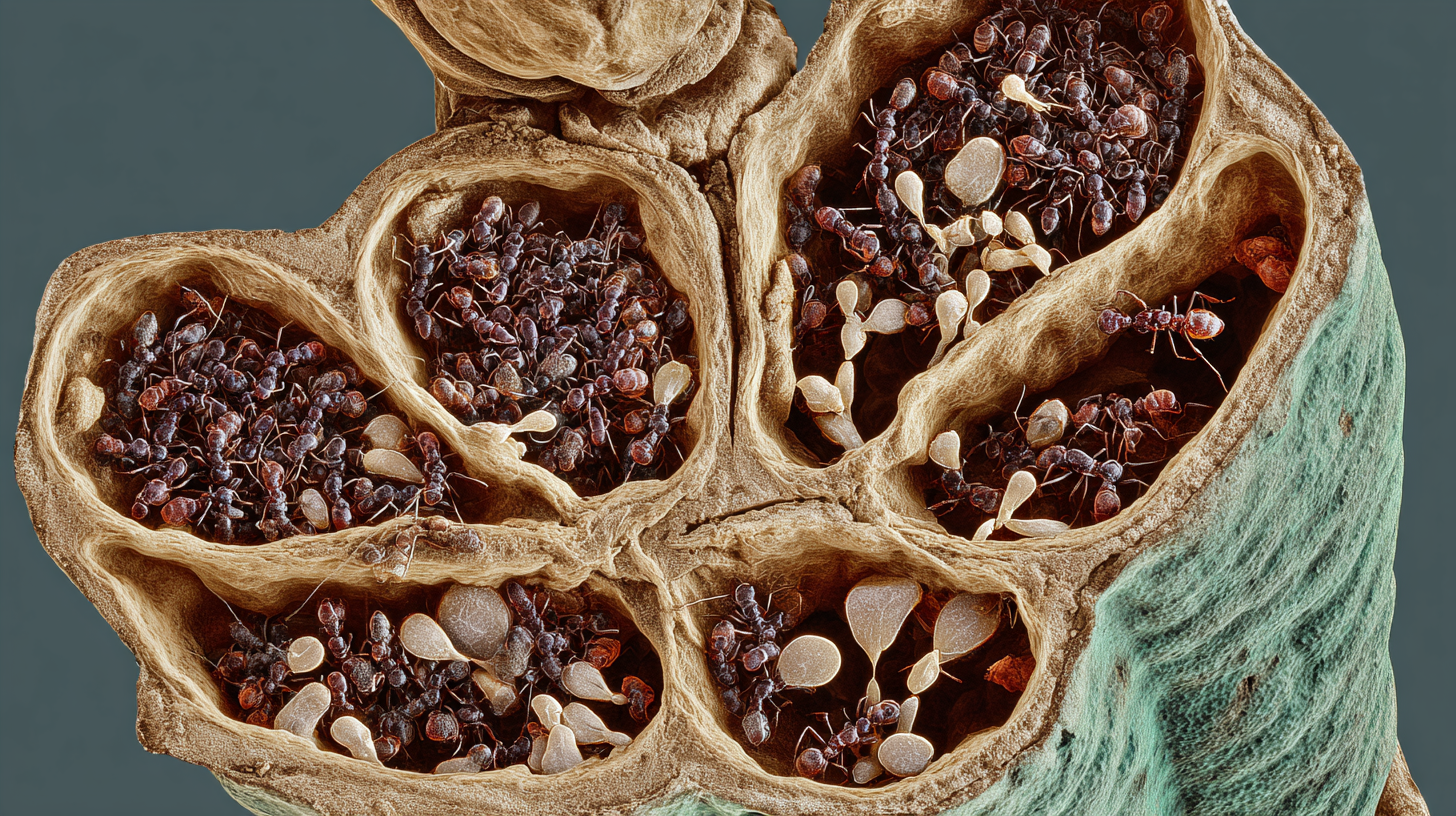
High in the rainforest canopy of Fiji, a peculiar plant has taken on the role of urban planner. Squamellaria, an epiphyte that clings to tree branches, has evolved a remarkable solution to an age-old ecological dilemma: how to house rival ant species without letting them tear each other apart.
The answer? Condos.
Not in the human sense, but in the form of swollen tubers that the plant grows as it matures. These hollow structures are compartmentalized into sealed chambers, each with its own tiny entryway. Inside, ant colonies nest in peace, fertilizing their leafy landlord with nitrogen-rich waste. And thanks to walls that keep them apart, they never meet their neighbors.
When researchers broke through the partitions to test what would happen, chaos erupted. Ants that had cohabited in apparent harmony turned violent within minutes. The result confirmed what the plant’s structure already hinted at: its design isn’t decorative, it’s diplomatic.

A blueprint millions of years in the making
Squamellaria belongs to a family of plants that includes coffee, but its evolutionary path is far stranger. DNA analysis suggests its relationship with ants began about 3 million years ago. Over time, the plant developed increasingly complex tubers. Some species evolved open interiors suited to loyal partner ants. Others, like Squamellaria tenuiflora, became landlords to many different ant tenantsand needed to keep them apart.
Using CT scans to map the tuber interiors, scientists discovered a labyrinth of isolated chambers. Each chamber has a single door to the outside but no passage to its neighbors. Just like apartments. This layout allows multiple ant species to live side by sideeven if they’d normally fight to the death.

Ants such as Camponotus polynesicus, Pheidole wilsonii, and even the invasive Tetramorium insolens have all been found inside a single plant. Up to five unrelated colonies can occupy different chambers in one tuber. As long as the walls hold, they remain peaceful.
The benefits go both ways. The ants gain shelter. The plant gains nutrients from their waste. The more chambers it builds, the more ants it can supportand the more nitrogen it absorbs. It’s an evolutionary trade-off sealed in cellulose.
Farming ants and cooperative design
But the relationship goes deeper than real estate. Some ants actively plant Squamellaria seeds into tree bark crevices. Others fertilize seedlings until they mature. One species, Philidris nagasau, farms at least six species of Squamellariamaking it the only known case of ants cultivating plants in the wild.
And the plant is designed for the partnership. Inside the tubers, smooth walls are kept clean for rearing brood, while warted surfaces serve as latrines. Specialized tissues absorb nutrients from the waste, converting it into growth.
This structure-based peacekeeping isn’t unique in nature. Legume plants compartmentalize root bacteria into nodules. Termites divide their guts into microbial zones. But Squamellaria may be the most visually striking examplea literal apartment complex in the treetops.
The lessons stretch beyond biology. By simply partitioning space, a plant has transformed rivalry into cooperation. It’s a case study in how architecture can shape behavior, reduce conflict, and support a diverse community.
Not bad for a tuber.

Leave a comment