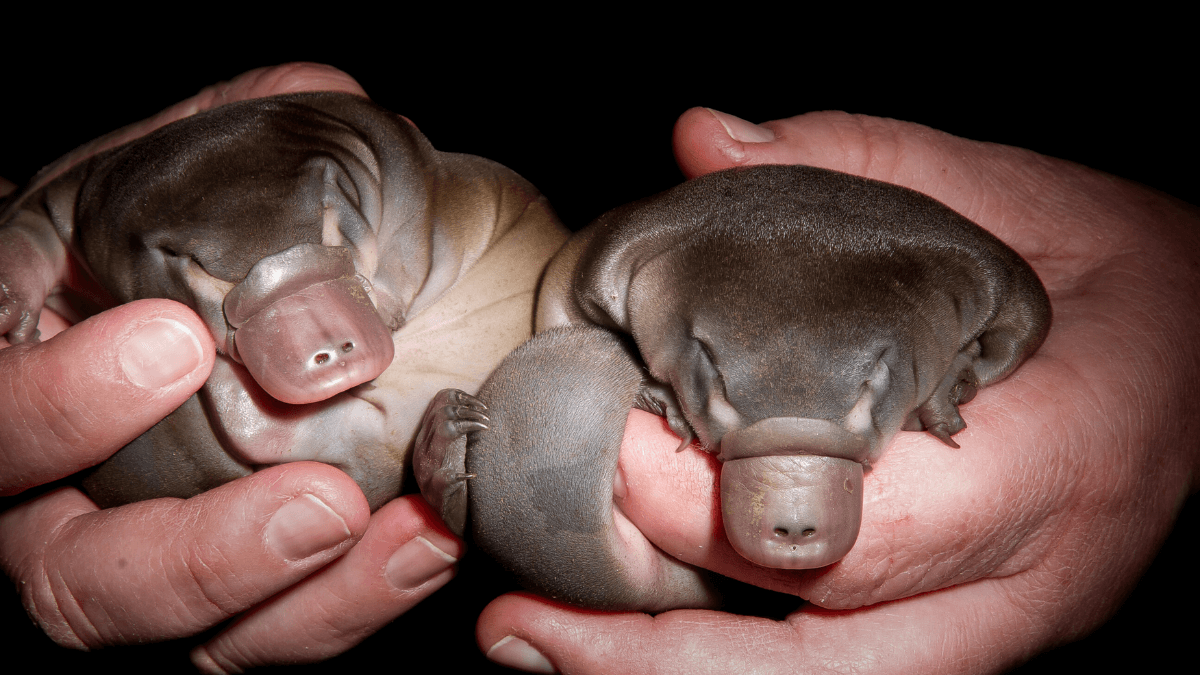
“Puggle” carries a whimsical charm, evoking a name plucked from a storybook.
Yet, this delightful term belongs not to fiction but to the real world—a nickname for baby platypuses, creatures so extraordinary they seem conjured by imagination.
A puggle enters a universe of contradictions. The platypus, its improbable parent, defies all categorization: a mammal that lays eggs yet nurses its young, a duckbilled, web-footed hunter with the electrifying skill of detecting prey underwater.
Evolution fused disparate traits into a singular animal cutie in one of its most eccentric moments.
And somehow, against all odds, the platypus exists, enigmatic and wondrous, defying nature’s conventions with quiet brilliance.
The Puggle: Nature’s Most Adorable Oddity

When European naturalists first encountered the platypus in 1799, they thought it was an elaborate hoax.
The idea that such a creature existed was absurd enough; the fact that it would go on to produce something as endearing as a puggle seemed downright preposterous.
Yet here we are, admiring puggles and their irresistibly cute moniker. The term is informal, not a product of Latin taxonomy but of human affection.
Some suggest it originated as a colloquialism among Australian researchers, charmed by the sight of these tiny, soft-skinned creatures that emerge from eggs no larger than marbles.
Others speculate that “puggle” simply caught on because it felt like the only name that could encapsulate such diminutive adorableness.
A Rare Glimpse into the Life of a Puggle
When first hatched, a puggle is nearly featureless—pink, blind, and helpless.
It relies entirely on its mother, nestled in the safety of her underground burrow. But even here, the platypus’s eccentricity persists.
Platypuses lack nipples; instead, they secrete milk through specialized patches of skin. The tiny and squirming puggle laps up this milk like a creature from another dimension.
Its early life is shrouded in mystery, mainly because platypuses are elusive. Few have ever witnessed a puggle outside of scientific studies or fleeting photographs.

Perhaps this scarcity enhances their charm. In an era where everything is documented, the puggle remains an enigma, known more by its name than by its face.
The word itself is part of its magic. It rolls off the tongue with a playful bounce, evoking images of innocence and mischief.

Unsurprisingly, the term “puggle” has taken on a cultural life of its own, even being co-opted to describe pug-beagle dog hybrids.
But in its truest form, the word belongs to the platypus—a singular creature that even its babies deserve a name as extraordinary as they are.
And what a fitting name it is. Puggle. Say it aloud, and you might feel a flicker of joy. It is a name that delights, a small linguistic reminder that nature, for all its strangeness, can also be profoundly playful.
Beneath the surface of rivers and burrows in Australia, a puggle grows, waiting to take place in the platypus’s weird and wonderful story.
If you find puggles as adorable as we do, this platypus plush brings a little piece of nature’s wonder into your home—soft, quirky, and irresistibly charming.
Leave a comment